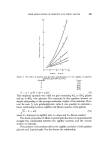
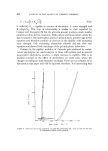
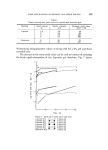
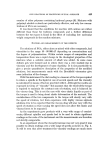
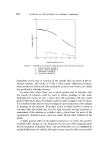
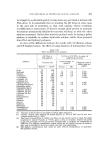
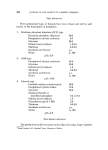
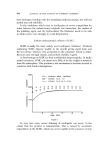
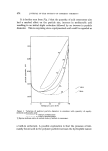
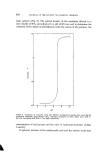
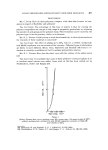
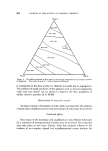
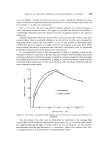
482 JOURNAL OF THE SOCIETY OF COSMETIC CHEMISTS DR. B. S. NEUMANN: You refer to viscosity of the system. Do we take it that these materials are Newtontan or do they have a yield value? I see that you use the Ferranti portable viscometer with which one can take readings at various rates of shear. Do you have any flow curves available? THE LECTURER: A Shirley-Ferranti curve is given in _Fig. 5. Shirley-Ferranti curves of Cycloryl NA thickened with an acrylic thickener were Newtontan. MR. C. PUGH: IS the process of thickening reversible or irreversible? How little can you get away with? THE LECTURER: According to the work of Muroi (20), thickening is only partly reversible rheologically in that you do not end up exactly with what you started with if you reverse the pH, but it will be something similar. The second question is difficult to answer in general terms, but the quantity required could be 0.2--2.0% of the total formulation. The thickening will depend also on the size of the cation (21). DR. J. W. B. SAaUEL: Can you tell me if by using a hydrophilic and a hydro- phobic monomer you can balance them so that you end up with a gel which is inter- mediate, presumably, between a water-soluble and a water-insoluble polymer? T•E LECTURER: Gels from methyl methacrylate-methacrylic acid copolymers have been studied (19). MR. R. S. McKEE: You suggest that in using these polymers for hair sprays you might be able to polymerise in a solvent other than water. Have you actually done this in, say, some of the alcohols? T•E LECTURER: It is possible to polymerise in ethyl or isopropyl alcohol, although solubility difficulties may arise with the lower levels of methacrylic acid. MR. J. B. W•LI•so•: You refer to the use of these materials as thickeners in typical shampoo type systems, and this type of material (not your own I think) has been in use in this field for many years, particularly on the Continent. I wonder if you could give me your own view on the particular advantage of using this type of thickener in the typically thickened shampoo system over some of the other equally well known ones some of them perhaps a little less expensive. THE LECTURER: It would be rash of me to make recommendations in a field which is not my own, but there is one point I can make. In principle, these are very versatile systems and it is therefore possible to build in almost any desired group of properties. (20) Muroi, S. J. Appl. Polymer Sci., 10 713 (1966). (21) Gregor, H. P., Gold, D. H. and Frederick M. J. Polymer Sci., 9,8 467 (1957).

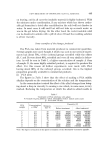
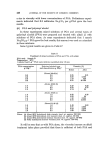
J. Soc. Cosmet. Chem. 21 483-500 (1970) ¸ t970 Society of Cosmetic Chemists of Great Britain The effect of glidant addition on the flowability of bulk particulate solids T. M. JONES* Presented at the symposium on "Powders", organised by the Pharmaceutical Society of Ireland and the Society of Cosmetic Chemists of Great Britain, at Dublin, on 17th April 1969. Synopsis•Systems where the GLIDANT is chemically similar or dissimilar to the bulk SOLID are discussed, and it is shown that glidant efficiency is dependent upon the PARTICLE SIZE of both coarse and fine component and the diameter of the ORIFICE through which material is discharged. The improvement in FLOWABILITY of fine POWDERS on admixture with coarse material is also outlined. It is suggested that glidants may act by one or more of the following mechanisms reduc- tion of interparticulate friction, change in surface rugosity, separation of coarse particles, reduction of liquid or solid bridging, and minimising static charge. INTRODUCTION In compressing coarse granular solids, lubricants are added to reduce friction between the punches and dies. In addition, some lubricants prevent the adhesion of powder particles to the punch faces and these have been termed anti-adherents. The term glidant was first introduced by Munzel (1) to describe those agents which added in small amounts improve the flow characteristics of granulations. Now many handling processes are concerned with the discharge of material from hoppers. In the compression of granules, however, the flow of bulk solids is further controlled by feed frames and hopper shoes so that flow into the die cavity is uniformly maintained. It *Department of Pharmacy, University of Nottingham, Nottingham. 483
Purchased for the exclusive use of nofirst nolast (unknown)
From: SCC Media Library & Resource Center (library.scconline.org)