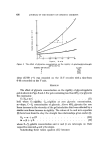
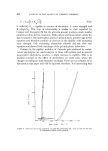
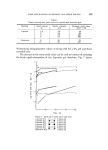
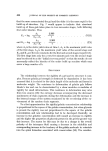
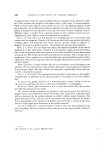
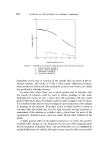
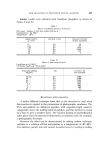
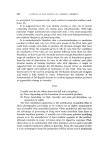
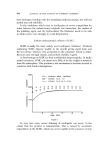
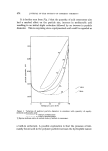
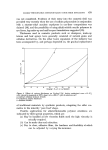
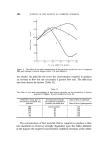
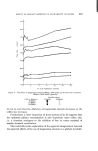
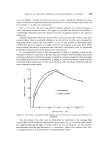
NEW REACTIONS OF PROPYLENE GLYCOL ALGINATE 443 number of other polymers containing hydroxyl groups (6). Mixtures with polyvinyl alcohol or starch are particularly effective, and only low concen- trations of PGA are necessary. It was found that the conditions for reaction with amines are rather different than those for hydroxy compounds and a further difference between the two types is found in the effect of including low molecular weight compounds in the reaction mixtures. NATURE AND MEASUREMENT OF THE EFFECTS The solutions of PGA, either alone or mixed with other compounds, had viscosities in the range 10--50 000 cP depending on concentrations and the degree of polymerization. Within certain ranges of composition and temperature there was a rapid change in the rheological properties of the mixtures when a suitable amount of alkali was added. In some cases definite gels were formed and in others there was a very marked rise in viscosity and the development of some elasticity. It is not practicable to give a precise quantitative description of the properties of the modified solutions, but measurements made with the Brook field viscometer give some indication of the changes. With this instrument the dial reading is a measure of the torque required to rotate a spindle in the liquid at one of several speeds and the viscosity is calculated by means of factors provided with it. Although the results are expressed in terms of "viscosity" this assumes that the whole of the torque is required to maintain the constant rate of rotation, and is balanced by the viscous drag. This is not the case with visco elastic liquids as part of the torque is used to bring about elastic deformation of the matehal. The contributions of the two components to the torque will clearly vary with the speed of rotation, but from experience with highly viscous alginate solutions it is to be expected that the viscous drag will also vary with the speed of rotation so that varying the speed does not allow the elastic and viscous forces to be separated. As the experiments gave products with a very wide range of consist- encies, different spindles and speeds had to be used to obtain significant readings on the scale of the instrument and the measurements are therefore not strictly comparable. In an experiment where the viscosity increase was not very great it was possible to obtain readings over a wide range of speeds as shown in Fig. I. It will be seen that after treatment the viscosity readings are much more

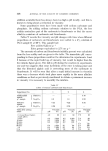
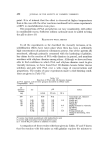
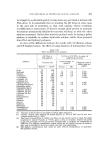
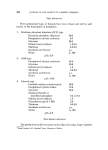
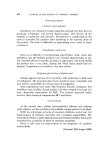
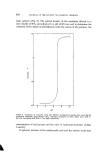
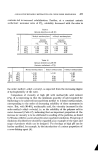
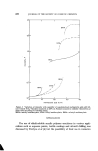
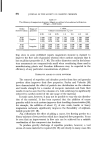
444 JOURNAL OF THE SOCIETY OF COSMETIC CHEMISTS IOOO Figure 1 Io 06 I I I 15 3.'5 6 -.. d 12 30 60 Speed of rotation, rev min-1 Brookfield viscometer measurements on 3.5 • PGA solution a Alkali treated, spindle 3 b Alkali treated, spindle 4 c Untreated, spindle 2 d Untreated, spindle 3 dependent on the rate of rotation of the spindle than are those of the un- treated solution. The results in Table I show similar differences between shear sensitivity before and after treatment in those cases where the alkali has produced a viscosity increase. In some cases where there was a much greater rise in viscosity only low speeds of rotation could be used to obtain readings on the scale. Although the curves in Fig. 1 show that this procedure will give much greater differences than if readings could be made at higher rates of shear, it is considered that the low shear readings are good indication of the change in rheology of the mixture. Prolonged action of alkali leads to a drop in viscosity after the initial rise, but the high viscosity and gel structure is maintained if the mixture is acidified after a short time. In most of the experiments described acetic acid was added 15 min after addition of the alkali. A fairly general effect of the alkali treatment is to render the product insoluble after drying, as was mentioned in the case of the original patent for the treatment of gelatine films. Any gel formation can be considered as an insolubilization of a colloid, although in some cases the effect is reversible
Purchased for the exclusive use of nofirst nolast (unknown)
From: SCC Media Library & Resource Center (library.scconline.org)