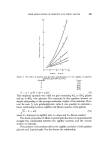
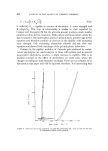
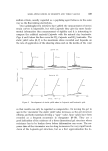
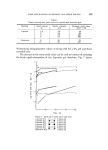
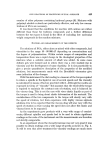
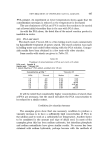
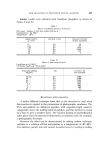
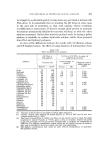
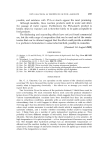
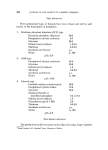
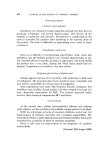
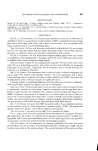
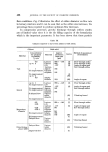
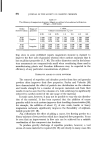
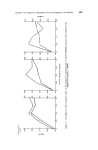
NEW REACTIONS OF PROPYLENE GLYCOL ALGINATE 449 Similar results were obtained with trisodium phosphate as shown in Tables V and VI. PGA used: Concentration: 4g 100g -• Temperature: 20øC Table V Effects of different amounts of Na3PO4 Sample D with free acidity 0.22 me g-1 mmole Na•PO4 g- 1 PGA o o.31 0.75 1.o 1.5 2.0 pH after 1 min 4.0 8.6 8.7 8.8 9.8 10.4 Viscosity (P) after 15 min (acidified) 32 127 3 700 3 500 112 9 Table VI Effect of time using Na3PO4 Conditions as in Table V 1.0 mmole NasPO4 g-' PGA added Time after adding Na sPO 4 10 min 15 ,, 30 ,, 2 h 4 ,, 6 ,, 21 ,, pH 8.3 8.0 7.9 7.6 7.5 7.3 7.0 7.0 Viscosity (P) (not acidified) 3 680 2 480 2 000 2 000 1 920 1 280 680 44 REACTIONS WITH GELATINE A rather different technique from that so far described is used when this reaction is applied to the preparation of photographic emulsions. The PGA and gelatine are dissolved together, with suspended light sensitive compounds, above the melting point of gelatine, and this mixture is coated on a base to give a sensitive layer. The reaction leading to insolubilization takes place when the material is immersed in an alkaline bath, for example, a photographic developer. However the effect can be demonstrated by adding sodium carbonate solution to a solution of PGA and gelatine at a temperature of 40ø-50øC. The mixture quickly sets and cannot be melted even by heating to boiling

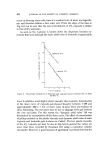
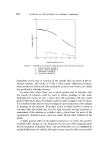
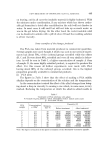
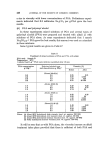
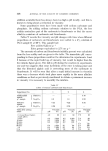
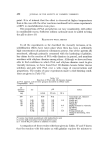
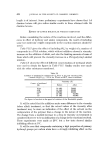
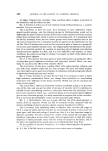
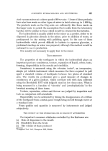
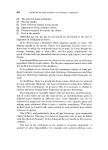
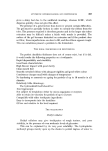
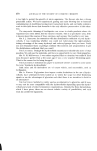
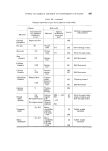
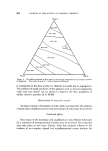
450 JOURNAL OF THE SOCIETY OF COSMETIC CHEMISTS point. It is of interest that the effect is observed at higher temperatures than is the case with the other reactions mentioned but in some experiments at 60øC no insolubilization took place. The proportions of PGA and gelatine can vary considerably, with either in considerable excess. Sufficient sodium carbonate must be added to bring the pH to above 10. REACTIONS WITH AMINES In all the experiments so far described the viscosity increases, or in- solubilization effects have taken place when there has been a sufficiently high concentration of polymeric substances present. One of the patents (4) mentioned, although primarily concerned with the hardening of gelatine, has claims for the reaction of PGA with diamines in general, and mentions reactions with ethylene diamine among others. Although we have not been able to find conditions in which PGA and ethylene diamine react to give viscosity increases, we have found that 1:6 diamino hexane forms viscous solutions and gels with PGA over a w/de range of concentrations and proportions. The results of some experiments made to find limiting condi- tions are given in Table VII. Table Vii Reaction of PGA with 1:6 diamino hexane lg PGA (approx. 2.6 me ester groups) dissolved in 100ml water. Temperature: 20øC 1:6 diamino hexane mg 150 107 86 54 43 me 2.6 1.85 1.49 0.93 0.74 2.6* 2.6i 0.74:[: initial 10.8 10.5 10.2 9.9 9.7 9.8 10.0 10.3 pH 15 min 10.2 8.8 8.5 7.3 7.0 7.0 8.2 9.4 18 h 6.4 4.9 Effect Immediate gel, thinned within 15 min Stable gel Stable gel Weak gel Slight increase in viscosity No effect Weak gel Strong initial gel, strength decreasing, then stable. (*) amine two thirds neutralized with hydrochloric acid (t) amine half neutralized with hydrochloric acid (•t) 1 mmole Na2CO3 added in addition to amine. A comparison of these results with those given in Tables I V and V shows that the reaction with this amine as with gelatine requires the mixture to
Purchased for the exclusive use of nofirst nolast (unknown)
From: SCC Media Library & Resource Center (library.scconline.org)