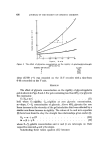
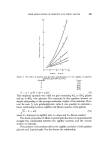
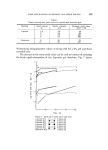
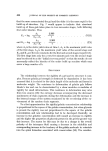
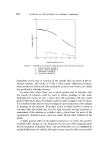
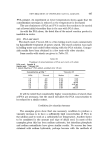
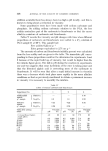
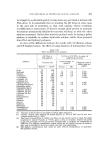
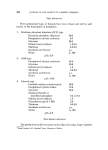
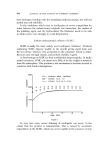
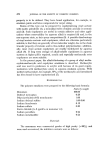
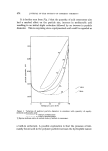
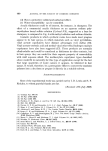
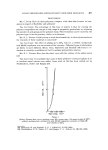
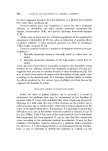
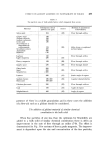
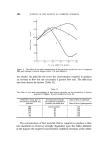
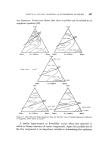
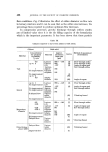
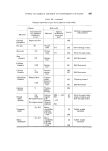
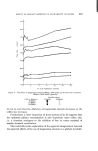
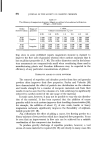
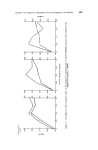
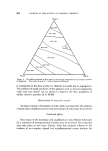
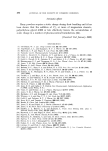
494 JOURNAL OF THE SOCIETY OF COSMETIC CHEMISTS 561/zm 600-650 650-700 600-650 500-600 400- 500 300-400 200- 300 48/.t.m 90/.t.m trigure &. The effect produced on flow rate by varying the composition of a ternary mixture of magnesia. Flow rates in g rain-1. Orifice diameter 8.98 mm is undesirable in the final product or difficult to handle due to segregation. The addition of small quantities of fine glidants such as A erosil, magnesium oxide and corn starch can be shown to improve the flow properties of mildly cohesive powders (4, 6, 36-38). MECHANISM OF GLIDANT ACTION An improvement in flowability of bulk solids is produced by the addition of many types of glidants and several mechanisms of action may be involved. Frictional effects Since many of the materials used as glidants are also efficient lubricants (1) a reduction of interparticulate friction may be involved. The reduction may take place in two ways. Firsfly, when fine material adheres to the surfaces of an irregular shaped but equidimensional coarse fraction the

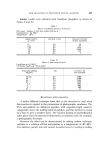
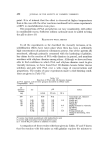
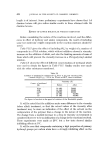
EFFECT OF GLIDANT ADDITION ON FLOWABILITY OF SOLIDS 495 reduction in surface rugosity will minimise the mechanical interlocking of the particle and thereby reduce the rolling friction. This would be parti- cularly relevant when flow improvement is caused by the addition of material of similar chemical constitution to the original granulation. Secondly, the added material may possess a coefficient of friction which is lower than that of the bulk solid to which it is added and therefore decrease interparticle friction. It has been suggested that the glidants which possess laminar crystalline forms, e.g. talc, graphite, roll up under low shear stresses to produce a 'ball bearing type' action (20). In addition, it may be that some substances are acting as boundary lubricants between the particles but it is considered that the low shear stresses involved in most handling processes do not seem great enough to place too much emphasis on this mechanism. Separation effects Although glidants may possess a minute crystallite size (of the order of several nm) on addition to bulk which the individual particles may become aggregated (sizes up to several [tm) (2). The aggregates increase the interparticulate distances of the coarse material and may reduce the forces of attraction between the surface asperities. This is also the case for fine material added to coarse material of similar chemical constitution but under these conditions the separation is much greater. Thus, during the gravity discharge of a bulk solid from a hopper, the points of slippage in a free fall arch over the orifice are increased by the interposition of the fine particles and flow may be increased (21). Many of the glidants used are also flow conditioning or anticaking agents, e.g. calcium phosphate, silico aluminates. The physical separation of the coarse particles which is produced when these materials adhere to their surfaces is thought to reduce the action of capillary adhesion forces and also prevent the formation of solid bridges between particles (22, 23). This is of importance where bin residence time is prolonged or the formulation subjected to a variable environment. The particle size of the added material is important since it is the ability of the additive to coat the surface of the coarse material that determines its efficiency (2, 19). The combination of both frictional and separation effects should therefore produce a useful improvement in flowability and this can be demonstrated by the improvement in flow produced on the addition of fines and talc to a tablet granulation {8).
Purchased for the exclusive use of nofirst nolast (unknown)
From: SCC Media Library & Resource Center (library.scconline.org)