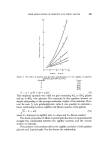
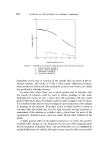
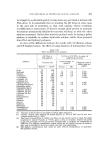
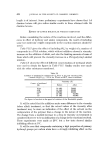
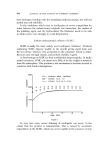
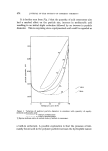
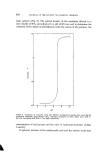
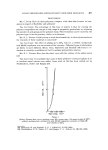
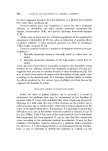
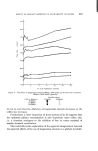
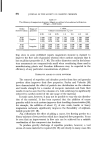
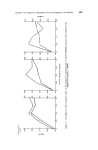
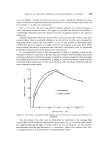
474 JOURNAL OF THE SOCIETY OF COSMETIC CHEMISTS It is further seen from Fig. 1 that the quantity of acid comonomer also had a marked effect on the particle size, increase in methacrylic acid resulting in an initial slight reduction followed by an increase in particle diameter. This is surprising since copolymerized acid could be regarded as o.•o ß • o,o6 E .u_ 0.0,' i I ! ! / /' I I I 0 10 20 3o 4o methacrylic acid (%wt) MMA "BMA Figure I Variation of polymer particle diameter in emulsion with quantity of copoly- merized methacrylic acid. methyl methacrylate -- n-butyl methacrylate. % figures indicate ratio of sodium dodecyl sulfate to monomer. a built-in surfactant. A possible explanation is that the presence of inti- mately bound acid in the polymer particle increases the hydrophilic nature

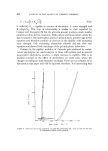
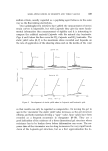
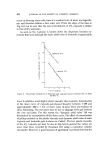
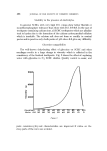
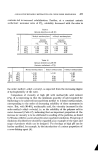
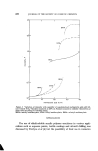
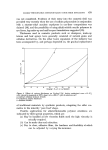
ALKALI-THICKENABLE METHACRYLATE COPOLYMER EMULSIONS 475 of the latter and that the large particle size is caused by swelling of the particle with absorbed water. On raising the pH of an alkali-thickenable emulsion, the viscosity could increase by any one of three different mechanisms.: (a) Solubilization of the polymer by forming its salt. (b) Swelling of the particle with absorbed water. (c) The electroviscous effect. The solubility of a polymer depends on the concentration of carboxyl groups in relation to the hydrophobicity of the polymer attached sur- factants can have a similar effect (9, 10) to copolymerized acid. For a given concentration of polymer, a smaller particle size will mean that the area of the discrete phase in contact with the continuous phase will be greater than for a larger particle size. This results in a higher emulsion viscosity. At the limit, when the particle is identical with the polymer molecule, maximum solubility in relation to the solvent will have been achieved. A polymer will be water-soluble in its salt form when it contains a sufficient number of acid groups. A comparatively hydrophobic material such as polymethyl methacrylate will require a much higher proportion of carboxyl groups to achieve solubility in aqueous alkali than a more hydro- philic one such as polyethyl acrylate (11). Swelling of the polymer particle is similarly dependent. Thus (12) a copolymer emulsion of styrene with 25% acrylic acid did not thicken at all with alkali, whereas ethyl acrylate copolymerized with only 10% acrylic acid increased in viscosity by a factor of ten. Whether, or in what ratio, solubilization and swelling occur will depend on the concentration of carboxyl groups and surfactant, and the compatibility of the surfactant with the polymer in the given system (10). The electroviscous effect (13) depends on the degree of ionization and the electric charge surrounding the particle. Another factor known to govern the viscosity achieved in aqueous alkali is the molecular weight of the polymer. This effect is complex, since for a given copolymer viscosity will increase with molecular weight. On the other hand, solubility could decrease with increase of molecular weight (11) giving the opposite effect. In the present series of methacrylate ester copolymers, dodecyl mercaptan was included in the formula in order to maintain the molecular weight as constant as possible. Thickening with pH was followed in the case of a methyl methacrylate: methacrylic acid (60:40 by weight) copolymer emulsion to establish the
Purchased for the exclusive use of nofirst nolast (unknown)
From: SCC Media Library & Resource Center (library.scconline.org)