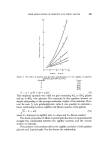
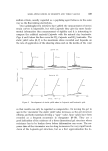
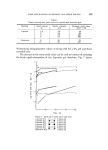
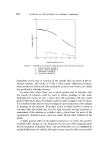
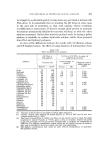
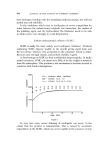
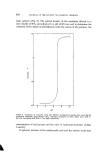
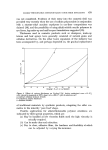
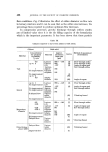
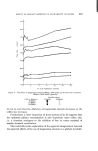
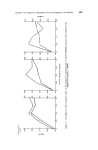
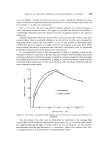
SOME APPLICATIONS OF RIGIDITY AND YIELD VALUES 433 sodium citrate, usually regarded as a peprising agent behaves in the same way as the flocculating electrolytes. Once gelatin/glycerin mixtures have gelled the measurement of stress/ strain curves is impossible, but with Laponite they give far more funda- mental information than measurement of rigidity and it is interesting to compare the artificial material Laponite with the natural clay bentonite. Figs. 4 and $ show the flow curve for 3% Laponite and 8% bentonire. The static yield value (6, 7) is the maximum stress recorded and depends on the rate of application of the shearing stress and on the inertia of the cone 500 50C Laporate 3 % 0-5 m•n mln Bentorate 8% rain 300 300 600 600 600 Stress, Nm -2 xlO in 300 Figure 5 Development of static yield value in Laponite and bentonitc gels. so that results can only be regarded as comparative. On leaving the gel to age in the viscometer the static yield value increases as the gel structure reforms and both materials develop a "spur" value. Spur values have been recorded as a frequent occurrence in rheograms (8-10). They are a good indication of the existence of a three dimensional gel structure whose resistance has to be broken down before deformation can occur. The res- ponse time of the viscometer was too long to measure the very rapid break- down of the Laponite gel structure, but as a first approximation the de-

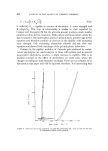
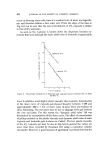
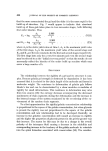
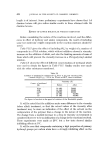
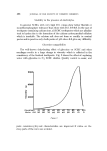
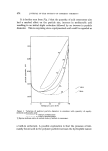
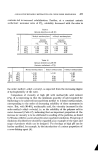
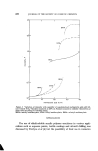
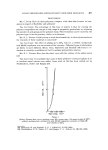
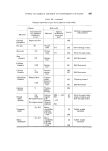
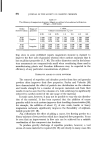
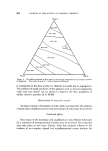
434 JOURNAL OF THE SOCIETY OF COSMETIC CHEMISTS crease in shearing stress with time at a constant rate of shear was logarith- mic and therefore follows a first order rate. From the slope of the lines in Fig. 6 it can be seen that the rate of breakdown of 2% Laponite is similar to that of 8ø//0 bentonite. As soon as the Laponite is broken down the dispersion becomes ex- tremely fluid and although the static yield value of bentonite is appreciably 1.8 1.4 I-0 0.6 x -- x• Bentonire 8% xN x x __ •nife 2 % \ 2 4 6 8 I0 Time of sheo½ing, s Figure 6 Thixotropic breakdown of bentonire and Laponite gels at constant rate of shear (17.59 lower it exhibits a much higher plastic viscosity than Laponite. Examination of the down curve of Laponite gels showed linearity between 1 759 and approximately 500 s-• but at lower rates of shear there was evidence of shear thickening. The curvature may be due to slippage of the gel between the cone and plate. For this reason the "dynamic yield value" (6) was determined by extrapolation of the down curve. The effect of concentration of gelling material on the plastic viscosity and dynamic yield value of some Laponite and bentonire gels is shown in Tabl• I. The low plastic viscosity of the 4% Laponit• gel may be due to slip but in general the values are lower than those recorded by Neumann (11) using a concentric cylinder viscometer. However, a good measure of agreement was found between the
Purchased for the exclusive use of nofirst nolast (unknown)
From: SCC Media Library & Resource Center (library.scconline.org)