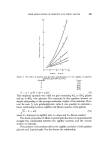
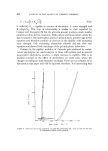
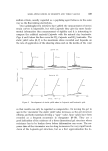
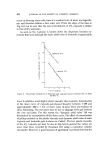
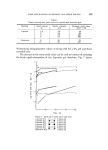
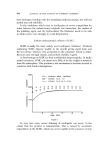
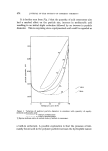
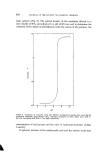
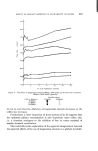
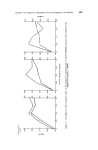
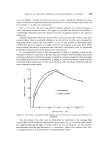
SOME APPLICATIONS OF RIGIDITY AND YIELD VALUES 439 is possible through the experimental data, as indicated in Fig. 6. It must also be remembered that the Ferranti-Shirley viscometer has a slow response and is being pushed to its limit by using a 10 s time axis. Bentonire gave a greater indication of being a double reaction than did Laponite B. MR. J. B. WILK•NSON: Have you made any studies of the effect on the theology of these gels caused by altering the water structure? There is always some question with protein gels whether the protein structure controls the water or vice versa. You will know that this is a matter of considerable interest in many circles. DR. NixoN: The structure of water has been investigated recently with regard to its association with bentonire gels and no correlation between water structure and these gels was found (15). As the yield value increased the nmr picture remained the same. Although it could be an important point we have not at the moment investi- gated this. DR. S. D. G•RSHON: The movement that takes place in the gel rigidometer can be either due to disruption of adhesive forces between the gel and the glass, or cohesive forces within the gel. If the cohesive forces are strong within the gel, it is conceivable that you would just simply be moving the whole gel along the surface. DR. NIXON: This is a standard method of measuring gel rigidity and with the small pressures used, slip of the whole gel along the surface of the glass is very unlikely. In any case we have measured the height of the meniscus at the side, both at rest and under applied pressure, and there has been no detectable movement, whereas the centre of the gel meniscus can be seen to move and return to its original position when the force is removed. DR. J. J. MAUSN•R: You have described the various factors which influence rigidity. Does pH play any role in these measurements and how critical is the control of pH? DR. NixoN: pH played a more important part in controlling the rigidity of gelatin gels. For this reason all the gelatin gels were adjusted to a definite pH. MR. D. F. ANST•AD: You mentioned that bentonire contained impurities which rendered its use not quite as acceptable as that of Laponite B. You used the pharma- ceutical grade of bentonire. Would I be correct in assuming that your impurities are not chemical? DR. NixoN: The bentonire used throughout this work has been one batch of B.P. grade and the characteristics of this material can vary considerably from batch to batch. The B.P. monograph gives limits for the alkalinity and arsenic content as well as for the amount of "gritty particles" present, but does not say whether these are silicacious. You would be correct in saying that our main bentonire impurity is not chemical. MR. D. F. ANST•D: It is possible to obtain completely grit-free bentonire to comply with pharmaceutical specifications. PROF. C•R•.ESS: The B.P. specification does not control the impurity limits or gel strength as closely as people would like. It tends to be rather a loose description. The calculation of yield values which we have used for Laponite B is rather a crude method utilising the determination of static yield values. Other people have attempted (15) J. Pharm. Sci. 511 714 (1969)

JOURNAL OF THE SOCIETY OF COSMETIC CHEMISTS to measure these values by means of spheres that are retained by the structure of the gel. They correlate the weight of the sphere with a yield value. A second method, which we have tried without much success so far, is to use different spheres of the same diameter, but of different densities to again find to what level the density of the sphere is balanced by the structure of the gel. Obviously all these methods will give different values. I wonder from a practical point of view whether anyone has any experience of yield value by rates of sedimentation of spheres. DR. G. W. SCOTT-BLAre: I feel that the use of failing spheres to determine yield values could be dangerous. Mardies (1t3) has shown that with some greases and paints a falhng sphere will gradually slow down because "greater energy is required to displace the system at greater depths". Presumably the material shear-thickens. MRs. J. V. BoYD: You say that your static yield stresses depended on the rate of application of this yield stress. Would it not be possible, using a much lower shear rate, to get an absolute value that depends only on the material? In your shear stress you go up to 1 500 reciprocal seconds and back in two minutes. This is a high rate of application. I have applied a low constant shear rate and watched the point at which a gel forms. This does not depend on the rate of application but seems to be a constant for the material. PROF. CARLESS: I would consider this to be an arbitrary way of looking at the problem. We have not tried low rates of shear, but these would in general be expected to give larger values. The rate of shear we chose gave reproducible values and was used for comparative purposes. DR. G. J. •)• LEEuw: The explanation for the effect of glycerine on the rigidity of gelatin-gels, as presented in the discussion part of your paper, is not very satisfac- tory. As long as the gelatin dissolves in a water/glycerine mixture, which is true for all your test conditions, the term "a decrease in solubility" is meaningless. As far as I know, spiral formation is not so much associated with coacervation, but with the gelation process itself. DR. lXT•xo•: As the proportion of glycerin in the gel increases the amount of gelatin which can be dissolved will fall. We believe that under these conditions there will be a tendency for the gelatin molecule to exhibit a tighter spiral formation. This spiral formation of the molecule can be associated with coacervation as we believe that a prerequisite of the separation of gelatin coacervate from a system is the adop- tion of a fairly tight spiral formation of the gelatin molecule. DR. B. S. lXTEU•A•: I would just like to refer to the very first question on the rate of swelling. The use of nearly boiling water does in fact speed up the swelliLig of Laponite. (16) Mardles, E. W. J. Nature 158 199 (194(i)
Purchased for the exclusive use of nofirst nolast (unknown)
From: SCC Media Library & Resource Center (library.scconline.org)