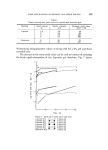
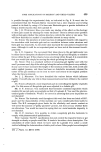
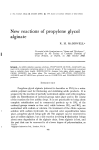
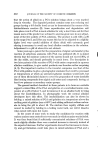
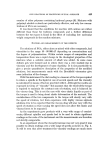
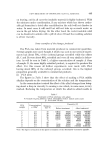
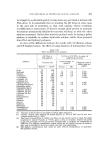
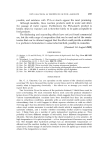
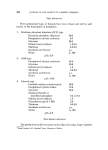
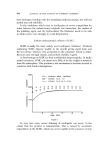
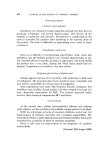
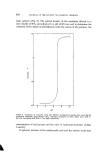
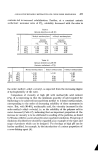
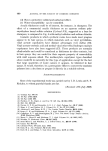
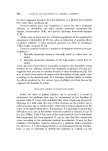
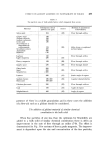
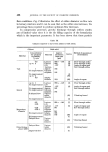
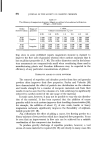
NEW REACTIONS OF PROPYLENE GLYCOL ALGINATE 445 on heating, and in all cases the insoluble material is highly hydrated. With the mixtures under consideration, if any mixture which has shown notice- able gel formation is dried after reacidification the solid will not dissolve in water. In most cases it will swell but will not take up as much water as •vas in the gel before drying. On the other hand the water insoluble solid can be dissolved in alkalis with a pH of above 10 and the resulting solution is of low viscosity. Some examples of the changes produced The PGA was taken from material produced in commercial quantities. Several samples were used. Sample A which was used in one series of experi- ments had about 70ø//0 of the carboxyl groups esterified while the others (B, C and D) were about 80% esterified and were all very similar in behav- iour. As will be seen in Table I, a higher concentration of sample A than of sample D, the more highly esterified product, is required to produce the effect. For this reason all further experiments were made with PGA having about 80% of the carboxyl groups esterified: this is the highest proportion generally available in commercial products. (i) PGA alone The figures in Table I show that the effect of making a PGA mildly alkaline depends on the concentration of the solution and the temperature. As the concentration is raised the effect of the alkali changes from bring- ing about a drop in viscosity to causing a rise which, in some cases, is very marked. Reducing the temperature at which the alkali is added results in Table I Treatment of PGA solutions with alkali 0.5 mmole Na•CO• added g-' PGA. Reacidified with 1 mmole acetic acid g-' PGA after 15 min. PGA sample Concentration g 100g -• 4.5 4.5 5.5 5.5 5.5 2.5 2.5 3.5 4.0 Tempera- Viscosity (P) ture øC After treatment Before treatment 10 135(2) 78(20) 20 75(2) 49(20) 10 490(2) 235(20) 20 186(2) 103(20) 40 140(2) 69(20) 3 -- 7(60) 20 -- 2(60) 20 16(6) 13(60) 20 48(6) 30(60) 2 100(2) 460(20) 65(2) 47(20) 11 000(2) 3 600(10) 3•300(2) 800(20) 28(2) 10(20) 352(3) 55(60) -- 0.85(60) 150(6) 35(60) 3 600(6) 3 250(12) Note: The figure in brackets is the speed of rotation of the Brookfield viscometer spindle.

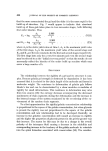
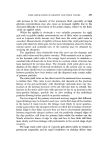
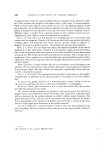
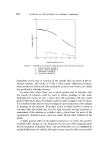
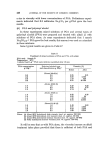
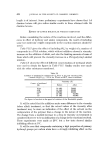
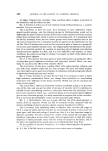
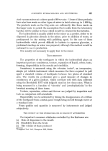
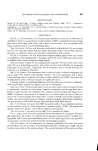
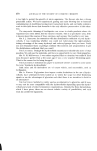
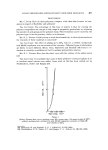
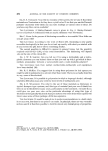
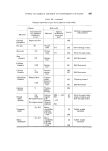
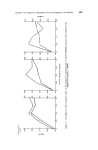
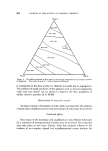
446 JOURNAL OF THE SOCIETY OF COSMETIC CHEMISTS a rise in viscosity with lower concentrations of PGA. Preliminary experi- ments indicated that 0.5 millimoles Na2C03 per g. PGA gave the best results. (ii) PGA and polyvinyl alcohol In these experiments mixed solutions of PGA and several types of polyvinyl alcohol {PVA) were prepared and treated with alkali as with solutions of PGA alone. As some experiments indicated that 1 mmole Na2C 03 g-1 PGA gave the best results, this amount was used as a standard in these mixtures. Some typical results are given in Table I! Table II Treatment of mixed solutions of PGA and PVA with alkali PGA used: Sample B Temperature: 20øC 1 mmole Na,CO• g-• PGA used, mixture reacidified after 15 rain PGA concentration g 100g -• 0.5 0.8 0.5 0.8 1.0 1.0 1.0 1.0 1.0 1.0 1.0 1.0 1.0 0.8 1.0 Polyvinyl alcohol type and concentration g 100g -• Elvanol 50-42 (a) 2.0 2.0 4.0 4.0 Viscosity (P) Before 0.25 0.60 1.10 3.00 After 0.21 2 000 425 20 000 Alcotex 88-05 (b) 1.5 3.0 5.0 Alcotex 88-20 (c) 1.0 1.5 3.0 6.0 Elvano171-30 (d) 1.0 2.0 3.0 3.0 0.37 0.52 0.74 0.50 0.60 1.20 5.00 0.45 0.91 0.63 1.68 0.20 0.75 32 0.35 60 3 000 12 000 0.60 2 600 2 200 8 340 Notes: (a) About 88 % hydrolyzed, high viscosity (mol. wt. approx. 200 000} {b) About 88 % hydrolyzed, low viscosity (mol. wt. approx. 25 000) {c) About 88 % hydrolyzed medium viscosity {mol. wt. approx. 80 000} {d) Fully hydrolyzed medium viscosity {mol. wt. approx. 130 000) It will be seen that as with PGA alone, the viscosity increase on alkali treatment takes place provided that there is sufficient of both PGA and
Purchased for the exclusive use of nofirst nolast (unknown)
From: SCC Media Library & Resource Center (library.scconline.org)