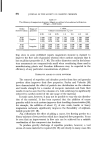
498 JOURNAL OF THE SOCIETY OF COSMETIC CHEMISTS TI•E LECTURER: This paper does not attempt to consider the overall picture of flowability of bulk particulate solids but is an attempt to clarify some of the confusion that exists in the literature concerning the use of gildants. For example, Strickland (1) states that "magnesium stearate which is an excellent lubricant at the tablet-die wall interface actually tends to retard the flow of granularions", yet Gold and Palermo (24) show that it increases the flow rate of granularions. DR. M. AllMAD: In Fig. 3 you have compared glidant efficiency of regular and irregular particles. I consider it essential that you should give some estimate of the shapes of the "regular and irregular" particles that you have used, otherwise this simply adds to the volume of ill-defined literature which cannot be used for reference. In your opening remarks, you said "equidimensional regular particles". It is, however, a very well-kno•vn fact that cubes and spheres, for example, covered by the said phrase have very different flow rates. TIlE LECTURER: I admit that this is a very preliminary investigation of this phenomenon and we have gone onto measuring the shapes of the particles. A •MEMBER OF TIlE AUDIENCE: It is known that the flow rates out of hoppers vary •vith the angle of the hopper and the orifice. You do not say how these measurements were carried out and •vhat apparatus you used. You talk about fine particles, but you go very fine in your experiments. I would also like to emphasise that humidity can affect the results very considerably •ve do our testing in humidity controlled rooms, •ve could not do it otherwise. TIlE LECTURER: The method and techniques are well reported elsewhere (12). As far as the gildants, which are chemically similar to the fine component, are concerned, once we get down to superfine powders of this nature, surface adhesion occurs and I have some results which show that the improvement from these compounds is virtually non-existent since both glidant and fine particle have poor flow properties. The small variation in humidity in the laboratory whilst these results were determined •vas shown to produce no change in flow rate in the systems investigated. DR. ]N. A. ARMSTRONG: From the line in Fig. I represented by the black circles, I note that the flow rate increases above about 80% of fine powder. Would you care to comment? THE LECTURER: One of the possible reasons at this,level is segregation. We start off with a uniformly packed, uniformly mixed, incrementally packed bed so that during flow, if segregation occurs, it would perhaps be reflected in that sort of change. MR. F. F. ADEY: Why was magnesium stearate chosen as a material for investi- gation when it is well known as a lubricant and not as glidant? Pyrogenie silica is well known as a glidant without lubricant properties, and it might have been a better choice. TIlE LECTURER: I picked magnesium stearate because, as I have already stated, in the literature this confusion exists, some people say it does not work as a glidant, others say it does. This is an attempt in the first instance to see exactly what is happen- ing with magnesium stearate. Gold and Palermo (24) have produced results showing this improvement of flow which tended to contradict a number of earlier studies. It has •ot been looked at since then and I am not claiming that magnesium stearate always

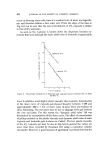
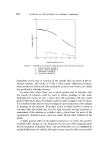
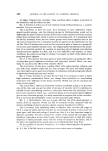
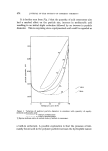
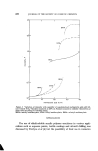
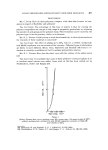
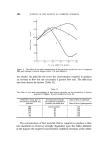
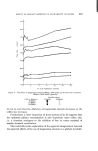
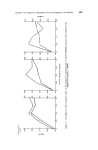
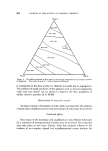
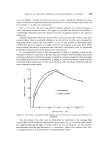
EFFECT OF GLIDANT ADDITION ON FLOWABILITY OF SOLIDS 499 acts as a glidant I would not advocate its use as such. I think the addition of these types of material to pharmaceutical formulations is to be discouraged when they can be avoided, i.e. if they are unnecessary. MR. G. DUNCALF: One practical effect of glidant addition is a marked change in case of aeration of some mixtures. The degree of aeration and therefore flowability is considerably dependent upon the degree and type of agitation given to the mixture before use. Equally important is the rate of deaeration. Practical tests have shown that with some mixtures there are marked differences in rate of flow (in this case measured by dispersing from a pack with 4-8 orifices, of say, 6 mm diameter) depending upon whether the tests are carried out within minutes of mixing or some time later. With some mixtures the rate of deaeration and reduction of flowability may be significant in less than 15 min and in other cases not for many hours. Is it possible that some of the discrepancies in effect of glidants noted in the literature could have been due to the fact that this aeration and flowability factor had not been considered, and that the degree of agitation and time elapsed between mixing and testing had not been standardised? Judging by comments already made, similar variations in flow behaviour are often encountered under practical conditions and the same com•nents might apply. 40C 0.1 0.2 03 0.4 0'5 Particle size, mm Figure 6 The effect of change in bulk density on the flow rate of various size fractions of magnesia. T•E LEcxu•: The effect can be illustrated by referring to the changes that occur in flow rate for different initial states of packing (Fig. •). These are some results for magnesia flowing through a circular orifice 7.4 mm in diameter. As the particle size decreases the flow rate increases to a maximum. Below this particle size, flow is impaired because of the influence of interparticulate forces.
Purchased for the exclusive use of nofirst nolast (unknown)
From: SCC Media Library & Resource Center (library.scconline.org)