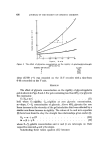
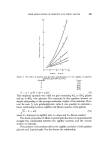
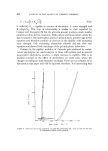
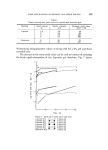
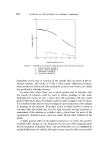
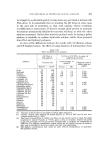
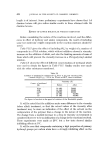
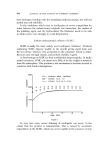
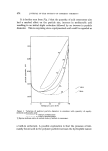
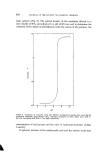
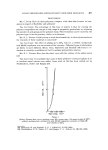
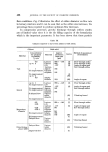
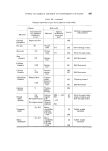
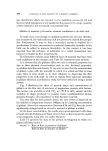
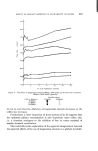
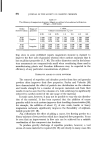
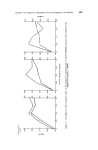
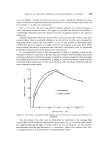
464 JOURNAL OF THE SOCIETY OF COSMETIC CHEMISTS form hydrogen bonding with the remaining hydroxyl groups, but will not permit any real solubility. In the conditions which exist in toothpastes of severe competition for water between the sodium lauryl sulphate, the humectant, the surface of the polishing agent and the hydrocolloid, the thickener needs to be able to retain water very strongly to avoid dehydration. Sodium carboxymethyl cellulose (SCMC) SCMC is easily the most widely used toothpaste thickener. Products containing SCMC disperse readily in the mouth giving rapid foam and flavour release, which is very acceptable to the consumer. Colour is white, flavours come through cleanly, and product stability is good. A disadvantage of SCMCs is their considerable hygroscopicity. In badly sealed containers, SCMC can absorb over 20% of its dry weight of moisture from the atmosphere. This problem is not uncommon in factories located in countries with humid atmospheres. 300' u 200. • ioo .•_ U XX-- hydroxy ethyl Cellulose 00-- SCMC D.S. 1.2 -,---- SCMC D.S 0'7-0'8 X X X X X X X X X X X X o 0 o O O 0 O o G 0 O 0 4 6 8 Age-days I0 Figure 1 In very rare cases, severe thinning of toothpaste can occur, to the extent that the product is unmarketable. This is caused by enzymatic degradation of the SCMC, which can occur rapidly in the presence of only

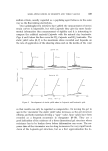
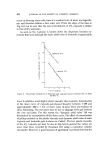
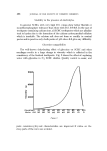
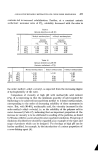
SYNTHETIC HYDROCOLLOIDS AND DENTIFRICES 465 a few parts per million of cellulase. The enzyme is produced by moulds and bacteria, and may originate in the water, on the factory floor, or within the bags of SCMC if this becomes damp enough to support growth. Killing the organism will not, of course, remove the enzyme. The more thixotropic grades of SCMC can cause difficulties in filling due to the very thin consistency of the toothpastes in the worked state (Fig. 1). It has also been our experience that toothpastes containing the more thixotropic grades retain occluded air quite tenaciously in the vacuum mixer, and more care is required in their manufacture. These manufacturing difficulties can be, and clearly are, overcome in the many factories successfully using SCMC for dentifrices. Selection of SCMC Grade Degree of substitution (D.S.) For toothpastes containing dicalcium phosphate dihydrate or calcium carbonate polishing agents, it is preferable to select a D.S. of about 0.7-0.8, because of better compatibility with calcium ions. These SCMCs tend to give products which are gel-like, and disperse very readily in the mouth. The extruded ribbon retains its shape but is often not completely smooth in texture when first extruded, due to disturbance of the gel surface. Materials with a D.S. of above 1.0, tend to give products of very shiny and attractive appearance but of lower dispersibility. They' are less thixo- tropic, and ribbon flow may occur. This behaviour may be the result of the better solubility of the high D.S. materials, which tend to give relatively less thixotropic toothpastes. The formulafor must therefore choose the D.S. most suited to his needs and usually there has to be some sacrifice o• one attribute or another. Viscosity There is a wide range of matehals available at the present time, although SCMCs with very high D.S. are restricted to rather low viscosity types. It is obviously more economical to use high viscosity thickeners, but on the other hand, it becomes difficult to manufacture uniformly when small weighing errors, or variations in SCMC quality, on a low level ingredient can have a very profound effect on final consistency. It is convenient to choose a grade which can be added at a level of approximately 0.5% to 2.0% to give the required consistency.
Purchased for the exclusive use of nofirst nolast (unknown)
From: SCC Media Library & Resource Center (library.scconline.org)