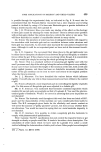
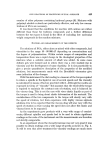
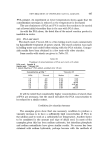
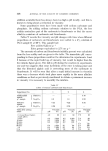
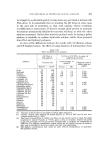
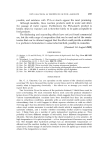
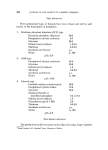
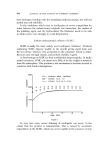
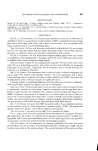
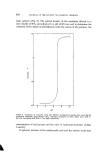
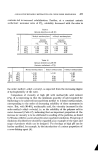
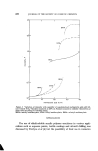
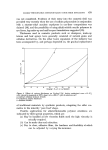
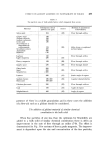
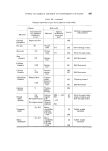
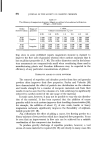
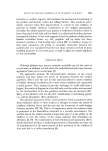
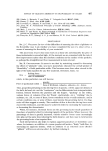
NEW REACTIONS OF PROPYLENE GLYCOL ALGINATE 451 be brought to a pH which quickly breaks down any gel which is formed with PGA alone. It is remarkable that on standing the pH drops in some cases to the acid side of neutrality, so that with suitably chosen conditions reacidification is unnecessary. If there is enough alkali present to maintain the mixture permanently alkaline the viscosity will drop, as with the other mixtures examined. On the other hand the product made by drying a gelled mixture is insoluble in sodium hydroxide solution, unlike those prepared from PGA and hydroxy polymers. In view of the differences between the results with 1:2 diamino ethane and 1:6 diamino hexane, the effect of using diamines of intermediate chain Table VIII Effect of additives on reaction 4 •o PGA q- % PGA q- 2 % PVA q- concn. of 8 •o additive additive given below Additive Lowest concn. to Viscosity (P) inhibits Highest concn.$ which does not Before* Afterr (wt •o) (M) inhibit None 75 450 -- -- -- Methanol 100 $ 1.6 0.5 0.375 Ethanol 85 310 7.8 1.7 0.950 n-Propanol 75 250 12.8 2.0 1.750 iso-Propanol 80 1 200 -- -- 4.000 õ n-Butane 1-ol 80 460 n-Butane 2-ol 120 1 000 Ethylene glycol 70 15 2.9 0.5 0.300 1:2 Propylene glycol 95 12 3.8 0.5 0.400 Diethylene glycol 70 60 Dipropylene glycol 80 700 n-Butane 1:3 dio1. 75 200 11.7 1.3 1.250 n-Butane 1:4 dio1. 62 80 5.4 0.6 0.500 n-Butane 2:3 diol. 67 800 -- -- 3.000õ Glycerol 54 24 Pentaerithritol 30 10 Sorbitol 50 20 Dextrose 70 32 Sucrose 70 40 Raffinose 65 26 Rhamnose 53 53 Formaldehyde 0.12 0.04 0.020 Acetaldehyde 2.60 0.60 0.500 (*) Viscosity of PGA solution and additive before alkali treatment. (t) Vicosity reading after adding 0.5 mmole Na,CO, g-• PGA at 20øC and 15 min later 1 mmole acetic acid g-1 PGA. (:•) The lowest concentration to inhibit was taken as the lowest tested in which the alkali treatment (1 mmole Na2CO3 g-1 PGA) gave a drop in viscosity. Figures are given in per cent of weight (cf. 8 •o in previous columns) and in molartry for comparison of additives. The highest concentration tested which did not inhibit is given in molartry only, and is included to show how nearly the limit was approached. (õ) The highest concentration that could be used without precipitation of polymers. No inhibition found.

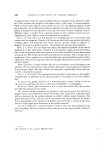
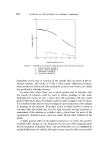
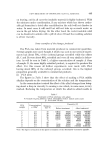
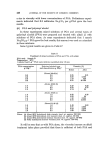
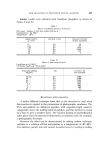
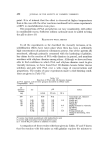
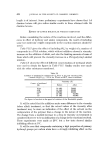
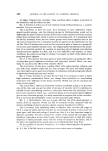
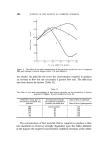
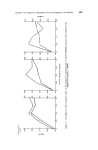
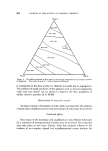
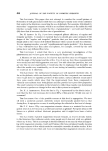
459. JOURNAL OF THE SOCIETY OF COSMETIC CHEMISTS length is of interest. Some preliminary experiments have shown that 1:4 diamino butane will give rather similar results to those obtained with 1:t3 diamino hexane. EFFECT OF LOWER MOLECULAR WEIGHT COMPOUNDS Before considering the nature of the reactions involved, and the differ- ences in effect of hydroxy and amino compounds, the result of including some low molecular weight compounds in the reaction mixtures should be noted. Table VIII gives the effect of including 8% by weight of a number of compounds in a PGA solution, which without additives showed a viscosity increase on the addition of alkali, and also the limiting amounts of some of them which will prevent the viscosity increase in a PGA/polyvinyl alcohol mixture. Table IX shows the effect of different concentrations of methanol which were used to obtain the figures in Table VIII. Similar studies were made with the other substances mentioned. Table IX Addition of methanol to mixture of 1% PGA q- 2 % low viscosity PVA. 1 mmole Na2CO3 g -1 PGA for 15 min at 20øC, then re-acidified. Concn. of methanol (M) None 0.25 0.375 0.5 1.0 Viscosity (P) Before 1.6 (60) 1.6 (60) 1.25(60) 1.6 (60) 1.7 (60) After 730(6) 220(6) 820(3) 0.7(60) 0.S(60) The figure in brackets is the speed of rotation of the Brookfield spindle. It will be noted that the additives make some difference to the viscosity before alkali treatment, so that the actual values of the viscosity after treatment may be more an indication of the effect of the solvent on the configuration of the polymer than a change in the nature of the reaction. The change from a marked increase to a drop in viscosity on treatment is considered however to be an indication of a change in the reactions involved. These experiments were made at 20øC but a few tests showed similar inhibiting effects at 5 øC. It will be seen that compounds containing a high proportion of primary hydroxyl groups per carbon atom have a strongly inhibiting effect on the
Purchased for the exclusive use of nofirst nolast (unknown)
From: SCC Media Library & Resource Center (library.scconline.org)