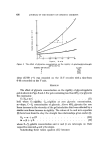
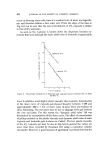
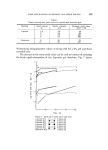
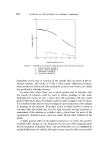
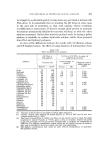
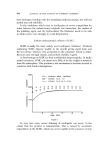
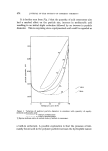
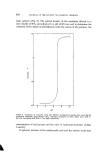
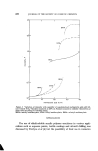
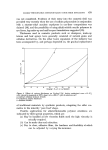
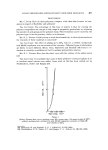
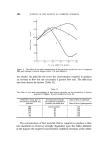
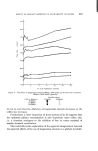
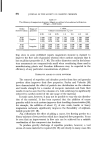
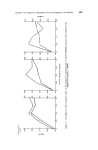
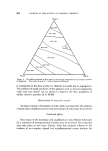
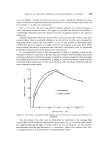
ß •00 JOURNAL OF THE SOCIETY OF COSMETIC CHEMISTS The two sets of points indicate that for non-cohesive material the effect of the initial state of packing is not very significant, perhaps because the flow limiting con- dition is bed dilation to a characteristic bulk density at the orifice region. Once inter- particulate forces become relevant, the initial state of packing seems to be quite important because the bed is trying to dilate before it flows. A MF•MUF•R OF T•F• AUX)IF•NCF•: We have also found a discrepancy between results, and having done some work in this I would agree that one can very easily be misled by making the mix in the morning and leaving the sample, doing it later in the day and getting a quite different set of results, i.e. until one realised that there had been a dramatic change in bulk density and therefore a move away from flowability. THF• LF•CTURE•: I wonder whether a lot of the problems here may be environ- mental changes. You may get surface adsorption of moisture and capillary adhesion, electrostatic changes, etc. A MF•MBF• OF ZHF• AUX)IF•NCF•: I wonder if one can get back to the original set of conditions? If this dramatic change is not appreciated, you might well get conflicting results. T•u LECZU•F•R: In my experience with those materials not subject to any inter- particulate forces their flow rate is not considerably affected by bulk density (Fig. •). A change in bulk density in the hopper has not made much difference in the eventual rate of flow from that hopper.

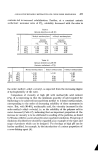
Book reviews OUTLINE OF iNDUSTRiAL OR- GANIC CHEMISTRY. A. Rieche. 3rd edn. Pp.xix+572 • Ill. (1969). Butter- worths, London. f4.90. This is an appropriate contri- bution from Germany, the birthplace of much of the organic chemical industry. The first (1955) edition was based on a series of lecture notes summarising the development of the more significant techniques used in the industry. The deliberate but nevertheless regrettable omission of organic dyestuffs, pharma- ceuticals and pesticides has been reme- died-albeit briefly--in this trans- lation of the 3rd (German) edition. However, cosmetic che•nists should note that industrial processing in perfumery and essential oils has still not been treated. The brief introduction is a common sense exposition of basic concepts and an explanation of the symbols em- ployed. The meat of the book is or- ganised in three divisions. The largest is concerned with the chemistry of the formation and properties of fossil fuels (coal, natural gas and crude oil--100 pages) and the petrochemicals industry derived therefrom (172 pages). A further 94 pages are allotted to agricultural and forestry products--wood, saccharides, fermentation, lipids and tannins. For many readers, however, the most inter- esting division will be that comprising a series of short studies of the pro- cessing of natural and synthetic mater- ials: fibres, polymers, textiles, pharma- ceuticals, pesticides, dyestuffs and ex- plosives. Perhaps the best section {44 pages) is, predictably, that on synthetic dyestuffs. Pesticides, however, are dis- missed in a mere 7 pages: in the pre- liminary discussion the phenomenon of insect resistance is briefly mentioned but there is no reference at all to the major environmental problem of per- sistent residues. Coverage of the phar- maceutical industry attempts to be more comprehensive but condensed and over simplified pharmacology is probably out of place, especially to the prejudice of space for details of industrial manu- facture. There are three discrete sections in the pharmaceutical chapter. The first deals with agents for the treatment of infectious diseases--mainly antibiotics: development of resistance is mentioned but the manufacturing account is restricted to fermentation. The text is severely outdated in supposing that "at least partial synthesis of many (antibiotics) should become possible one day". Another section examines the preparation of biological catalysts, notably hormones and enzymes how- ever, reference to androgens is strangely placed in a discussion of corticosteroids. The vast field of chemotherapeutic agents is reviewed in a series of short sub-sections allocated according to pharmacological function: each has a brief outline of the class of drug with a limited number of illustrative syntheses. Narcotics are too briefly discussed and nothing is foreseen of the considerable industrial applications of work, for example, by Paul Janssen (in Belgium) and K. W. Bentley (in England). On points of detail, it is difficult to agree with the description of paraldehyde as a "harmless hypnotic" or accept the several references to "malaria pro- ducing germs". The book is generally well trans- lated although in a number of instances chemical nomenclature has suffered in the process. There are relatively few 501
Purchased for the exclusive use of nofirst nolast (unknown)
From: SCC Media Library & Resource Center (library.scconline.org)