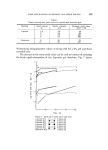
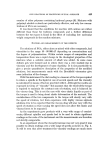
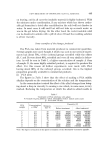
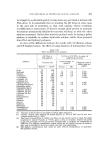
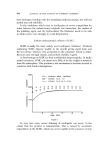
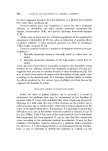
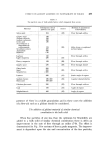
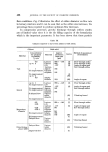
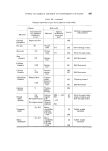
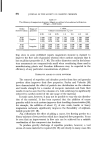
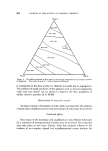
NEW REACTIONS OF PROPYLENE GLYCOL ALGINATE 447 PVA present. An experiment at lower temperatures shows again that the concentration necessary is reduced as the temperature is decreased. The use of mixtures of PGA and PVA enables the reaction to be carried out at lower initial viscosities than is the case with PGA alone. As with the PGA alone, the dried film of the mixed reaction product is insoluble in water. {iii) PGA and starch The starch used, Viscosol 810, is a thin boiling starch made commercially by hypochlorite treatment of potato starch. The starch solution was made in boiling water and cooled before mixing with the PGA solution. Compar- able results have been obtained in a few tests with other starches. Some results with starch are given in Table III. Table III Treatment of mixed solutions of PGA and starch with alkali PGA used: Sample B Starch used: Viscosol 310 1 mmole Na,CO, g-• PGA added, acidified after 15 min Concentration g 100g -• Viscosity (P) PGA Viscosol Before After 1.0 0.5 1.0 2.0 0.5 1.0 4.0 8.0 8.0 8.0 12.0 12.0 0.44 0.14 0.47 2.20 0.20 0.45 0.42 0.12 90.00 stiff gel 3.80 84O.OO It will be noted that considerably higher concentrations of starch than of PVA are necessary, but the starch will allow the PGA concentration to be reduced to a similar extent. Conditions for viscosity increases The examples given show that one necessary condition to produce a viscosity increase is to have a sufficiently high concentration of PGA in the solution and to work at a sufficiently low temperature. Another factor to be considered is the amount and type of alkali used. In most of the examples given this has been sodium carbonate, but trisodium phosphate and sodium metasilicate have given similar results. No success has been obtained with sodium hydroxide, perhaps because with the methods of

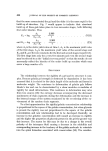
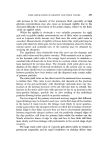
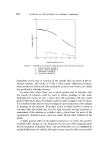
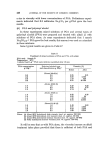
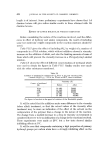
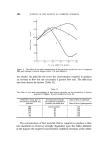
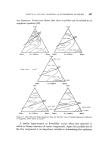
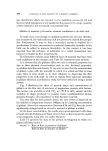
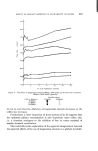
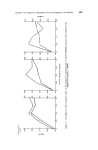
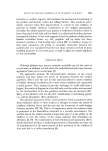
448 JOURNAL OF THE SOCIETY OF COSMETIC CHEMISTS addition available there has always been too high a pH locally, and this is known to bring about a reduction in viscosity. Some quantitative tests have been made with sodium carbonate and phosphate. On adding sodium carbonate solution to the PGA, the free acidity neutralises part of the carbonate to bicarbonate so that the excess alkali is a mixture of carbonate and bicarbonate. Table IV records the viscosity and pH changes with time when different proportions of carbonate and bicarbonate were added to a 49/0 solution of PGA sample D at 20øC. This sample had Free acidity 0.22 me g-1 Ester groups equivalent to 2.71 me g-1 The amounts of carbon and bicarbonate initially present were calculated from the free acidity and are given in the table. The immediate pH corres- ponding to these proportions could not be determined in experiments 1 and 2 because of the rapid build up of viscosity, but would be higher than the five minute figure given. The fall in pH during the reaction in experiments one and two suggests that some hydrolysis of the ester is taking place and that the liberated alginic acid is converting more of the carbonate to bicarbonate. It will be seen that after a rapid initial increase in viscosity there •vas a decrease which took place more rapidly in the more alkaline conditions so that as previously mentioned to obtain a permanent increase in viscosity it is necessary to reacidify the mixture. Table IV Effect of sodium-carbonate and bicarbonatc Experiment No. 1 2 3 Alkali added } NaHCO 3 -- -- 3.10 mmole g-• sample Na2CO 3 0.5 1.0 0.22 Effective } NaHCO3 0.22 0.22 3.32 mmole g- • sample Na 2CO 3 0.28 0.78 -- .... Time after adding Viscosity Viscosity Viscosity alkali pH (P) pH (P) pH (P) 0 (1 and 2 just before 4.0 30 4.0 30 7.9 18 3 just after) 5 min 9.2 3 600 9.5 2 240 7.9 28 15 min 8.4 3 920 8.7 216 7.9 30 30 min 8.0 2 960 8.2 120 ..... 45 min ...... 7.9 140 90 min 8.0 2 320 8.1 96 7.9 180 3 h 8.0 1 440 8.1 80 7.8 124 24 h 7.8 248 7.8 12 7.8 18
Purchased for the exclusive use of nofirst nolast (unknown)
From: SCC Media Library & Resource Center (library.scconline.org)