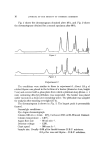
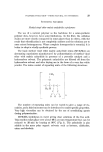
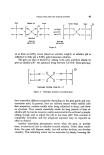
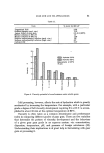
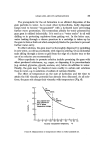
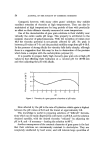
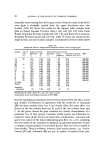
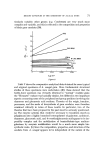
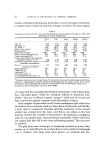
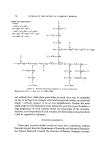
THE ANALYSIS OF ODORIFEROUS VAPOURS 11 Fiõur• $ DISCUSSION Some of the experimental results are unexpected although not contrary to estal•lished theoretical principles. In the procedure described there are three stages in the transport of odoriferous vapour from the source to the absorbing liquid:- (1) The release of vapour from the source. If the source of the odour is a liquid, as in experiments 1-•l, then the rate of release is a function of the vapour pressure of the components of the liquid, the rate at which they diffuse to the surface, and the temperature. In the case of a living flower there will probably be a continuous change in the rate of generation of the odoriferous components and the technique described will give an average composition. (2) After the molecules of the odoriferous components have left the sur- face, they must diffuse through the air space. The driving force of the diffusion is a concentration gradient and transport will continue until this becomes zero. The rate of diffusion depends also upon the molecular weight of the molecules and their mean free path between collisions. The rate of diffusion of gases and yapours into gases was studied by Clerk Maxwell (6) who derived an equation for the diffusion coefficient, D, in terms of the total pressure, molecular weights of the two gases, and the sum of the radii of the two diffusion molecules. The diffusion co- efficients in air for many yapours, including safrole and eugenol, have been measured {7). The most important result from the present view- point is that the rate of diffusion is inversely proportional to the pressure. (3) The final stage in the transport is the absorption of the vapour on to the dibutyl phthalate. One would expect this to be a slow step, but

12 THE JOURNAL OF THE SOCIETY OF COSMETIC CHEMISTS experiments show that this is not so owing to the extreme thinness of the liquid layer. The result is not surprising when it is considered that the equilibrium between vapour and stationary phase in a glc column must be reached in less than a second, since it is not difficult to obtain 30 theoretical plates in 1 cm length of column. It is possible that the rate limiting step would be transferred to this stage by a relatively small increase in the thickness of the absorbing drop. Choice of liquid for the absorption The magnitude of the equilibrium concentration of volatile matter taken up from the vapour will depend upon the molecular weight of the absorbing liquid. In accordance with Raoult's law the uptake of vapour will increase as the molecular weight of the absorbing liquid is lowered. Phthalate esters were chosen because they are odourless, excellent solvents and readily obtained free from low boiling impurities. Dibutyl phthalate has a relatively low molecular weight and a longer retention time than most, if not all, the known odoriferous substances. The concentration of volatiles taken up by dibutyl phthalate in the experiments with the roses and with the rubbed thyme, is thought to be around 1%. Larger quantities of volatiles can be collected by using the device described in experiment 1, with the phthalate absorbed on a support as in a glc column. The procedure described has the advantage that it is not influenced by water. In the alternative method, a current of air or inert gas is passed over the odour source and then through a short tube cooled in liquid air or acetone and solid carbon dioxide freezing mixture. The resulting con- densation of all the moisture in the gas causes blockages through ice formation and an additional step is necessary to remove the water from the desired volatiles. So far only a limited number of experiments has been made with the new procedure, but these promise much interesting work for the future. ACKNOWLEDGEMENTS The willing co-operation of my colleagues is acknowledged, particularly Mr. B. Jaggers, for the experiments with thyme and Mr. P. L. Williams, without whose assistance the basic experimental work would not have been possible. (Received: 30th January 1970)
Purchased for the exclusive use of nofirst nolast (unknown)
From: SCC Media Library & Resource Center (library.scconline.org)