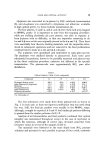
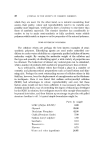
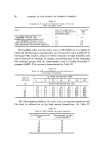
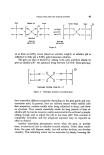
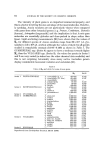
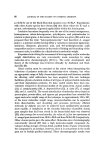
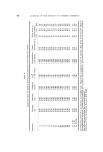
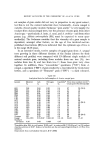
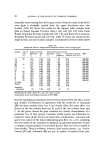
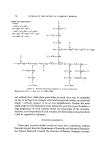
THE ANALYSIS OF ODORIFEROUS VAPOURS motor, 2 ml of gas from the vapour space was passed back and forth 100 times min-1. Linalol and a-ionone were absorbed from the vapour by the dibutyl phthalate by the laws of thermodynamics the absorption must continue until the two solutions have the same composition since both will finally be in equilibrium with the same vapour. Glc analysis of the vapour gave the following results:- Height of linalol peak - greater than 240 mm. Height of ionone peak - 4 mm. Ratio of peak heights - Linalol/ionone, greater than 60. Glc analysis of the liquid in the measuring cylinder under the same con- ditions gave:- Height of linalol peak - 188 mm. Height of ionone peak - 179 mm. Ratio of peak heights - linalol/ionone, 1.05. The motor was run for 24 h. Glc analysis of the liquid in the U-tube after various times gave the following results:- Table I. Ratio of peak Time Linalol peak Ionone peak heights (h) Height (mm) Height (mm) linalol/ionone 1 49 2 25 2 121 19 6.4 4 124 24 5.2 24 129 100 1.29 Thus the two peaks given by a sample of the liquid were of about equal heights, whereas in the vapour sample the linalol peak was more than 60 times as high as the ionone peak. The rate of pick-up of ionone vapour by the dibutyl phthalate was such that after 4 h the linalol peak was about 5 times as high as the ionone peak. The important point for the perfumer to note is that this procedure gives the composition of the liquid that produces the desired vapour composition. This information is often more useful than that obtained by the usual procedure in which the vapour is analysed, parti- cularly when an identification of the higher boiling constituents is desired. A portable unit using this principle but with an inch or so of packed chromatographic column has been used successfully for vapour analysis by my colleague Mr. T. M. Poynder (private communication).

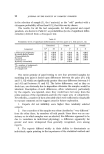
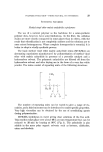
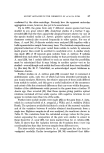
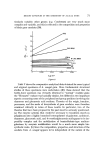
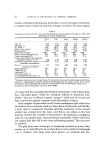
JOURNAL OF THE SOCIETY OF COSMETIC CHEMISTS Experiment oe. In this experiment the ionone, linalol, dibutyl phthalate mixture having the same composition as before was placed in the bottom of a jar 13 cm in dia. and 3 cm high. A platinum wire loop, (ca. 6 mm X 1 mm) containing a drop of dibutyl phthalate was suspended in the vapour space and the whole was covered with an air-tight plate. In this case the transfer of the linalol and ionone to the dibutyl phthalate contained in the loop of wire was dependent upon diffusion only. Under these conditions it was found that after four days the heights of the linalol and ionone peaks of a sample from the loop were 87 mm and 27 mm respectively, compared with 112 mm and 121 mm for a sample from the bulk. Peak height ratios, linalol/ionone: On loop 3.2 and in bulk, 0.93. Experiment $. It might be expected that the time taken to reach an equilibrium is determined by the rate of absorption of the vapour by the dibutyl phthalate. The following experiment shows that under the given conditions the rate controlling step is the diffusion of vapour through the air space, The general conditions were the same as in experiment oe, but the jar was placed in a desiccator from which the air was exhausted so that only the yapours of linalol and ionone were present. The heights of the linalol and ionone peaks in the starting mixture were 108 mm and 130 mm respectively, corresponding to a peak height ratio linalol/ionone of 0.83. After standing for one hour at less than 1 mm pressure a sample of dibutyl phthalate taken from the loop gave linalol and ionone peak heights of 80 mm and 69 mm respectively, corresponding to a peak height ratio linalol/ionone of 1.16. Thus the equilibrium was very nearly complete. After standing under vacuum for 18 h the linalol and ionone peak heights were 100 mm and 127 mm respectively, corresponding to a linalol/ionone peak height ratio of 0.87, which was the closest approach to complete equilibrium that had been achieved so far. Experiment It will be appreciated that water vapour will be present in any practical experiment involving the odour of, for example, a flower, and for this reason it is desirable that the vacuum employed should not be less than the vapour
Purchased for the exclusive use of nofirst nolast (unknown)
From: SCC Media Library & Resource Center (library.scconline.org)