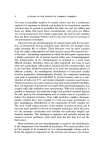
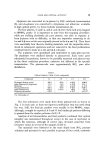
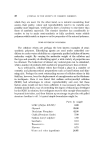
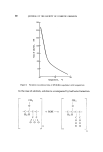
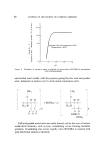
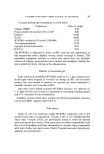
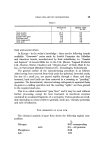
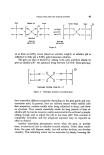
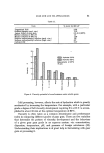
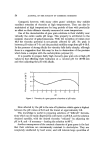
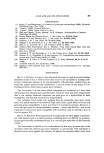
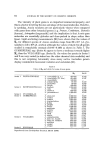
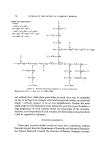
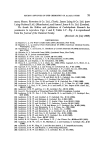
50 JOURNAL OF THE SOCIETY OF COSMETIC CHEMISTS pH to 7, or below. The gum will then hydrate and develop viscosity in the usual manner. This phenomenon may be utilised as a way of dispersing guar containing products, that tend to lump, especially with not very efficient equipment. The powder is initially slur fled into an alkaline borated solution, which is then neutralized to promote hydration (3). An interesting use of some of the properties of borated galactomannans is made in a patent (11) for hair straightening composition with sulphites. The rationale of this application is that such borated gums have a very low initial rate of hydration in acidic media thus enabling the product - in powder form - to be easily dispersed in water. The resulting solution wets the hair easily and conveniently and after a while develops high viscosity (of the order of $ 500 cP) which, aided by combing, manages to keep in the desired shape the sulphite softened hair. Guar gum grades are also available possessing gelling properties based on a principle entirely different from that of the borax/galactomannan system. They either utilize an oxidising catalyst to activate the complexing mechanism in a two-step procedure, or are "one step" and entirely self complexing types. The latter form sols on dispersion, and then develop into firm, water-tight gels (2, 3). PHYSICAL PROPERTIES OF GUAR SOLS Galactomannans are insoluble in hydrocarbons, fats, alcohols, esters, ketones - in fact with a very few exceptions (e.g. formamide) in organic solvents in general. The only important solvent for galactomannans is water, for which - on account of the structure of their molecule - they have tremendous affinity - for water in its liquid state - that is. Wate• in the vapour phase merely changes the moisture equilibrium. There is no hygroscopicity. When dispersed in water, hot or cold, galactomannans hydrate rapidly to form colloidal solutions of unusually high viscosity characteristics even at very low concentrations. Table II indicating concentrations of various hydrocolloids required to produce an apparent viscosity of 800 cP at 20øC shows that a brand of guar gum is - in that respect - a runner-up to Carbopol. What is even more remarkable, guar gum attains nearly its full viscosity potential in cold water, while other gums (including the related locust bean galactomannan) require sometimes prolonged "cooking".

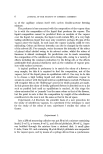
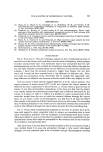
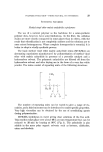
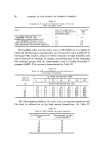
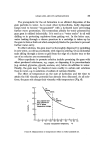
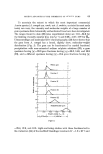
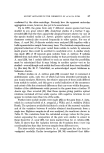
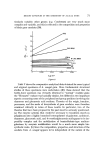
GUAR GUM AND ITS APPLICATIONS 51 Table II. Gum Tragacanth USP Sodium alginate (med. visc.) Jaguar brand of guar gum Methyl cellulose (1 $00 cP) Methyl cellulose (4 000 cP) Sodium carboxymethyl cellulose (reed. visc.) Sodium carboxymethyl cellulose (high visc.) Carbopol 934 •o (w/v) for 800 cP 2.75 1.15 0.2-0.3 (2SøC) 1.7 1.35 1.9 0.7 0.17 5O 4O 30 20 10 0 _J ,•'• Hydrofed 25øC • Hydrofed 85øC Measurernenfs o1' 25øC sols 2 .=- .-- .-- Figure 4. Viscosity potential of some {common water soluble gums. Cold processing, however, affects the rate of hydration which is greatly accelerated by increasing the temperature. For example, with a particular grade a degree of full viscosity development requiring 5 h at R.T. is accom- plished in about 10 min at the optimal temperature of 80 øC. Viscosity is often taken as a common denominator and performance index in comparing different grades of guar gum. There are five variables that determine the pattern of viscosity development and the behaviour of a given guar gum grade in an aqueous system. viz: concentration, dispersion, temperature, pH, and presence of foreign substances (113). Understanding their implications is of great help in formulating with guar gum or processing it.
Purchased for the exclusive use of nofirst nolast (unknown)
From: SCC Media Library & Resource Center (library.scconline.org)