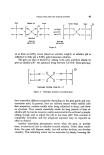
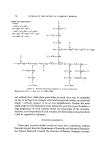
ODOR AND OPTICAL ACTIVITY 17 antipodes, a truly remarkable finding, not confirmed by other cases in the literature. In neither of the above cases were details given of the method of evaluation of the final products. The interconversion of one form into the other The recently reported case (3) for carvone and several carvone deriva- tives is fairly conclusive that d- and l- isomers of this type can indeed be distinguished readily, and the fact that in going, for example, from d-car- vone-+/-carvone-d-carvone, one gets an unquestionable caraway -+spear- mint-+caraway character, seems to exclude extraneous reasons for the odor differences. It should be pointed out, however, that the differences are still rather subtle, and certainly not as spectacular as in the case of taste differ- ences between d and I forms of sugars, for example. Also, the proof that the difference is truly olfactory, and not trigeminal, for example, is not yet established. Nevertheless, this would seem to be begging the question and the fact remains that the isomers can indeed be distinguished, at least in this series. It seemed desirable to extend the search for differentiable d and I forms to other groups of compounds. Unfortunately, the interconversion of d and I forms is feasible in very special cases only, and in the present study only the first method was employed with, however, a built-in check control on impurities which was designed to overcome previous uncertainties, as will be shown. Five compounds with definite fragrance characteristics were prepared in both d and I forms, and evaluated by panels for ability to discriminate. However--and this is the crux of the matter--each compound was made by two different routes so that there were obtained in each case, two pairs, namely d-1 and d-2, and l-1 and 1-2. Furthermore, the synthetic route was the same for each d-1 and 1-1 compound and differed from the preparative method for d-2 and 1-2. This procedure leads to a condition in which the various steps in the syntheses constitute purification steps, while any build-up of impurities due to the chemistry involved would automatically bring the pairs (d-l, /-1) and (d-2, /-2) closer together, at the same time putting the pairs (d-l, d-2) and (l-l,/-2) further apart. The olfactive effect of impurities in the end products thus would have to be subordinate to the olfactive effect of the rotation if d could still be distinguished from I with statistical significance.

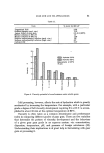
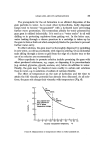
18 JOURNAL OF THE SOCIETY OF COSMETIC CHEMISTS The purpose of this approach was to obtain valid judgements on preparations in which the unavoidable impurities, though reduced to a minimum, did not have to be completely eliminated. This is essential, since absolute olfactive purity is not attainable. Preparations which show only one peak on glc under conditions of maximum sensitivity of the instrument are virtually unattainable, particularly with compounds with useful frag- rance qualities, which are often associated with materials of lesser chemical stability. When one considers that "glc purity" even if attainable, would not guarantee the absence of undetected trace amounts of impurities which could influence the known greater analytical power of the human nose, the task of preparing standards of absolute odor purity clearly remains beyond our ability. It is the olfactory analysis of this series based upon pairings from four presented materials which comprises the essentially novel approach to the question of chiral odor discrimination. The evaluation method used permitted a statistical analysis of these odor judgments by both expert and lay panels. A priori, three possible results were possible: (1) The panels would render judgements close to random selection, thus showing no significant differences. This would mean only that the impurities did not dominate the judgments. (2) The panels would select (d-l,/-1) and (d-2, 1-2) as matching pairs. This would mean that the impurities due to the synthetic methods were the main cause of the odor differences, and would render the whole research meaningless. (3) The panels would select (d-l, d-2) and (l-l, 1-2) as pairs, at least in some of the five comparisons. The more such (d-l, d-2) rs. (/-1, 1-2) pairings and the greater the statistical weight of these, the more convincing the conclusion that dextro and laevo isomers can indeed be distinguished by odor. PROCEDURE Preparation of test compounds The starting materials were dextro-alpha-pinene and laevo-beta-pinene from Greek and American turpentine oils respectively. They were of approx- imately 98-99% glc purity and were over 90% optically pure. The impurities were the isomeric terpenes known to be present in all pinenes and not separable even by glc trapping.
Purchased for the exclusive use of nofirst nolast (unknown)
From: SCC Media Library & Resource Center (library.scconline.org)