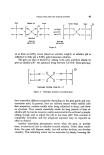
THE ANALYSIS OF ODORIFEROUS VAPOURS passes to a detector and the peaks are recorded in the usual way. The rest of the stream is used for smelling. Others use a non-destructive detector, such as a catharometer, so that the whole of the exit gas can be used for smelling. Notes of the odours are usually dictated and either recorded on magnetic tape or written directly on to the chromatogram. The technique is not without difficulties of which perhaps the most important is that an organoleptically essential constituent may be present in such a small proportion that it is not recorded on the gas chromatograph. It is suspected too that some odoriferous compounds are so unstable that they do not survive the chromatographic separation. The simplest procedure for vapour analysis is to take a measured volume of air from the free space in a closed vessel containing the odorifer- ous material, such as food, fruit or perfume. The air is then injected directly on to the chromatographic column. The limitation of the method is that it is relatively insensitive to high boiling, but perhaps strongly odoriferous constituents of the vapour. Furthermore, there must be a loss of resolution that is related to the volume of the sample and the gas flow rate. With sensitive detectors and temperature programmed dual columns to com- pensate for bleeding of the stationary phase, it is possible to distinguish around 20 peaks in a 5 ml sample of the vapour above fresh pineapples {2). Greater sensitivity can be obtained by concentrating the vapour by freezing. Thus, in the analysis of tobacco smoke it has been found that the direct injection of 30 ml of smoke on to a column at 30øC gave a chromatogram with around 18 peaks. However, if the column was cooled to minus 65øC, then all the constituents collected on the inlet to the column without spread- ing and were not released until the column was warmed. In this way the same volume of tobacco smoke produced around 130 peaks (3). It was found when using 304 m of 0.76 mm I.D. open-tubular column coated with methyl silicone that unacceptable broadening of the peaks occurred when a vapour sample measuring more than 0.5 ml was injected, a volume which unfortunately contained insufficient material for a satisfactory analysis (4). The resolution was improved by trapping the components in a 20 ml sample of vapour by passing it through a short length {about 75 mm) of coated capillary tube cooled in solid carbon dioxide and acetone. By means of a switching valve, the capillary was connected in series with the inlet to the glc column and heated rapidly to 130-140øC in a current of hot air. Ex- cellent resolution was obtained and the procedure was used in a study of apple variety and the changes that take place during processing. Other workers obtained similar improved resolution by cooling the first inch or

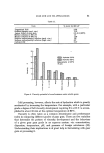
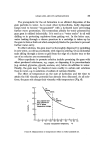
JOURNAL OF THE SOCIETY OF COSMETIC CHEMISTS so of the capillary column itself with carbon dioxide-acetone freezing mixture. The perfumer is less concerned with the composition of the vapour than he is with the composition of the liquid that produces the vapour. The liquid composition cannot be predicted from an analysis of the vapour over the liquid, for example, the liquid could contain 50% of a very high boiling odoriferous liquid that may only constitute perhaps 10 ppm of the vapour above the liquid. In such cases the vapour analysis could be very misleading. Odour and flavour intensity can also be changed by the nature of the solvent (5). For example, water decreases the intensity of the odour of phenyl ethyl alcohol owing to its solvent action, whilst the odour of limonene is almost unchanged. No predictions can be made concerning the composition of the odoriferous oil in living cells, owing to a variety of effects including the constant production by the living cell, or the effects predictable from physical chemistry such as the variation of vapour pres- sure with surface curvature. A typical problem in perfumery is to match the odour of a flower or soap sample for this it is required to find the composition, not of the vapour, but of the liquid phase in equilibrium with it. One way to do this is to choose a high boiling liquid and allow the odoriferous vapour to remain in contact with the liquid until an equilibrium is reached. Perfumers will recognise this as the 'Enfleurage' process by which pomades are made. In this process the odour of freshly gathered flowers is absorbed on to a fat such as purified lard until an equilibrium is reached. At this stage the odour-saturated fat or 'pomade' has the same odour as that of the flowers, but the point to note is that the composition by weight of the odoriferous constituents in the wax is not the same as that in the air space. Experiments 1-4 illustrate the scientific basis of a new procedure for the study of odoriferous yapours. In experiment 6 the technique is used for the study of the odour of rose experiment 7 studies the odour of thyme. Experiment Into a 250 ml measuring cylinder was put 50 ml of a mixture containing linalol, 2 vol % a-ionone, 8 vol % and dibutyl phthalate, 90 vol %. Argon was bubbled through the mixture from a sintered disk. A small glass U-tube, 2 mm I.D. and containing 10 [tl of dibutyl phthalate was suspended in the vapour space, and by means of a syringe driven from a synchronous
Purchased for the exclusive use of nofirst nolast (unknown)
From: SCC Media Library & Resource Center (library.scconline.org)