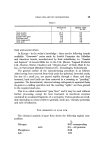
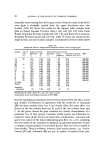
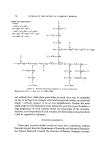
JOURNAL OF THE SOCIETY OF COSMETIC CHEMISTS a--0.54 for use in the Mark-Houwink equation [*1] =K'Mw a. Experiments with other Acacia species have shown (24) that these values for K' and a are not, unfortunately, of general applicability within the Acacia genus. Confusion has arisen frequently over the use of the terms homogeneous, heterogeneous, micro-heterogeneous, polydisperse, and polymolecular in relation to plant gums. A discussion of these terms was given (23) and it was proposed that the term "heteropolymolecular" best described A. senegal gum i.e. a polymer system having either a variation in monomer (galactose, arabinose, rhamnose, glucuronic acid, and 4-0-methylglucuronic acid) composition and/or a variation in the mode of linking and branching of the monomer units, in addition to a distribution in molecular weight. Experiments involving the assessment of heterogeneity and/or molecular weight distributions are very conveniently made nowadays by using molecular-sieve chromatography (M.S.C.). The early development and theory of the technique was reviewed critically by Anderson and Stod- dart (25, 26). Great caution must be exercised at the outset when interpreting the behaviour of polymer molecules on molecular-sieve columns, but when an appropriate range of fully characterised materials and fractions suitable for effecting valid calibrations has been acquired, this new technique facilitates physico-chemical studies of all types of polysaccharide molecules and their degradation products. To date, useful results have been con- veniently obtained in structural studies of the gums from •4cacia arabica (11), A. campylacantha (16), A. drepanolobium (12), A. laeta (17), A. senegal (18), and A. seyal (15). The recent introduction of molecular-sieves based on porous-glass, porous-silica, and agarose gel preparations has extended the upper molecular weight range of the technique to approximately 150 x 10 6 at the lower molecular weight range, monosaccharides can be separated from disaccharides, and de-salting and processes previously effected tediously by dialysis can now be achieved more satisfactorily and much more rapidly. A complexity in the viscosity behaviour of purified Acacia gum samples that had been stored in the freeze-dried state was observed (22) after storage for several months, the value of [*1] for two specimens of A. senegal gum increased from 19.9 to 29.0 and from 24.5 to 35.1 respectively. Other Acacia species gave the same effect. Molecular-sieve chromatography conveniently showed (27) that a high molecular-weight component de- veloped during storage of freeze-dried, purified forms of gum structurally the component is an artefact, however, since it is not present in the crude gum nor in freshly purified material. These chromatographic results were

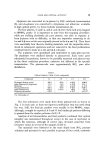
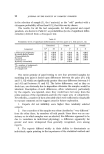
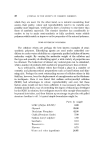
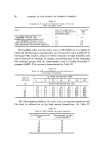
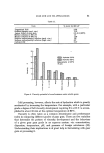
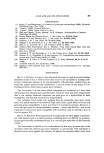
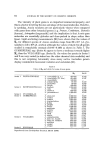
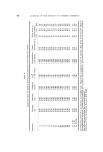
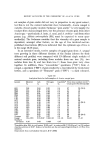
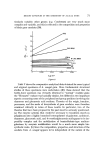
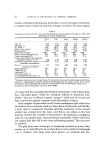
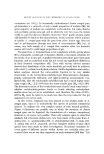
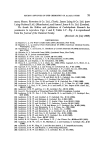
RECENT ADVANCES IN THE CHEMISTRY OF ACACIA GUMS 67 confirmed by the ultra-centrifuge. Precisely how the apparent molecular aggregation occurs, however, has yet to be ascertained. Up to 1957, the gums from only 7 different Acacia species had been studied to any great extent (28). Analytical studies of a further 7 spp. revealed (28) that the then apparently atypical features shown by one of the species studied earlier (A. karroo positive optical rotation, and low rhamnose content) also occurred frequently in other species. For one of these, A. seyal Del., 8 discrete nodules were analysed (29) together with a bulk representative sample from many trees. The chemical composition and physical behaviour of the gum varied from nodule to nodule by amounts much greater than could be ascribed to analytical error. A similar study was made (30) of 10 separate gum nodules from A. nilotica 9 nodules differed from each other by amounts similar to that previously recorded for A. seyal (29), but 1 nodule differed to such an extent that the possibility must be entertained that it may belong to another species--not so far studied--even although each nodule had been collected from trees identified by (the late) Mr. M. P. Vidal-Hall, an acknowledged expert fieldsman in Sudanese Acacias. Further studies on A. nilotica gum (30) revealed that it contained 4 aldobiouronic acids, only two of which had been identified previously in any A cacia exudates. Moreover, the relative amounts of these acids differed from nodule to nodule, and this gave a useful indication of the occurrence and extent of the fine structural differences that can occur within the genus. Studies of the aldobiouronic acids present in the gums from a further 17 Acacia spp. then revealed (31) that those species giving positive optical rotations contained all four acids species with negative rotations do not appear to contain more than two of the acids. Further inter-nodule studies were made (32) on the gum from A. laeta, which is a natural hybrid of A. senegal (L.) Willd. and A. mellifera (Vahl.) Benth. The specimens available facilitated a study of the seasonal variation and of the variation between 6 nodules obtained simultaneously from a single tree. Eighteen samples in all were analysed the results are shown in Table II. The variations from the calculated average values for the para- meters expressing the composition of the gum were similar in extent to those found for A. seyal (29), but more marked than for A. nilotica (30). Table II shows that the variation between the 6 nodules from 1 tree was considerably less than that between samples from different trees. The inter-nodule variation shown by A. senegal gum has also been in- vestigated carefully. Earlier investigators (33, 34) considered that differ-
Purchased for the exclusive use of nofirst nolast (unknown)
From: SCC Media Library & Resource Center (library.scconline.org)