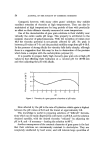
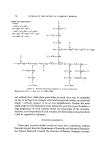
76 JOURNAL OF THE SOCIETY OF COSMETIC CHEMISTS (39) Anderson, D. M. W. and Speed, C. E. forthcoming publication. (40) Anderson, D. M. W. and Dea, I. C. M. Carbohyd. Res., $ 104 (1968). {41) Anderson, D. M. W. and Dea, I. C. M. Carbohyd. Res., 8 440 (1968). (42) Jones, J. K. N. and Smith, F. Advances Carbohyd. Chem., 4 243 (1949). DISCUSSION DR. J. J. MAus•.R: Could you give us an example where molecular shape plays a part in molecular sieve chromatography in Acacia gums ? DR. D•.A: An example of this is given by Acacia arabica gum, the molecular weight of which is very much higher than Acacia senegal gum. If you would look at _Fig. 1, Acacia senegal gum is eluted at the void volume and light-scattering studies have shown that the molecular weight (•w) of this polysaccharide is in the region of 600 000. Similar experiments with A cacia arabica gum have shown that its molecular weight (•w) is of the order of 2 X 10⁶ and, as a result, one would expect it also to be eluted at the void volume, which is represented by the dotted line. Acacia arabica gum has a very much more compact highly branched, globular-like structure, how- ever, and because of this difference in molecular shape, it is eluted not at the void volume of 270 ml as defined by Acacia senegal gum, but at an elution volume smaller than that (approx. 240 ml). This effect is also shown by fraction 1. MR. R. H. McDowELL: I wonder whether you are prepared to perhaps speculate on the nature of the gel fraction for example, whether treating it with borohydride is the only way of getting it into solution or whether any other simple chemical operations would dissolve it and how that would throw any light on its nature? DR. ANDERSON: I could deal with this question, but it involves the very problem on which Dr. Dea broke even as an independent research worker, i.e. instead of being a student doing what I suggested, he came one day to tell me what had happened with something he had thought up himself. DR. D•.•: At Edinburgh, I worked with an Acacia gum--Acacia drepanolobium gum--which gives much more insoluble ge• than Acacia senegal which usually gives only one to, say, five percent of this insoluble gel. A cacia drepanolobium gives about 20% of gel and therefore this gave us the chance to study this problem more con- veniently and in greater detail. What in fact we found was that the gel material was virtually identical chemically with the soluble material. The only major difference involved the molecular weight, •w, which for the soluble portion of this gum was of the order of 700 000, while the molecular weight of the gel was, at least, 2X 10⁶. I say "at least" because we studied the solution obtained when the gel was solubilised by a 1% solution of sodium borohydride. We have not yet found out for certainty why sodium borohydride should solubilise this gel material but it could well be that this solvent did break down the molecular structure in some way. Molecular size seems to play at least some part in the gelling properties of these materials, but in other ex- periments sodium hexametaphosphate, for example, was also found to solubilise the gel material to some extent. This suggests that possibly the larger molecules may also be held together in some way by heavy metal cartons.

Book reviews HYDROPHOBIC SURFACES. Editor: F. M. Fowkes. Pp.xvi q- 227 q- Ill. {1969). Academic Press, New York. $9.50. This volume is a record of the Symposium on Hydrophobic Surfaces honouring Professor Zettlemoyer upon his being awarded the Kendall Award of the American Chemical Society in colloid and surface chemistry in 1968. The first paper by Zettlemoyer on Hydrophobic surfaces--the Kendall Award Address--sets the pace for the following chapters. The physics are, as one would anticipate, of an advanced order, and primarily, in the cosmetic industry, will only concern the research scientist, but the discussion and con- clusions, in this and the other papers will be of interest and value to develop- ment teams. Professor Zettlemoyer discusses the hydrophilic sites found on "real" hydrophobic surfaces--such sites being responsible for the nucleating ability of hydrophobic "cloud seeders". Saunders writes on the "Adsorption of methylcellulose on polystyrene latexes" and finds that this depends on the available surface area determined by the sodium lauryl sulphate, used as the emulsifier, adsorbed on the latex par- ticles. There follows a further interesting monolayer study by Sheppard and Tcheurekdjian, who describe the spread- ing of emulsion latex particles on water using organic liquids as spreading aids. These are but a few of the papers which particularly interested this re- viewer--there is a total of 24, all with excellent summaries and references. The volume is clearly of vital interest to all colloid and surface chemists, and should also be on the shelves of reference libraries within the cosmetic industry. M.A. COOKE SEPARATION METHODS IN OR- GANIC CHEMISTRY AND BIO- CHEMISTRY. F. J. Wolf. Pp.viii +237 +Ill. {1969). Academic Press, New York. $11.50. This book is essentially for the analyst, although not exclusively so. It arises from a realization that the isolation of a pure substance is frequently the major laboratory effort involved in the solution of a chemical or biochemical problem. The choice of the best pro- cedure to use, therefore, requires a careful evaluation of many factors, in- cluding the available equipment and time, extent of experience and scale of the operation. The objective of this book is to provide a background which will enable such choice to be made as rapidly and as accurately as possible. The approach is primarily from a theoretical point of view and the actual examples of separations given serve to demonstrate the methods rather than to provide the analyst with specific details of a particular analytical operation. After an essentially theoretical intro- duction and statement of general principles, the treatment falls into five main headings, viz. the determination of 77
Purchased for the exclusive use of nofirst nolast (unknown)
From: SCC Media Library & Resource Center (library.scconline.org)