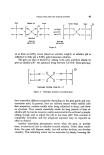
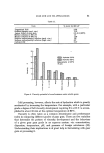
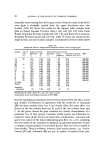
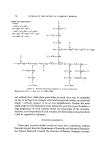
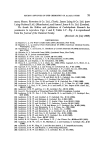
60 JOURNAL OF THE SOCIETY OF COSMETIC CHEMISTS crept into the flour from the seeds - or rather their germs. The germs contain enzymes which tend to depolymerise the galactomannan to get rid of them, the standard procedure is to autoclave the bulk, and that - at the same time - probably takes care of the bacteria as well. I wish to emphasise that guar gum is widely used in the food industry where the microbiological considerations are certainly important. It is easy to preserve, being compatible with sodium benzoate, which incidentally has an interesting property of increasing its viscosity, and with benzoic and sorbic acids, the preservatives most frequently used in the food industry. MR. G. A. GREINER: Could you clarify that the "viscosity potential" figures in pages 50 and 51 are for pure guar gum or are there additives, such as borax in the product cited? T•F. LECTURER: This concerns natural guar gum. The order of viscosities averages 5 000 cP, for a 1% solution. DR. N. A. R. LERoux: Would you like to comment further about the synergistic effect of guar gum with other hydrocolloids? T}m LEcx'•mE•: I have no experience of that. MR. ID. M. •BUSF•ELD: It seems to be widely assumed that a lot of guar formulations contain borax. I would like to discount this belief because, in fact, very few guar formulations need to contain borax to achieve the viscosity potential. In the literature it has been reported that perhaps the structure of guar gum is not as simple as you put it in the paper, and one of the common beliefs is that the structure consists of short chains of D-galactose units randomly positioned along the D-mannose chain, rather than single D-galactose units positioned at regular intervals on every other D-mannose molecule. This possibly may account for some of the rheological effects in that if the chains are longer than one molecule units there will be some entanglement of the branches in the solution. Coupled with the hydrogen bonding effect this would give two reasons for viscosity, and may possibly account for the pseudothixotropic effect. Would you care to comment? T• LF_c,ut•.R: You are perfectly right. Both Smith et al (1), and Heyneetal (5) comment on that. It must be realised that the formula quoted is an idealised one, and has been arrived at by the way of quantitative analysis which gives about •6% of galaclose and 63% of mannose consequently it has been assumed that they are in the formula in the proportion of roughly 1:2. This has led to an idealised picture but all investigators agree that this is not as simple as that. First of all, the proportions notwithstanding, the distribution of side chains may vary according to the natural process(•s occurring in the forming of the galactomannan, and further changes which may occur in processing. Quite a few authors also postulate the ramification of the chains. The existence of short branched chains of galaclose rather than units on the mannose chain is said to explain quite a few anomalies (1, 5).

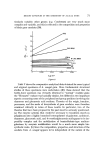
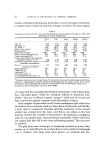
J. Soc. cosmet. Chem. 22 61-76 (1971) (C) 1971 Society of Cosmetic Chemists of Great Britain Recent advances in of Acacia gums the chemistry D. M. W. ANDERSON* and I. C. M. DEAr Presented at the Symposium on "Gums and Thickeners", organised by the Society of Cosmetic Chemists Of Great Britain, at Oxford, on 13th October 1969. Synopsis--As a result of a greatly increased rate of activity over the past five years, our knowledge of the chemistry of ACACIA GUM exudates is now based on analytical and structural studies of the different gum exudates characteristic of some 30 Acacia species. The TAXONOMIC divisions of the genus Acacia have been found to offer a useful basis for arranging the species studied into groups, whereby their points of CHEMICAL similarity or difference can be systematised most significantly. The inter- and intra-species differences in composition and properties of the gums from several Acacia species have been studied, including two species, Acacia laeta and Acacia drepanolobium, which tend to give GELS or show only partial solubility. The different forms of the gum that can be given by the most important commercial species (Acacia senegal syn. verek) have been studied, and the range of MOLECULAR WEIGHT-VISCOSITY relationships shown by this species has been estab- lished. MOLECULAR-SIEVE CHROMATOGRAPHY is useful for studying molecular weight distribution and for following the course of degradations an outline of the materials and methods associated with this rapidly developing technique is given. The gums exuded from species of the genus Acacia have been im- portant commercial materials since ancient times. Some of their industrial uses and applications were listed by Mantell (1, 2) who also summarised the extensive list of names and native vernacular terms under which Acacia gums are marketed. In the cosmetics industry the use of Acacia gums is reported (3) to be favoured because of their freedom from dermatological and allergic toxicity they are used as protective colloids in emulsions, as *Department of Chemistry, The University, Edinburgh EH9 3JJ tChemistry Department, The University, Stirling
Purchased for the exclusive use of nofirst nolast (unknown)
From: SCC Media Library & Resource Center (library.scconline.org)