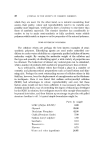
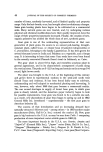
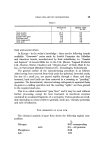
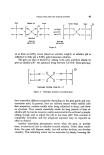
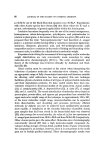
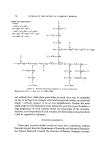
ODOR AND OPTICAL ACTIVITY 25 components as forerun, the last fractions, boiling at 71-72 ø at 1 mm being 99% pure. (Vda), (Vd [t), (Vla), (V l [t). These fractions were used for the odor comparisons. Pinoacetaldehyde (VI) 47 g t-pinocarveol {IV) were heated to 150 ø in a stainless steel autoclave for 150 min with 56 g ethyl vinyl ether and 0.1 g 85% H3PO 4. The trieth- anolamine neutralized product was distilled to give a mixture consisting mainly of pinoacetaidehyde and its diethyl acetai. The aidehyde acetai mixture was refluxed 10 min with 15 vol of 75% ethanol containing 0.1% HCl to split the acetai, the aidehyde combined by stirring with excess 25}/0 NailS03, and the non-combining impurities removed by repeated pentane extraction. The aidehyde was liberated with 10% NaOH and extracted with pentane. After drying, the pentane was removed by vacuum evaporation. In this manner the four pinocarveols (IVda, IV la, IVd [I, IV l [I) gave respectively the four pinoacetaldehydes (Vlda, VI la, VId [t, VIl [1) used for odor comparisons. Myrtenal diethyl acetal {VIII) In a typical run, 100 g t-pinocarveol (IV), 256 g water, 97 g sodium bichromate was reacted with 264 g H2SO 4 added over 1 h at 70 ø. The organic material, taken up in excess toluene, was washed neutral, and after solvent stripping, gave a mixture consisting mainly of myrtenai, pinocarvone, and unreacted pinocarveol on vacuum distillation. These components were not readily separable by fractionation. To 60 g of the mixture from the oxidation, 80 g triethyl o-formate and 300 g anhydrous ethanol, was added 8 drops conc. hydrochloric acid and the whole stirred at 25-30 ø for 120 min, drowned in excess 5}/0 KOH and extracted with pentane. The washed, dried, solvent stripped material was fractionated through a 60 cm protruded packed column at 9:1 reflux, which separated the myrtenai diethyl acetai from the non-reacting pinocarvone and other impurities which distilled as forerun. The acetai had B.P. 100 ø at 1 mm. In this way, the four oxidation mixtures gave the four myrtenai acetais {VIIIda, VIII la, VIIId [I, VIII l [t) in 97-90}/0 purity for odor comparisons. Myrtenal (VII) The diethyl acetal (VIII) was hydrolysed by distilling from 50 vol 33% ethanol containing 0.1% HC1. The aidehyde was extracted from the distillate with pentane, which was washed, dried and stripped.

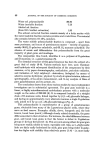
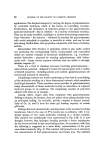
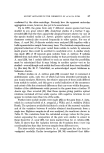
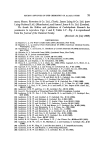
26 JOURNAL OF THE SOCIETY OF COSMETIC CHEMISTS In this way the four acetal preparations gave the four myrtenals (VIIda, VII l •, VII d [!, VII 1 •) substantially pure and free from acetal, for odor comparisons. Hydroxy citrondlol 1 and d 600 g commercial dextro citronellol ex d-citronellal refluxed 25 h with 600 g 85% phosphoric acid in 1 200 ml 50% aqueous acetone yielded, on work up, by washing, drying and fractionating dextro-hydroxy citronellol boiling 140-141 ø at 5 mm [ad] q- 2.3 ø (35% yield). In the same way commercial laevo-citronellol ex /-pinene gave laevo- hydroxy citronellol [ad] , --2.3 ø. Hydroxy citronellal 1-1, d-1 (Table I) 15.8 g hydroxy citronellol in 750 ml methylene chloride was oxidized to the aidehyde with 150 g chromium trioxide pyridine complex (5). The washed, dried, solvent stripped product was distilled on high vacuum and purified to approximately 98}/0 purity by prep-trapping. The exact purity of the test materials could not be established because of the tendency to dehydrate to citronellal on the glc column. Hydroxy citronellal d-2 was prepared in like purity by prep-trapping best grade commercial material. •UMMARY Evaluation by panels of five fragrance materials presented as two pairs of differently prepared d- and l- isomers gives significant evidence that the average nose can discriminate between the two optical forms. Individual ability, however, varies widely, and what may be called Specific Chiral Anosmia seems present in a significant percentage of experts including perfumers. (Received: 8th July 1970) REFERENCES (1) Sobotka, H., Bloch, E., Cahnmann, H., Feldbau, E. and Rosen, E. Cosmet., Studies on Ionone. II. Optical Resolution of dl-a-Ionone, J. Am. Chem. Soc. $õ 2061 (1943). (2) Naves, Y. R. Etudes sur les matiSres vegetales volatiles (XLVI1). Sur le dedoublement de la a, 1-a-ionone, Heloet. Chim. Acta 30 769 (1947). (3) Friedman, L. (private communication--to be published). (4) Kogami, K., Takahashi, F., Monda, M., and Kumanotani, J., A new synthetic route for hydroxycitronellal, Soap Perfumery Cosmet. 4•. 819 (1969}. (5) Dauben, W., Lorber, M. and Fullerton, S. Allylic oxidation of olefins with chromium trioxide-pyridine complex, J. Org. Chem. 34 3587 (1969). (6) Richter, F. and Wolff, W. l•lber katalytische Isomerisation des Pinens, Ber. õ91733 (1926).
Purchased for the exclusive use of nofirst nolast (unknown)
From: SCC Media Library & Resource Center (library.scconline.org)