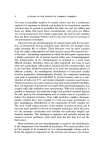
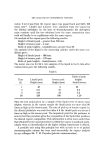
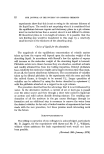
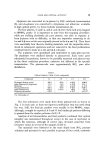
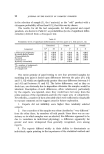
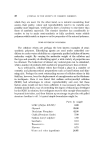
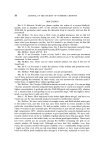
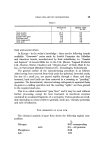
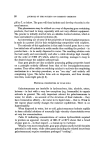
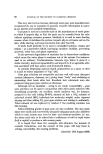
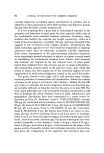
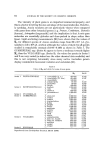
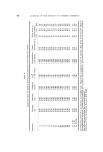
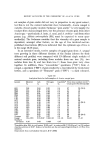
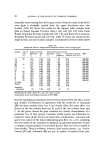
72 JOURNAL OF THE SOCIETY OF COSMETIC CHEMISTS wound or stimulus inducing gum production, it is not necessary botanically to propose that invasion by bacteria or fungi is involved. The mere ingress Table V Co•nparative analytical data* for some electrodialysed typical (QN1) and atypical (HW, BB) specimens of Acacia senegal gum QN1 HW BB(a) BB(b) BB(c) Ash, • 0.07 0.01 0.02 0.01 0.02 Nitrogen, • 0.33 0.35 0.25 0.21 0.28 Ifil, cm 33-1 19.9 20.6 16.4 15.8 20.1 (oc)D (c 1.0, water)P --31.0 ø --27.6 ø --30.5 ø --31.3 ø --31.5 ø Methoxylt• • 0.25 0.25 0.25 0.25 0.25 Equivalent weightt 1 085 1 047 1 066 1 065 I 060 Hence, uronic anhydride• õ % 16.2 16.8 16.5 16.5 16.5 Uronic anhydride•t • 17.2 17.5 17.4 17.3 17.5 Formic acid released on periodate oxidationt (mole g-') X 103 1.62 1.69 1.76 1.85 1.90 Periodate consumed• (mole g-i) x 103 5.07 5.18 5.23 5.34 5.42 periodate consumption Hence, 3.13 3.06 2.97 2.89 2.85 formic acid released Rhamnose•:• •o 14.0 6.2 13.0 12.6 12.8 Galactoset •o 40 46 43 43 44 Arabinose• • 28 30 27 27 26 Glucuronic acidt •o 16.0 16.5 15.5 15.5 15.5 4-o-methylglucuronic acid, l[ •o 1.5 1.5 1.5 1.5 1.5 *All data corrected to a dry-weight basis $corrected for all non-carbohydrate material :•deter- mined by vapour-phase, infrared methods õassuming that all acidity arises from uronic acid groups II assuming that all methoxyl content arises from 4-o-methylglucuronic acid. Reproduced from Carbohydrate Research, 6 97 (1968). of oxygen and the associated physiological disturbance could initiate gum- flow, and plant gums--which are extremely difficult to dehydrate com- pletely-may act as efficient natural "sponges" which seal off wounds and form a protection against complete local dehydration of tissue. Some samples of gum arabic tend to form mucilaginous gels rather than the desired viscous aqueous solutions. Since this is troublesome industrially, a great deal of commercial prejudice affecting marketing of the natural product has evolved over the years, and this is not always in the best interests of either the consumer or the producer. By insisting on paying top price for top quality gum, some purchasers mistakenly believe that they can acquire gum that will be free from gel-forming material. This can never be attained. The gum from some Acacia spp. is completely insoluble in water other species e.g.A. laeta (32) give an exudate that is water-soluble but forms gels --as is common with gums from other genera--at relatively low con-

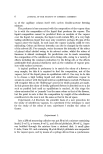
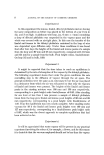
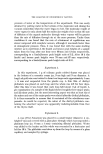
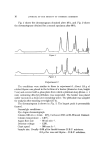
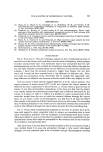
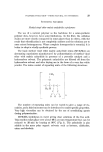
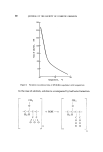
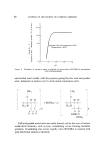
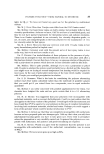
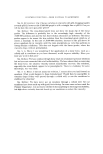
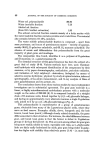
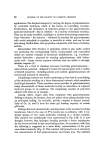
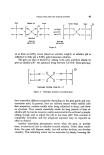
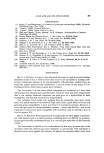
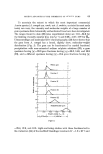
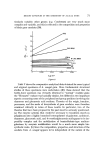
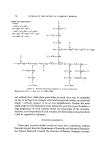
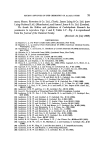
RECENT ADVANCES IN THE CHEMISTRY OF ACACIA GUMS 73 centrations (ca. 2-5%). In botanically authenticated Acacia senegal gum, gel-formation is a property of only a small proportion of nodules (3t3) the great majority of nodules are completely water-soluble, but some dissolve only partially, giving some gel, and in relatively very few cases the nodule swells to a gel but does not dissolve. Even the "best" grades of gum arabic will therefore be liable to this characteristic, which is innate. Direct mixture of soluble A. senegal gum with the gum from other Acacia spp. does not lead to gel-formation through any form of cross-reaction (3t3) but, of course, any bulk sample of A. senegal that contains other less desirable species will tend to yield larger proportions of gel. The gum from A. drepanolobium is not completely soluble, giving about 20% of insoluble, swollen gel: it therefore offered a convenient substrate for the study of an Acacia gel. A graded extraction procedure gave three gum fractions, and an analytical study did not reveal any significant differences in their chemical composition (41). Tests with various solvent systems showed that dissolution of the water-insoluble gel could best be achieved with cold 1% sodium borohydride solution. Smith-degradation and methy- lation analyses showed the water-soluble fraction to be very similar structnrally to the borohydride-solubilised gel. Molecular-sieve chromato- graphy subsequently indicated, and light-scattering measurements con- firmed (41), that the borohydride-solubilised gel had a much higher mole- cular-weight (Mw=2.2 X 10⁶) than the water-soluble gum (Mw=9.5 X 10⁵). The dissolution action of the borohydride must clearly break some bonds-- whether carbohydrate/protein bonds or bonds affecting carbohydrate moities alone has yet to be established--and therefore the value of 2.2 X 10⁶ for 2w must be taken to be much less than the true value for the gel material in its native state. In this review, emphasis has been placed on the studies made of A. senegal gum, since it is undoubtedly the species of greatest commercial interest. To indicate the very complex nature of such natural products, Figure $ illustrates one possible way in which the structure of Acacia senegal gum can be depicted: the formulation of a unique, unequivocal structure is, of course, not possible. There only remains space to state that similarly full structural studies have now been made of the gums from A. arabica (11), A. campylacantha (113), A. drepanolobium (12), A. laeta, (17), A. nubica (14) and A. seyal (15), and less complete studies of some other species have been made by other investigators. Structural variations be- tween gums of different species within Acacia are certainly more pro- nounced than was at one time supposed an early statement (42) that "it is
Purchased for the exclusive use of nofirst nolast (unknown)
From: SCC Media Library & Resource Center (library.scconline.org)