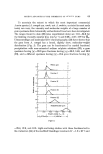
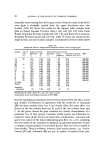
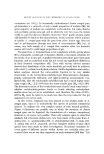
THE ANALYSIS OF ODORIFEROUS VAPOURS pressure of water at the temperature o[ the experiment. This xvas easily attained by putting water in the bottom o[ the desiccator and closing the vacuum connection when the water began to boil. The molecular weight of water vapour is only about half the molecular weight of air so that the rate of diffusion of the organic molecules through water vapour will be greater than the rate of diffusion through air at the same pressure. Under these conditions it was found that the rate of attainment of equilibrium was slower compared with complete vacuum, although it was much faster than at atmospheric pressure. Thus, it was found that with the same starting mixture as in experiment 8, the linalol and ionone peak heights of a sample taken from the loop after one hour were 68 mm and 13 mm respectively, corresponding to a linalol/ionone peak height ratio of 5.2. After 18 h the linalol and ionone peak heights were 79 mm and 87 mm respectively. corresponding to a linalol/ionone peak height ratio of 0.91. Experiment In this experiment, 1 g of culinary grade rubbed thyme was placed in the bottom of a cosmetic cream jar, 3 cm high and 3 cm diameter. A length of gold wire was twisted to form two loops each approximately 1 mm X 6 mm and suspended from the plastic cap. A thin film of diethyl phthalate was placed on each loop and the whole was left for four days. After this time it was found that each loop held about 3 gl of liquid. A glc examination of a sample of the liquid showed roughly three major peaks and 22 minor peaks, but the most interesting aspect was that at least six of the minor and one of the major peaks were eluted after the diethyl phthalate. It is thus reasonable to assume that it contained all the odoriferous com- ponents. As would be expected, the odour of the diethyl phthalate con- taining the adsorbed x?apour was apparently indistinguishable from that of the thyme itself. Experiment A rose (Pink Sensation) was placed in a small beaker (diameter 4 cm, height 7 cm) and covered with a glass plate through which was suspended a platinum loop (ca. 6 mm X 1 mm) containing dibutyl phthalate. Water was added to the beaker and the whole was evacuated in a desiccator and left for 18 h. The phthalate was taken up from the loop by means of a glass capillary and sampled by syringe.

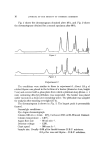
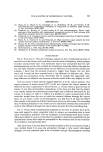
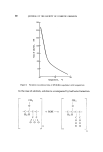
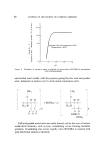
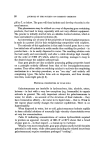
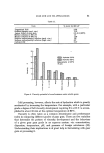
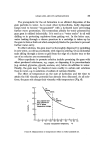
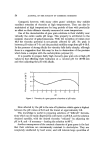
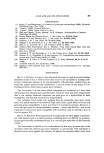
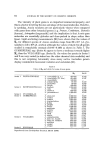
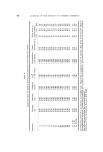
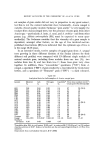
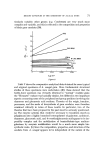
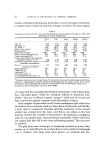
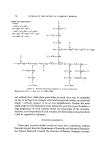
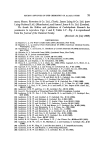
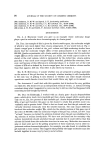
10 JOURNAL OF THE SOCIETY OF COSMETIC CHEMISTS Fig. I shows the chromatogram obtained after 18 h, and Fig. • shows the chromatogram obtained for a second specimen after 68 h. Figure 1 Figure l Experiment 7. The conditions were similar to those in experiment 6. About 1.8 g of rubbed thyme was placed in the bottom of a beaker (diameter 4 cm, height 7 cm) and covered with a glass plate from which a platinum loop (6 mm X 1 ram) containing dibutyl phthalate was suspended. The beaker was placed under vacuum in a desiccator containing water. The phthalate was sampled for analysis after standing overnight (17 h). The chromatogram is shown in Fig. $. The largest peak is presumably thymol. General glc conditions:-- Pye Argon chromatograph Column 120 cm X 4 mm 20% Carbowax •OM on 60-85 mesh Embacd. Column temperature - 140øC. Argon flow rate - 60 ml min-1. Detector voltage - 1250. Chart speed - 380 mm h-1. Sample size. Usually 0.08 gl for linalol-ionone-D.B.P. mixtures. 0.5 i•1 for rose and thyme - D.B.P. solutions.
Purchased for the exclusive use of nofirst nolast (unknown)
From: SCC Media Library & Resource Center (library.scconline.org)