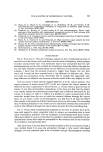
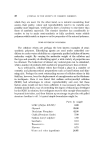
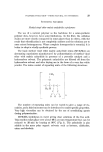
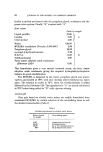
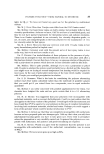
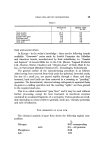
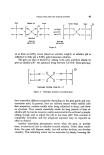
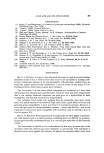
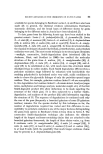
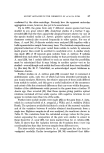
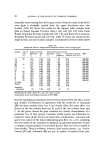
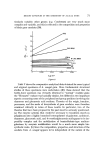
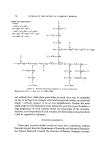
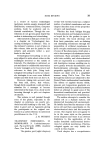
46 JOURNAL OF THE SOCIETY OF COSMETIC CHEMISTS Water sol. polysaccharide 86.50 Water insoluble fraction 7.75 Alcohol sol. fraction {from 24 h Soxhlet extraction) 1.50 The solvent extracted fraction consists mainly of a fatty matter while the water insoluble fraction contains proteins and crude fibres. The material also contains between 10-13% moisture. The water soluble polysaccharide fraction is composed - apart from some pentosans, and traces of proteinaceous matter - entirely of approxi- mately 36.6% D-galactose anhydride, and 63.1ø/0 mannose anhydride. The absence of uronic acid differentiates this polysaccharide from the great majority of plant gums and mucilages. The composition thus found, identifies it as a polymer of D-galactose and D-mannose, i.e. a galactomannan (5). The chemical structure of this galactomannan has been the subject of a great deal of study (6-8). Various methods have been used. Chemical: acid hydrolysis with subsequent identification of the components by their osazones, or by paper chromatography, methylation, periodate oxidation, and formation of tolyl sulphonyl- derivatives biological: by means of selective enzyme hydrolysis physical: by study of optical rotation, infra-red spectrography, stress-strain measurement, and X-ray analysis of films of pure galactomannan and its acetate, etc. The conclusions drawn from those various studies by many independent investigators are in substantial agreement. The guar gum molecule is a linear, or highly anisodimensional carbohydrate polymer with a molecular weight on the order of 220 000 {9). It is composed basically of a straight chain of D-mannose units, linked together by • {1--•4) glycoside linkages, and having on approximately every alternate mannose a single D-galactose unit, joined to it by an a (1-•6) glycoside linkage {Fig. 1). This polysaccharide is representative of a group of galactomannan gums, obtainable from many of the Leguminosae plants' seeds, where they serve as food reserve. Examples: alfalfa, clover, fenugreek and, the best known, locust bean {carob.) Although closely related chemically, the gums differ somewhat in their structure. For instance, the chief difference between guar, and locust bean gums is that the former is richer in D-galactose groups (1: 2) than the latter (1: 4). This accounts among others for guar gum being more readily soluble in water, especially cold. Also, as 1-•6glycosidic links are fairly easily hydrolysed by acids, guar gum being richer in galac- rose has higher acid stability than relatively poorer (1: 4) - i.e. more easily

GUAR GUM AND ITS APPLICATIONS •HzOH H OH [ C.H•OH Figure 1. 47 "stripped" locust bean gum, which fairly rapidly loses its viscosity in acidic media. There exists a galactomannan which is even richer in galactose than guar gum, and has correspondingly different properties. It is obtained from seeds of Fenugreek plant (Trigonella Foenum Graecum) (10). Further processing of crude guar flour consists of preparing a mucilage, which after autoclaving to destroy possible enzymes is freed from the insoluble part by centrifugation (supercentrifuge, 40 000 rev min-1). From such clarified mucilage, the galactomannan is then precipitated in various fractions by the gradual addition of ethyl alcohol. Those fractions are then filtered, dried, milled and blended to a desired grade to meet a wide variety of industrial process and product needs. The "natural" galactomannan grades, differ mainly in their purity, particle size, dispersion properties, rate of hydration and viscosity potential. They are whitish powders, with bland taste, edible, but with relatively little nutritional value. They meet the requirements of the U.S. Food and Drug Administration (G.R.A.S.) and on account of that and their other beneficial properties are used extensively in the American Food Industry. Guar gum may be identified among others by its perfect solubility in cold water resulting in a viscous sol which gives a gel-like complex with 23 Fehling, and borax solutions, and exhibits specific rotation {a) • q- 60 in 0.6N NaOH. Further possible processing of guar gum depends on chemical modifica- tions. Various treatments are instrumental in developing functional charac- teristics that make this gum versatile and useful in a variety of industrial
Purchased for the exclusive use of nofirst nolast (unknown)
From: SCC Media Library & Resource Center (library.scconline.org)