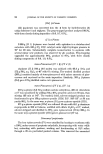
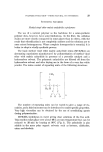
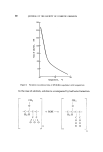
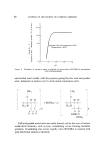
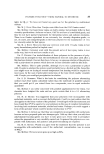
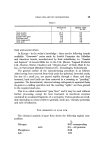
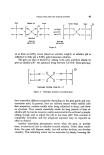
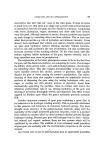
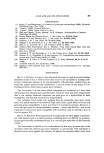
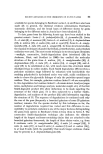
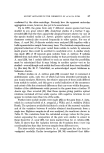
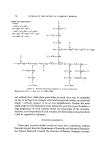
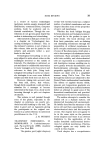
48 JOURNAL OF THE SOCIETY OF COSMETIC CHEMISTS applications. The simplest change is by varying the degree of polymerization by controlled hydrolysis which is the means of controlling viscosity. Furthermore, the abundance of hydroxyl groups in the galactomannan molecule lends itself - like in cellulose - to a variety of chemical reactions. They can be easily esterified, resulting in a variety of interesting compounds. Guar triacetate - for instance - obtained by reacting the galactomannan with acetic anhydride in pyridine, is insoluble in water, and can be cast into strong, flexible films, with properties comparable with those of cellulose acetate. Alkoxylation with ethylene or propylene oxides is also easily carried out producing the corresponding ethers. Carboxyalkyl and cyanoalkyl ethers are another example of functional modifications, e.g. o-carboxy- methyl derivative - prepared by reacting galactomannan with chloro- acetic acid - forms viscous aqueous solutions that are stable to strongly alkaline reagents (1). There are a host of chemical processes involving galactomannans - some of them patented - designed to endow the natural gums with a variety of desired properties - including anionic and cationic (galactomannans are neutral and nonionic in character). ½omplexing reactions are worth mentioning as they lead to cross linking of the molecules resulting in a three dimensional network which manifests itself in gel formation. These reactions are not peculiar to galactomannans, being characteristic of linear molecules having an abundance of adjacent hydroxyl groups in cis positions. The complexing reaction of polyvinyl alcohol with borax is an example. Among others, copper salts form complexes with galactomannans. Fehling's solution, for instance, does not reduce those polysaccharides even on prolonged boiling. An insoluble, gel-like complex is formed instead. Salts of Ca, A1, and Cr have the same gel forming capacity at certain pH levels. Perhaps the most characteristic, and important, is the reaction involving borate ions. Like in the case of PVA borate ion co-ordinates with 4 hy- droxyl groups of two chain molecules, resulting in a di-diol complex. This reaction has traditionally been represented by Fig. 2 (3). It is now thought, however, that hydrogen bonding provides a better explanation for the forces involved in tiffs cross-linking action. In accordance with tiffs, the following is suggested as a more likely representation of the guar cross-linked molecule {Fig. $). This reaction will proceed even at extremely low concentration of both galactomannan and borate ions. The addition

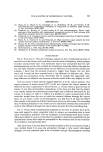
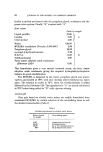
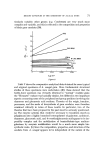
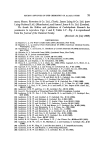
GUAR GUM AND ITS APPLICATIONS 49 Guar Binate ion Guar Cross- linked Guar • • pH •8-0 ' , '• H•C•OH HO•C•H pH• 7.0 • •0 / •0 • Hydrated • • Guar sol Guar gel (pH •7.0 ) (pH •8-0) of as little as 0.05% borax (based on solution weight) at alkaline pH is sufficient to fully gel a 0.25% galactomannan solution. The gels can also be formed by adding boric acid, and then alkalis to give an alkaline pH - the optimum being between 7.5-10.5. These gels may (Hydrogen bonding shown by ..,) Figure 3. Hydrogen bonded cross-linked guar have somewhat different properties depending on the gum grade and con- centration used. In general, they are rubbery masses which exhibit cold flow properties, coalesce readily after being subjected to shear, and show no syneresis. They remain essentially stable for long periods of time at alkaline pH, but can be, however, easily reconverted to the sol form by simply adding enough acid to adjust the pH to less than pH7. This reaction is completely reversible, and the sol-gd-sol sequence may be repeated as often as desired. Another interesting phenomenon occurs when the gum, in powder form, is introduced into an alkaline borated solution. Under these condi- tions, the gum will disperse easily, but will neither hydrate, nor develop viscosity. This inhibiting action can be overcome by simply lowering the
Purchased for the exclusive use of nofirst nolast (unknown)
From: SCC Media Library & Resource Center (library.scconline.org)