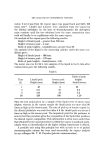
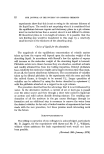
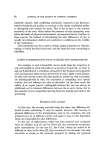
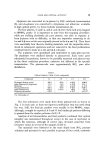
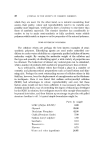
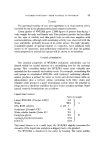
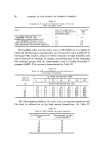
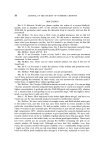
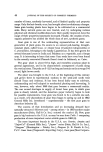
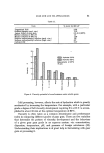
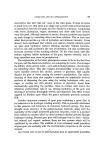
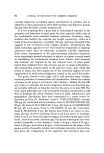
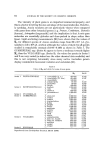
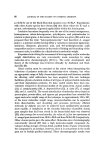
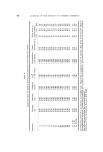
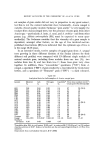
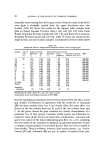
64 JOURNAL OF THE SOCIETY OF COSMETIC CHEMISTS The viscosity of plant gums is an important commercial property, and this is a factor involving the size and shape of the macromolecules. Relative- ly speaking, Acacia exudates are not particularly viscous when compared with gums from other botanical genera [e.g. Prunus, Combreturn, Sterculia (karaya), Astragatus (tragacanth)• and the implication is that Acacia gum molecules are essentially globular and close-packed in shape rather than linear. Light-scattering measurements (20) have shown that the values of M'-w for different species of Acacia exudates range from 60X 103 (A. pyc- nantha) to 2.3X 10⁶ (A. arabica) although the values of dn/dc for all species studied is remarkably constant (0.144•0.149) as shown in Table I. The GUMMIFERAE spp. (Series 4) appear to have a tendency towards higher M'-w than the VULGARES spp. (Series 5) the values for species in Series 1 and 2 are very varied (as indeed are the other chemical data available) and this is not surprising botanically since many native Australian genera display considerable taxonomic variation and endemism (21). Table I Value of •w and dn/dc for some Acacia gums •lw dn/dc Series 1. PHYLLODINEAE A. cyanophylla (S. A.) 470 000 0.146 A. cyanophylla (W. Aus,) 610 000 0.147 A. cyanophylla 183 000 -- A. podalyriifolia 74 000 0.146 A. pycnantha 60 000 0.149 A. rubida 430 000 0.145 Series 2. BOTRYOCEPHALAE .4. dealbata 1 200 000 0.145 A. elata 70 000 0.145 A. rnearnsii 460 000 0.148 .4. parramattensis 1 220 000 0.146 Series 3. PULCHELLAE -- -- -- Series 4. GUMMIFERAE A. adansonii 2 360 000 0.146 .4. arabica 2 300 000 0.146 A. arablea 1 870 000 0.146 A. drepanolobiurn 950 000 0.144 A. fistula 740 000 0.145 A. giraffae 1 780 000 0.146 `4. karroo 1 460 000 0.145 A. rnultijuga 625 000 0.145 A. nilotica 2 270 000 0.146 A. nubica 870 000 0.147 A. seyal 850 000 0.149 A. tortills 580 000 0.147 Series 5. VULGARES A. campylacantha 300 000 0.147 A. laeta var. hashab 725 000 0.144 A. laeta vax. rnellifera 670 000 0.145 A. rnellifera 640 000 0.146 A. senegal 580 000 0.146 A. senegal 600 000 0.146 Series 6. FILICINAE -- __ -- Reproduced from Carbohydrate Research, l0 161 (1969)

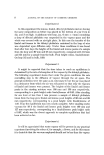
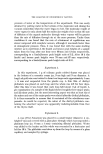
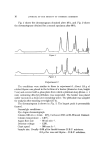
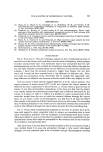
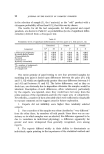
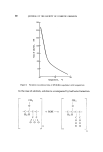
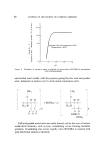
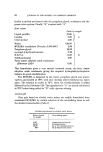
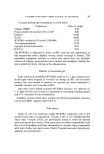
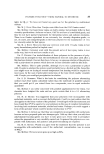
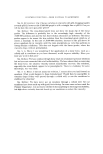
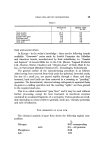
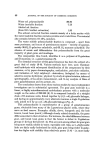
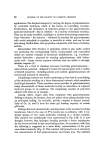
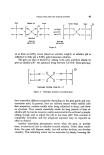
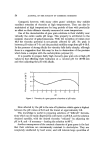
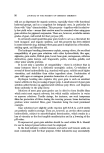
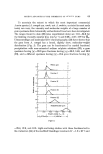
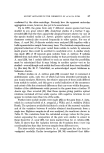
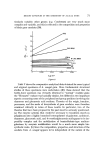
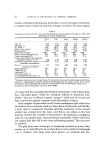
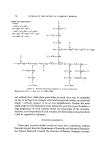
RECENT ADVANCES IN THE CHEMISTRY OF ACACIA GUMS To ascertain the extent to which the most important commercial Acacia species (A. senegal syn. verek not A. arabica, as stated in most early texts) can vary, the viscosity and molecular weights of a large number of gum specimens from botanically authenticated trees have been investigated. The ranges found to date (22) (also unpublished data) are 11.0--24.6 for the limiting viscosity number ([q], (cmS g-l) and 0.26•1.16 x 10⁶ for Ultracentrifuge and molecular-sieve chromatography (23) have shown that the gum from A. senegal has a broad, slightly skew, molecular-weight distribution (Fig. 1). The gum can be fractionated by careful fractional precipitation with near-saturated sodium sulphate solutions (23) a gum specimen having [q] =20.0 gave fractions having [q] =33.5, 14.8, and 10.8 (23), and a different specimen having [q] = 16.4 gave fractions having [•1] i I 0.5[ ••le gum 0 • I 0.5 - I 02 - • Fraction TI- •tion TIT 0.5 0 1 I - • Fraction • 0.•- o • I , 0.5 I I 0 200 Vo= 270 mt V• = 664 m • I Autohydrolysed gum I 400 600 800 I000 Figure 1 =25.4, 12.9, and 12.5. Light-scattering studies with these fractions led to the evaluation (24) of the modified Staudinger constants K' = 1.3 x 10⁻² and
Purchased for the exclusive use of nofirst nolast (unknown)
From: SCC Media Library & Resource Center (library.scconline.org)