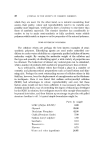
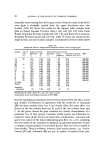
62 JOURNAL OF THE SOCIETY OF COSMETIC CHEMISTS viscosity improvers, as binding agents and fixatives in powders, and as adhesives in other preparations where their inclusion also improves spread- ing and other desirable cosmetic properties (4). It is not surprising that a great deal of technological expertise in the properties and behaviour of plant gums has been acquired within some of the traditionally craft-controlled chemical industries. Doubtless, where tradition dies hardest, the expertise was bought expensively--either as a result of sheer inexperience, or possibly through capricious disregard of the vagaries of one of Nature's most complex products. Unfortunately this dated technology appears to have been based too frequently on empirical experience rather than on competent, acceptable scientific experiment. Even today, management in the gum-consuming industries frequently shows surprisingly marked reluctance to initiate or support research aimed at establishing the fundamental chemical facts. Errors--both botanical and chemical--are frequent in the few classical texts on plant gums: indeed those published more than 10 years ago are no longer authoritative. The fundamental progress made in the past five years, upon which this review is based, has been largely due to the continued support of a few organisations, to which acknowledgement is made at the end of this article. The genus Acacia is very large, and it still provides many complex botanical problems of nomenclature and classification. Indeed the number of species in the genus is not known with certainty. Tindale (5) lists 616 spp. native to Australia the known indigenous African and American spp. are probably sufficient to bring the total for the genus to at least 900. The most useful (although now very incomplete) botanical classification is still that of Bentham (6), whose divisions, based on habit, inflorescence, and geographical distribution, have been summarised in a recent review by Anderson and Dea (7). Bentham's Series 1, PHYLLODINEAE, contains 570 spp (5), subdivided into 8 sub-series Series 2, BOTRYOCEPHALAE, 32 spp. (5) Series 3, PULCHELLAE, 14 spp. (5) Series 4, GUMMIFERAE, 60 spp. (6), 3 sub-series Series 5, VULGARES, 75 spp. (6), 4 sub-series Series 6, FILICINAE, 2 spp. (6). Species from Series 1 are native to Aus- tralia, Hawaii, and New Caledonia Series 2 and 3 are native to Australia Series 4 and 5 are found throughout tropical and semi-tropical parts of the world Series 6 are South American spp. The species whose gums have been studied chemically to date belong to Series 1 (6 spp.), Series 2 (5 spp.), Series 4 (13 spp.) and Series 5 (6 spp.) a full discussion of the names of the species and the frequently complex and confusing synonymy involved has been given (7). Comparisons of the analytical and structural data now

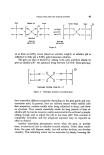
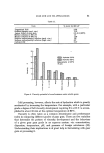
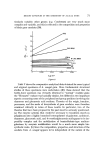
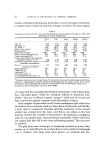
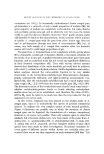
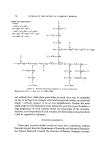
RECENT ADVANCES IN THE CHEMISTRY OF ACACIA GUMS available for species belonging to Bentham's series 1, 4, and 5 have also been made (7) in general, the chemical evidence substantiates Bentham's taxonomic divisions, and the broad bases of difference shown by gums belonging to the different series in .4 ½a½ia have been tabulated (7). To date, gums from the following .4½•½i• spp. have been studied to the greatest extent:- Series 1--A. podalyriifolia (8), A. pycnantha (9): Series oe--A. data (8), A. mearnsii (10) Series 4--A. arabica (11), A. drepanolobium (12), A. nilotica (13), A. nubica (14), and A. seyal (15) Series •--A. campy- lacantha (16), A. laeta (17), and A. senegal (18). In these structural studies, the classical techniques of graded hydrolysis, permethylation, and periodate oxidation were used. The most recent technique in structural gum chemistry --multiple, consecutive, Smith-degradations {first introduced (18) by Anderson, Hirst, and Stoddart in 1966)•has enabled the molecular structure of the gums from A. arabica, (11), A. campylacantha (16), A. drepanolobiura (12), A. laeta (17), A. nubica (14), A. senegal (18), and A. seyal {15) to be established so far, with much more fine structural detail elucidated than in earlier studies. Each Smith degradation (19) involves a periodate oxidation stage followed by reduction with borohydride the resulting polyalcohol is hydrolysed under very mild, acidic conditions in order to cleave the glycosidic linkages of only the periodate-opened sugar residues. Thus, for example, galactose residues linked 1-+6 are susceptible to this degradation but residues linked 1-3 remain intact. Analyses (sugar ratios, methylation and linkage analysis, molecular-weight etc.) of the first Smith-degraded product (S1) allow deductions to be made regarding the structure of the whole gum. S1 is then subjected to a further Smith- degradation, and analyses of the product (S2) yield information regarding the structure of S1. The sequence of degradations is continued until only the core of the gum {frequently a branched galactan of some 25 galactose residues) remains. For the species studied by this technique so far, the number of degradations required has varied and this difference in sus- ceptibility to periodate oxidation is one of the major features distinguishing the gums from species in Bentham's Series 4 from those in Series 5. The consecutive Smith-degradation technique also indicates the effective length of the longest arabinose-containing chains that are attached to the branched galactan framework the length of these chains varies, e.g. from 3 arabinose units [A. campylacantha (16)], 4 units [A. senegal (18)], 5 units [A. laeta (17)], at least 6 units [A. arabica (11) and A. nubica (14)], to at least 8 units (with the possibility that much longer arabinose chains may be present) in A. drepanolobium gum (12).
Purchased for the exclusive use of nofirst nolast (unknown)
From: SCC Media Library & Resource Center (library.scconline.org)