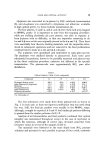
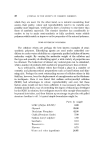
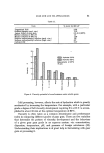
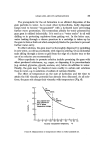
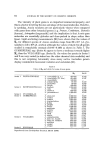
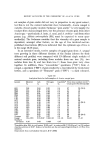
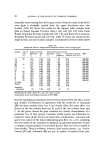
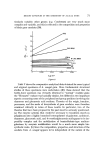
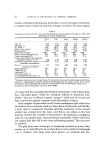
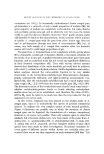
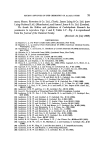
ODOR AND OPTICAL ACTIVITY 23 the danger of accepting individual judgements as absolute. For example, expert A had not the slightest difficulty sorting d and/-pinocarvyl pro- pionates, but found d- and/-pinoacetaldehydes "all the same". Expert B, recognized as equally competent in general, was able to sort the pino- acetaldehydes, but found no difference in the propionates. Such behaviour suggests prevalent specific anosmias, which in the absence of other evidence may be confined to optical isomers and for which the term "Chiral Anosmia" is proposed. Ability to discriminate seems to be helped by using a reference point from past experience, at least in part. This might explain the ready sorting of the carvones since they smell like the known spearmint and caraway oils. In the present series, one of us (E.T.T.) had no difficulty with the pinoacetaldehydes since the laevo had a "hydroxycitronellal" character and the dextro reminded of cyclohexyl acetaldehyde. In the same way, l- and d-pinocarveols were easily separated by reminding of geraniol palmarosa and camphor respectively, and d- and /-myrtenals suggested cuminic aldehyde and again cyclohexyl acetaldehyde respectively. Obviously, such reference points are available in greater number to the experienced than to the lay panelist. 4. Ability to perceive d-l differences fails off due to fatigue as was seen by greater consistency in the first of two consecutive pairings with both panels. EXPERIMENTAL The preparative trapping of the pinenes was carried out at 125 ø on a 2 m X 10 cm column packed with 20% Carbowax 20M on Chromosorb W (250-590 gm). The selected cuts were analysed by capillary glc on a 60 m X 0.5 mm column coated with Carbowax 20M. The optical rotations of the final products are shown in Table I. (Id) a-Pinene Greek turpentine oil, 91% in a-pinene gave, on prep-trapping, a-pinene 98% containing closely eluting impurities of 1.3, 0.4, 0.3%. (II l) •-Pinene A commercial cut of American sulfate turpentine (Arizona Chemical Co.) 97.7% •-pinene gave, on prep-trapping, •-pinene 98.2%, containing one closely eluting impurity of 1.5%.

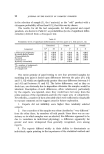
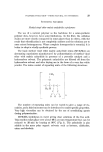
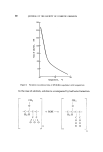
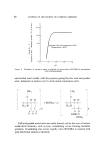
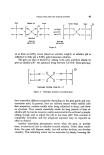
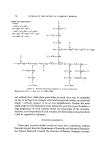
24 30URNAL OF THE SOCIETY OF COSMETIC CHEMISTS (Hd) •-Pinene (Id) (a-pinene) was converted into the 15 form by hydroboration {4) using dodecene-1 and triglyme. The prep-trapped product analysed 98.13}/o with three closely eluting impurities of 0.13, 0.7, 0.5%. (I l) a-Pinene 2 000 g (II l) [t-pinene were heated with agitation in a stainless steel autoclave with 100 g 5}/o Pd/C catalyst under slight hydrogen pressure to 70 ø for 20 min. Substantially complete isomerization to a-pinene with several minor new products was observed by glc analysis. Prep-trapping upgraded the approximately 94ø/0 product to 97% with three closely eluting components of 0.8, 1.0, 0.5%. trans-Pinocarveol (IV 1 •) (IV d •) [t-pinene (II l) 544 g (4.0 moles) was oxidized with 65.13 g Se02 and 272 g 50}/o aq. H20•. at 40 ø with 6 h stirring. The washed distilled product (13513 g) consisted mainly of trans-pinocarveol with minor amounts of pino- carvone and myrtenal as the main impurities. Similarly, 13513 g I•-pinene (IId) gave 1713 g distilled centre cut t-pinocarveol. trans-Pinocarveol (IV d a), (IV l a) 272 g a-pinene (Id) 54 g sodium acetate anhydrous, 400 ml chloroform at 0 ø was epoxidized by adding 1314 g 40% peracetic acid over 55 min, then stirring 1135 min at 0-5 ø. The washed, dried, solvent stripped product was fractionated to give 150 g a~pinene epoxide (IIId) B.P. 105-115 ø at 50 mm purity 98%. In the same way, a-pinene (I l) gave a-pinene epoxide (III/). 571 g a-pinene epoxide (IIId) was refluxed 10 min with 45.1 g aluminum isopropoxide in 500 ml toluene, acidified with dilute H2SO 4 at 0 ø, washed, solvent stripped and distilled to 90ø/0 pure t~pinocarveol {IVda) 1328 g. In the same way a-pinene epoxide (III l) gave t-pinocarveol (IV l a). Pinocarvyl propionates The four t-pinocarveols (IV) were esterified by heating to exotherm with a 100% molar excess of propionic anhydride, decomposing with water while hot, extracting with pentane, washing and fractionating at 10/1 reflux through a 25 cm protruded packed column. This removed the unreacted
Purchased for the exclusive use of nofirst nolast (unknown)
From: SCC Media Library & Resource Center (library.scconline.org)