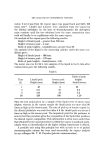
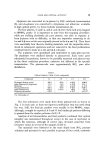
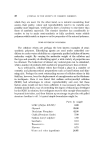
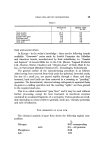
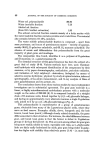
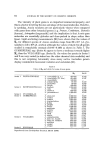
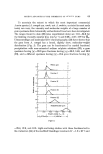
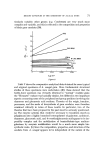
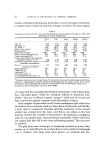
THE ANALYSIS OF ODORIFEROUS VAPOURS 13 REFERENCES (1) Flath, R. A., Black, D. R., Guadagni, D. G., McFadden, W. H. and Schultz, T. H. Identification and organoleptic evaluation of compounds in delicious apple essence. J. Agr. Food Chem. 1õ 29 (1967). (2) Teranishi, 1•., Buttery, 1•. G. and Lundin, 1•. E. Gas chromatography. Direct vapor analyses of food products with programmed temperature control of dual columns with dual flame ionization detectors. Anal. Chem. 84 1033 (1962). (3) l•ushneck, D. 1•. Cryogenic injection and chromatographic separation of cigarette smoke. J. Gas Chrometog. 8 318 (1965). (4) Flath, 1•. A., Forrey, 1•. 1•. and Teranishi, 1•. High resolution vapor analysis for fruit variety and fruit product comparisons. J. Food Sci. 84 382 (1969). (5) Newer, W. W. Some considerations in interpretation of direct headspace gas chromato- graphic analysis of food voletiles. Food Technol. 9,0 115 (1966). (6) Clerk Maxwell, J. Phil. Meg. 8õ 185 (1868). (7) Gilliland, E. 1•. Diffusion coefficients in gaseous systems. Ind. Eng. Chem. 9,6 681 (1934). DISCUSSION MR. J. RID•.INaTON: This new technique appears to show considerable promise of practical use in the future, and I note that it has the merit of simplicity, which perhaps is rather unusual these days. You mentioned that it was unexpected that the rate determining step was the rate at which the odoriferous molecules diffused through the air, and what surprised me particularly was the difference in rate bet•veen linalol and a-ionone. I know that the adonone molecule is bigger than linalol, but not that much and I would not have expected such a big difference in diffusion rate. Have you made any calculations on the theoretical side to explain this apparently very large difference in diffusion rate between molecules which differ only slightly in size? THE LECTURER: I think that the biggest difference is in the vapour pressure. The vapour pressure of ionone around 20øC is 0.01 mm whereas the vapour pressure of linalol at the same temperature is about 0.2 mm, i.e. twenty times as great as that of ionone. If you take intermediate compositions of the drop you find that the linalol very rapidly reaches its maximum glc peak height and is followed afterwards by the ionone, as is shown in Table I. I believe it is possible to make a measurement of the molecular weight from the rate at which the material diffuses through the vapour space. If you make a series of chromatograms, you find first of all that the linalol rises quickly to its maximum followed much more slowly by the ionone. The absorbing drop of dibutyl phthalate is very small and it is absolutely essential that it should be small so that diffusion through the vapour phase becomes the rate controlling step. DR. V. KLEIN: Most manufacturing industries at one time or another have prob- lems with regard to odour emanation which in essence are something akin to head space examination problems. Has the technique of determining head space compo- sition been refined to such an extent that it is possible to determine quantitatively and qualitatively odours that might be perceptible to the ordinary nose at the boundary of an ordinary manufacturing unit? THE LECTURER: I am sure that it would be possible in fact in our factory we get a very decided blank if we pass the atmosphere through a tube cooled with liquid nitrogen you can condense quite a lot of material and get chromatograms showing

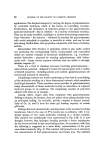
14 JOURNAL OF THE SOCIETY OF COSMETIC CHEMISTS almost everything that is used in the factory. We have not studied it quantitatively, but it is actually a nuisance in this kind of work. MR. L. Gr.ArJsirJsz: Could you describe in some detail how you decide upon the proportions, especially in the head space ? THE L•CTrJRER: The vessel that was used in some of this work consists of a jar covered by a glass plate with a piece of wire going through it. To analyse the yapours of a rose you need a vessel large enough to contain the flower without crushing, but it still should not be bigger than necessary. In the experiments described, the rose was put into a beaker and the platinum wire with the drop of dibutyl phthalate was suspended from the cover. The whole was then put into a desiccator which was evacuated to about 20 mm. The vacuum is important because the diffusion rate is inversely proportional to the pressure. DR. J. D. BAC•HrJRST: If a drop of, say, dibutyl phthalate is suspended above a rose in a closed system, is the distribution of components in the dibutyl phthalate when equilibrium is reached the same as that obtained by solvent extraction of the rose by dibutyl phthalate? Tr•E L•-CTrJR•.R: Are you wondering why dibutyl phthalate was chosen? DR. J. D. BXCKHrJRS•: No, if you use any solvent--I chose dibutyl phthalate because you had used it with your rose--would you get the same chromatogram if you had actually extracted the rose with dibutyl phthalate? THE LEC•rJR•-R: That may be so if the extraction is only partial, but you must remember that the equilibrium is produced specifically for dibutyl phthalate. If I had used another high boiling solvent, say a hydrocarbon, then I would not necessarily get the same chromatogram because the concentration of absorbed volatile material required to produce a given vapour pressure depends upon the polarity of the solvent. One thing is certain--if I had used a hydrocarbon instead of dibutyl phthalate then I would still get a composition in the hydrocarbon which would reproduce the odour of the rose. The liquid composition would be different because you are using a non-polar absorbing solvent, but the vapour composition would be the same. You know, for example, that water in a perfume suppresses the partial vapour pressure of phenylethyl alcohol. The same composition containing phenylethyl alcohol made up in, say, medicinal paraffin or something similar, instead of aqueous spirit, would have a much higher partial pressure of phenylethyl alcohol and it would smell different. Probably dibutyl phthalate is just about equivalent to alcohol, so that it would be better in that respect. MR. J. H•CKFOR•H-JoN•s: Perfumers are familiar with the differences between the odours of products smelled statically--as when wrapped--or smelled dynamically, their perfumes wafted around by convection currents. Do you intend to examine the effect of convection on the experiment? THE LECTURER: That point has not been considered in the present work, but it may be connected with the composition of the drop at some intermediate time before equilibrium has been established.
Purchased for the exclusive use of nofirst nolast (unknown)
From: SCC Media Library & Resource Center (library.scconline.org)