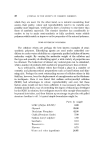
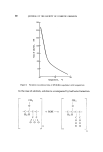
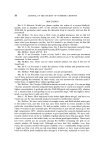
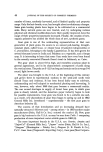
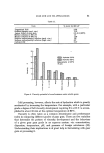
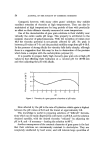
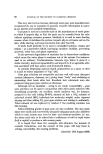
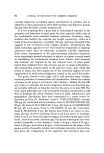
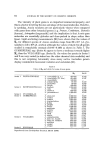
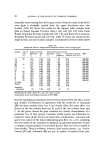
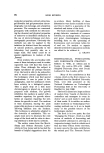
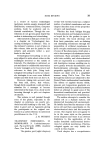
52 JOURNAL OF THE SOCIETY OF COSMETIC CHEMISTS As can be seen from Fig. 5, the incremental increases in the gum concentration result in almost exponential increases in viscosity up to a concentration of about 1.5%. At concentrations higher than about 3% (depending on a grade), guar gums form jelly4ike pastes which, however, are not true structural gels. .[ I00,000 1,000 I00 Concen'l'rafion, % Figure •. Variation of viscosity with concentration. For comparing viscosities of guar gums a "standard" concentration of 1.0% (w/v) is used as a rule. Quantitative measurements are best carried out with a torsion viscometer(e.g. Brook field RVF, Syncro-Lectric type with a No. 3 spindle at 20 rev min- •), although for qualitative comparisons other methods like, for instance, "Ford" cup, may be employed. It is essential to state the method of measurement while quoting viscosity. Guar gum solution viscosities - in common with most other hydro- colloids - are strongly dependent on shear rate, and can be more properly described as "apparent viscosities". In short, guar gum sols are thixotropic having, however, a relatively low yield value.

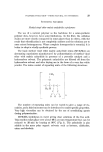
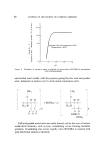
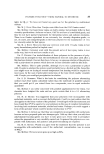
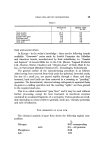
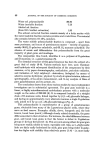
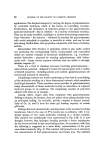
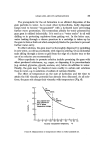
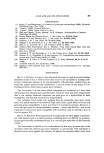
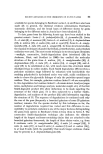
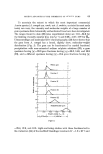
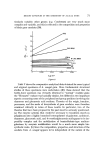
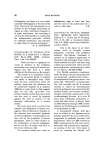
GUAR GUM AND ITS APPLICATIONS 53 The prerequisite for the sol formation is an efficient dispersion of the gum particles in water. As in most other hydrocolloids, badly dispersed lumps tend to become "encapsulated" with a hydrated layer preventing further water penetration. The tremendous affinity for water possessed by guar gum is utilized industrially. It is used as a "water sealer" in oil well drilling or in protecting explosives from getting wet. In the latter case, water leaking through a chance puncture in a cartridge is taken up by the gum to form a thick sol which completely blocks the puncture to prevent further water entry. To effect solution, the gum must be thoroughly dispersed by sprinkling it onto water, as cold as practicable, with vigorous stirring. On an industrial scale sifting through a screen or grid from the edge of a shaker tray or the use of an eductor are recommended. Other expedients to promote solution include premixing the gum with other powdered substances, e.g. sugar, or dispersing it in pre-retardants (e.g. alcohol, glycerine, glycols, acetone, etc.) before its addition to water. Finally, the gum may be dissolved more readily in certain salt solutions than in water, e.g. in solutions of sodium of calcium chloride. The effect of temperature on the rate of hydration and the time to attain the full viscosity potential has already been discussed. As all solu- tions, the guar sols change their viscosity with temperature (Fig. 6). 60 5O 40 3O 20 On S01s prepared and ! '•e•ring fully hydrated 25* C before temperature chencje - I I ß _ I I I -•o c• Io 2o 3o 40 50 o 7o Bo 9o Viscosity measurement temperature, øc Figure 6. Measurement of temperature effect on fully hydrated sol.
Purchased for the exclusive use of nofirst nolast (unknown)
From: SCC Media Library & Resource Center (library.scconline.org)