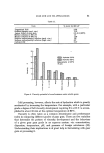
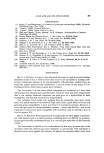
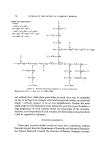
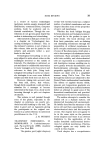
44 JOURNAL OF THE SOCIETY OF COSMETIC CHEMISTS number of items, randomly harvested, and of limited quality and property range. Only the last decade, or so, has brought about revolutionary changes. Some gum bearing plants have begun to be cultivated on a commercial scale. Many natural gums are now treated, and, by undergoing various physical and chemical modifications have their quality improved, have the range of their properties immensely increased. Finally, the creation of new, organic polymers has yielded the whole class of new, synthetic gums. Guar gum is one of the outstanding representatives of that new generation of plant gums. Its source is an annual pod-bearing, drought- resistant plant, called Guar, or cluster bean (Cyamopsis tetragonolobus or C. psoraloides), belonging to the family Leguminosae. It has been grown for several thousand years in India and Pakistan as a vegetable, and a forage crop. It is interesting to learn that some Guar seeds have even been found in the recently excavated Pharaoh Zoser's tomb in Sakkarah, nr. Cairo. The guar plant is about 0.6 m high, and resembles soyabean plant in general appearance, and in its characteristic arrangement of pods along the vertical stem. The pods are 5-12.5 cm long and contain on the average 5-6 round, light brown seeds. The plant was brought to the U.S.A. at the beginning of this century and grown there in experimental stations in the semi-arid south west {South Texas and Arizona). It has been found fairly easy to cultivate, undemanding and well adapted to mechanical planting and harvesting. It was, however, only about 1940 that guar became a commercial reality. The war caused shortages in supply of locust bean gum, to which guar gum is closely related, and the American paper industry began to look for possible replacements. Guar gum was found to be a suitable one and, as a result, new plantations of guar bean began to spring up and in 1942 General Mills Inc. introduced - experimentally - the first guar gum to American industry (2). The success of that introduction and an increasing demand have naturally attracted followers and - among others - in 1953 another major manufacturer (Stein, Hall & Co. Inc.) entered the market (3). Now, guar gum is big business in the U.S.A. as may be seen from Table I comparing production of more important water soluble gums in 1963 (4). The more important brands in the U.S.A. are: Guartec, Arearex and "SuperCol" (General Mills Inc.), "Jaguar" series (Stein, Hall & Co. Inc.), "Starguar" (Morningstar - Paisley Inc.), Penguar (S. B. Penick & Co.), T.I.C. Guar Gum {Tragacanth Importing Corp.), Guargum (Meer Corpora-

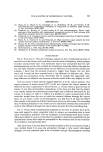
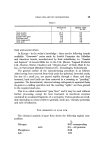
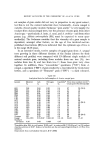
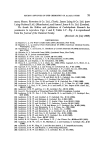
GUAR GUM AND ITS APPLICATIONS Table I Gum Arabic Gum karaya Locust bean gum Psyllium seed Gum tragacanth Guar gum Production t 21.0 10.0 8.0 3.0 1.6 26.0 Market value $ x 106 5.2 5.1 2.7 1.0 7.2 7.8 45 tion) and several others. In Europe - to the writer's knowledge - there are the following brands available: "Guaranate" series made by Socidtd Fran9aise des Colloides and American brands, manufactured by their subsidiaries, i.e. "Guartec and Supercol" of General Mills Inc. in the U.K. (Messrs. Tragasol Products Ltd., Hooton, Wirral, Cheshire) and "Meypro-Guar" of Stein, Hall & Co. Inc., in Switzerland (Meyhall Chemical AG - Kreuzlingen, Switzerland.) The general outline of the manufacturing procedure is as follows: After having been removed from their pods the spherical, brownish seeds, the size of a small pea, are passed rapidly through a flame and thus loosened hard seed hulls are then removed in a scouring or "pearling" operation. The decorticated, vitreous looking endosperm is separated from its germ in a milling operation and the resulting "splits" are then ground to the required mesh size. This is so called commercial "guar flour" and it may be used without further processing, except for heat treatment to inactivate enzymes contained in occasional fragments of a seed germ. Various grades are avail- able depending on colour (white to greyish), mesh size, viscosity potential, and rate of hydration. THE CHEMISTRY OF GUAR GUM The chemical analysis of guar flour shows the following typical com- position: To Nitrogen 0.67 corresponding with 3.5 - 4.0 proteins Phosphorus 0.06 Ash 1.07
Purchased for the exclusive use of nofirst nolast (unknown)
From: SCC Media Library & Resource Center (library.scconline.org)