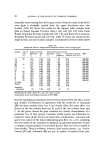
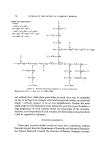
16 JOURNAL OF THE SOCIETY OF COSMETIC CHEMISTS relatively obscure, with conflicting statements reported in the literature both for threshold and quality, in contrast to the clearly established ability to distinguish such isomers by taste. This is due in part to the extreme sensitivity of the nose, which makes the presence of trace impurities, even below the limits of physical measurement, an important factor. Further, in these reports, the method of determining the odor differences, if any, is usually not elaborated, which is not conducive to confidence in the validity of the conclusions. Three methods have been used to obtain optical antipodes for olfactive testing, of which the first is the least, and the third the most convincing in reliability. Isolation or preparation from sources of optically active starting materials For example, d- and/-citronellols can be made from the respective d- and/-citronellals ex oil of Citronella Java and Java Lemon Oil, or from d- and 1-2, 6-dimethyl-2, 7-octadienes prepared by the thermal rearrangement of d- and/-pinanes which in turn derive from d- and l- alpha or beta pinenes. If, after such diverse routes, the final products, purified as well as possible, are indistinguishable in odor, the conclusion is compelling that optical activity does not influence the odor of citronellol. On the other hand, the ability of an expert panel to distinguish between the two can always be attributed, not to inherent differences between the d- and l- forms, but to the presence of trace impurities deriving from the starting materiMs or the processing. Resolution of the racemate In this case, the starting material being the same, any difference de- tected is more convincing. It may be argued, however, that because of physical differences in the intermediates used in the resolution, the end products may be of different purity, and again it may be the impurities which are responsible for odor differences. In the case of alpha-ionone, which has been resolved and evaluated twice by Sobotka et al (1) and by Naves (2), the conclusions reached are quite contradictory. In one case (1), the d and l forms are stated to be different in odor in the other (2), they are stated to be the same, but only one-tenth as strong as the racemate prepared by mixing the prepared

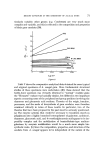
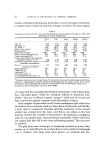
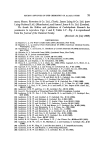
ODOR AND OPTICAL ACTIVITY 17 antipodes, a truly remarkable finding, not confirmed by other cases in the literature. In neither of the above cases were details given of the method of evaluation of the final products. The interconversion of one form into the other The recently reported case (3) for carvone and several carvone deriva- tives is fairly conclusive that d- and l- isomers of this type can indeed be distinguished readily, and the fact that in going, for example, from d-car- vone-+/-carvone-d-carvone, one gets an unquestionable caraway -+spear- mint-+caraway character, seems to exclude extraneous reasons for the odor differences. It should be pointed out, however, that the differences are still rather subtle, and certainly not as spectacular as in the case of taste differ- ences between d and I forms of sugars, for example. Also, the proof that the difference is truly olfactory, and not trigeminal, for example, is not yet established. Nevertheless, this would seem to be begging the question and the fact remains that the isomers can indeed be distinguished, at least in this series. It seemed desirable to extend the search for differentiable d and I forms to other groups of compounds. Unfortunately, the interconversion of d and I forms is feasible in very special cases only, and in the present study only the first method was employed with, however, a built-in check control on impurities which was designed to overcome previous uncertainties, as will be shown. Five compounds with definite fragrance characteristics were prepared in both d and I forms, and evaluated by panels for ability to discriminate. However--and this is the crux of the matter--each compound was made by two different routes so that there were obtained in each case, two pairs, namely d-1 and d-2, and l-1 and 1-2. Furthermore, the synthetic route was the same for each d-1 and 1-1 compound and differed from the preparative method for d-2 and 1-2. This procedure leads to a condition in which the various steps in the syntheses constitute purification steps, while any build-up of impurities due to the chemistry involved would automatically bring the pairs (d-l, /-1) and (d-2, /-2) closer together, at the same time putting the pairs (d-l, d-2) and (l-l,/-2) further apart. The olfactive effect of impurities in the end products thus would have to be subordinate to the olfactive effect of the rotation if d could still be distinguished from I with statistical significance.
Purchased for the exclusive use of nofirst nolast (unknown)
From: SCC Media Library & Resource Center (library.scconline.org)