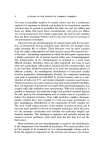
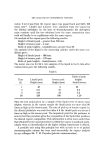
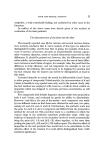
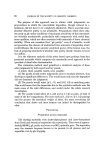
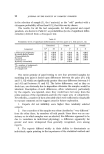
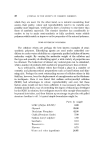
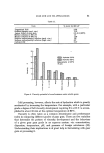
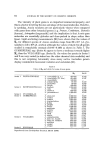
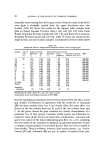
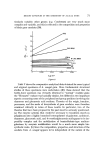
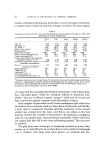
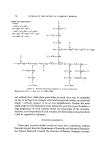
22 JOURNAL OF THE SOCIETY OF COSMETIC CHEMISTS in the selection of sample (1), the I material, as the "odd" product with a chi square probability of less than 0.1% that this was by chance. The results, for all the test compounds, for both general and expert panelists, are shown in Table II, as probabilities (levels of significant differ- entiation) derived from a chi-square test. Table iI Probability levels of significant differentiation between pairs (d-l, d-2) and (l-l, /-2) Compound t-Pinocarvyl propionate Myrtenal diethyl acetal Pinoacetaldehyde Myrtenal t-Pinocarveol Hydroxy citronellal$ *N----number of judgements. '•P---- probability level :•----triang]e test Untrained N* Pt 32 99.9 37 25.0 42 95.0 96 99.0 99 90.0 Expert Overall N P N P •9• 99.9 51 99.9 29 98.0 66 90.0 20 95.0 62 98.0 28 99.0 124 99.9 29 99.9 128 99.9 I 99.9 The entire premise of panel testing to sort four presented samples for matching into pairs is based upon differences between the pairs (d-l, d-2) and l-1,/-2) which are significantly greater than any difference between d-1 and d-2 and between l-1 and 1-2. The latter differences, real as they no doubt are, are obviously due to impurities otherwise the samples would be identical. Description of such differences, often volunteered, particularly by the experts, was ignored, since they would have led away from the prime purpose of the experiments and into the vague area of subjectivity. Nevertheless, a number of facts obtruded which were sufficiently remarkable to warrant comment and to suggest areas for future exploration. 1. Experts did not infallibly score higher than randomly selected subjects. 2. One or another of the samples was often classified as "very different" from the other three, by members of both panels. Since there was no con- sistency as to which samples were so selected, the difference appeared to be due to variations in individual physiology, a difference apparently far greater and more widespread than generally recognized, even among experts. 3. The experts differed widely in their ability to discriminate as individuals, again pointing to the importance of the statistical method and

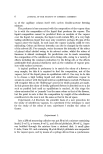
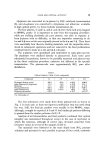
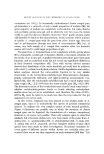
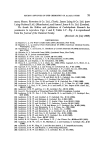
ODOR AND OPTICAL ACTIVITY 23 the danger of accepting individual judgements as absolute. For example, expert A had not the slightest difficulty sorting d and/-pinocarvyl pro- pionates, but found d- and/-pinoacetaldehydes "all the same". Expert B, recognized as equally competent in general, was able to sort the pino- acetaldehydes, but found no difference in the propionates. Such behaviour suggests prevalent specific anosmias, which in the absence of other evidence may be confined to optical isomers and for which the term "Chiral Anosmia" is proposed. Ability to discriminate seems to be helped by using a reference point from past experience, at least in part. This might explain the ready sorting of the carvones since they smell like the known spearmint and caraway oils. In the present series, one of us (E.T.T.) had no difficulty with the pinoacetaldehydes since the laevo had a "hydroxycitronellal" character and the dextro reminded of cyclohexyl acetaldehyde. In the same way, l- and d-pinocarveols were easily separated by reminding of geraniol palmarosa and camphor respectively, and d- and /-myrtenals suggested cuminic aldehyde and again cyclohexyl acetaldehyde respectively. Obviously, such reference points are available in greater number to the experienced than to the lay panelist. 4. Ability to perceive d-l differences fails off due to fatigue as was seen by greater consistency in the first of two consecutive pairings with both panels. EXPERIMENTAL The preparative trapping of the pinenes was carried out at 125 ø on a 2 m X 10 cm column packed with 20% Carbowax 20M on Chromosorb W (250-590 gm). The selected cuts were analysed by capillary glc on a 60 m X 0.5 mm column coated with Carbowax 20M. The optical rotations of the final products are shown in Table I. (Id) a-Pinene Greek turpentine oil, 91% in a-pinene gave, on prep-trapping, a-pinene 98% containing closely eluting impurities of 1.3, 0.4, 0.3%. (II l) •-Pinene A commercial cut of American sulfate turpentine (Arizona Chemical Co.) 97.7% •-pinene gave, on prep-trapping, •-pinene 98.2%, containing one closely eluting impurity of 1.5%.
Purchased for the exclusive use of nofirst nolast (unknown)
From: SCC Media Library & Resource Center (library.scconline.org)