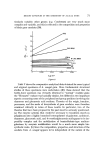
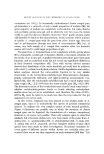
JOURNAL OF THE SOCIETY OF COSMETIC CHEMISTS so of the capillary column itself with carbon dioxide-acetone freezing mixture. The perfumer is less concerned with the composition of the vapour than he is with the composition of the liquid that produces the vapour. The liquid composition cannot be predicted from an analysis of the vapour over the liquid, for example, the liquid could contain 50% of a very high boiling odoriferous liquid that may only constitute perhaps 10 ppm of the vapour above the liquid. In such cases the vapour analysis could be very misleading. Odour and flavour intensity can also be changed by the nature of the solvent (5). For example, water decreases the intensity of the odour of phenyl ethyl alcohol owing to its solvent action, whilst the odour of limonene is almost unchanged. No predictions can be made concerning the composition of the odoriferous oil in living cells, owing to a variety of effects including the constant production by the living cell, or the effects predictable from physical chemistry such as the variation of vapour pres- sure with surface curvature. A typical problem in perfumery is to match the odour of a flower or soap sample for this it is required to find the composition, not of the vapour, but of the liquid phase in equilibrium with it. One way to do this is to choose a high boiling liquid and allow the odoriferous vapour to remain in contact with the liquid until an equilibrium is reached. Perfumers will recognise this as the 'Enfleurage' process by which pomades are made. In this process the odour of freshly gathered flowers is absorbed on to a fat such as purified lard until an equilibrium is reached. At this stage the odour-saturated fat or 'pomade' has the same odour as that of the flowers, but the point to note is that the composition by weight of the odoriferous constituents in the wax is not the same as that in the air space. Experiments 1-4 illustrate the scientific basis of a new procedure for the study of odoriferous yapours. In experiment 6 the technique is used for the study of the odour of rose experiment 7 studies the odour of thyme. Experiment Into a 250 ml measuring cylinder was put 50 ml of a mixture containing linalol, 2 vol % a-ionone, 8 vol % and dibutyl phthalate, 90 vol %. Argon was bubbled through the mixture from a sintered disk. A small glass U-tube, 2 mm I.D. and containing 10 [tl of dibutyl phthalate was suspended in the vapour space, and by means of a syringe driven from a synchronous

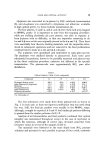
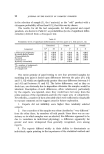
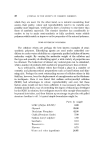
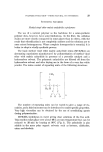
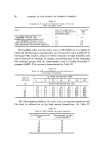
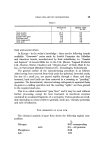
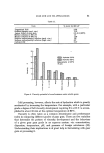
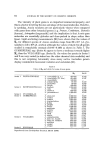
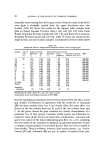
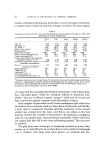
THE ANALYSIS OF ODORIFEROUS VAPOURS motor, 2 ml of gas from the vapour space was passed back and forth 100 times min-1. Linalol and a-ionone were absorbed from the vapour by the dibutyl phthalate by the laws of thermodynamics the absorption must continue until the two solutions have the same composition since both will finally be in equilibrium with the same vapour. Glc analysis of the vapour gave the following results:- Height of linalol peak - greater than 240 mm. Height of ionone peak - 4 mm. Ratio of peak heights - Linalol/ionone, greater than 60. Glc analysis of the liquid in the measuring cylinder under the same con- ditions gave:- Height of linalol peak - 188 mm. Height of ionone peak - 179 mm. Ratio of peak heights - linalol/ionone, 1.05. The motor was run for 24 h. Glc analysis of the liquid in the U-tube after various times gave the following results:- Table I. Ratio of peak Time Linalol peak Ionone peak heights (h) Height (mm) Height (mm) linalol/ionone 1 49 2 25 2 121 19 6.4 4 124 24 5.2 24 129 100 1.29 Thus the two peaks given by a sample of the liquid were of about equal heights, whereas in the vapour sample the linalol peak was more than 60 times as high as the ionone peak. The rate of pick-up of ionone vapour by the dibutyl phthalate was such that after 4 h the linalol peak was about 5 times as high as the ionone peak. The important point for the perfumer to note is that this procedure gives the composition of the liquid that produces the desired vapour composition. This information is often more useful than that obtained by the usual procedure in which the vapour is analysed, parti- cularly when an identification of the higher boiling constituents is desired. A portable unit using this principle but with an inch or so of packed chromatographic column has been used successfully for vapour analysis by my colleague Mr. T. M. Poynder (private communication).
Purchased for the exclusive use of nofirst nolast (unknown)
From: SCC Media Library & Resource Center (library.scconline.org)