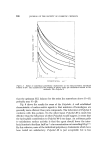
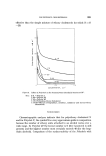
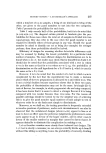
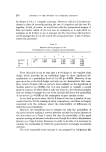
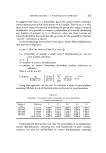
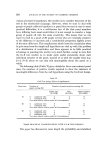
210 JOURNAL OF THE SOCIETY OF COSMETIC CHEMISTS that of ethoxy cholesterol 17-20 strongly suggests that the inferior per- formance of the former arises from its heterogeneous composition and, in particular, from its wide range of N-values. Fractionation of Polychol into narroxv cuts is likely to give products having improved surface activity. Because Polychol contains many compounds which vary over a wide range of N-values, the activities of its most useful components are dimin- ished by dilution with less useful components. Several advantages may be foreseen if Polychol were to be fractionated. For example, the cuts will cover a range of fairly specific surface-activities, and at least one cut should exhibit a surface-activity superior to that of the parent Polychol the relatively homogeneous composition of the individual cuts will eliminate problems of incompatibility in blending caused by the extreme components of the original range. ACKNOWLEDGEMENTS We thank E. S. Lower, Esq., for gifts of Polychol and one of us (J.S.) thanks the International Wool Secretariat for financial assistance. (Received: 26th June 1970) REFERENCES (1) Brit. Pat: 643 422 (2) Harkins, W. D. and Brown, F. E. The determination of surface tension (Free surface energy), and the weight of failing drops: the surface tension of water and benzene by the capillary height method. f. Am. Chern. Soc., 41 49• (1919). (3) Gaddum, J. H. A simple method of measuring surface tension. Prov. Roy. Soc., London, Ser. B 109 114 (1931). (4) Purdy, S. J. and Truter, E. V. Quantitative analysis by thin-film chromatography Analyst, 87 802 (1962).

J. Soc. Cosmet. Chem. 22 211-229 (1971) ¸ 1971 Society of Cosmetic Chemists of Great Britain Sensory testing--a approach statistician's W. A. PRIDMORE* Presented on 22nd April 1970 at the Symposium on "Perfumery", organised by the British Society of Perfumers and the Society of Cosmetic Chemists of Great Britain, at Eastbourne, Sussex. Synopsis--This paper shows ways in which the statistician can assist the cosmetic chemist in SENSORY TESTING by (1) employing his knowledge of PROBABILITY, (2) stressing the importance of a fuller understanding of the purposes for which the sensory tests are being used, and (3) stressing the importance of EXPERIMENTAL DESIGN in getting the full benefit from any set of tests. It sets out the theory behind certain forms of tests of differences and preferences. INTRODUCTION This paper deals with some techniques devised by one group of statisticians to help the cosmetic chemist in the appraisal of new product formulations, in the development and modification of existing products, and in the routine control of raw materials and of production. It is always difficult in any experimental or investigational process with which a statistician is associated to distinguish between that part of the plan which is directly attributable to the statistician's intervention and the basic experience, scientific knowledge and technical know-how contributed by the rest of the team. It is therefore to be understood that, whilst this paper will stress the statistical and probability aspects of the work which link together the various parts, most of the ideas have come from the statistician's technical colleagues, sometimes as a spontaneous contribution, sometimes in response to the statistician's awkward questions. *Reckitt & Colman Products Ltd., Hull, Yorks. 211
Purchased for the exclusive use of nofirst nolast (unknown)
From: SCC Media Library & Resource Center (library.scconline.org)