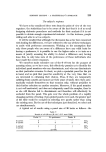
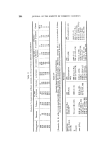
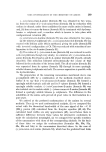
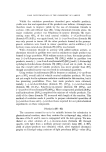
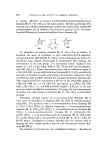
216 JOURNAL OF THE SOCIETY OF COSMETIC CHEMISTS by chance is 1.0, i.e. complete certainty. However, with 2+2, we have one chance in three of correctly putting the two A's together and the two B's together. It will, of course, be noted that with the symmetrical designs, it does not matter which of the two sets we nominate as A and which we nominate as B if there is one A amongst the B's, then there will clearly be one B amongst the A's at the end of the sorting procedure. Table II demon- strates the procedure. Table II. Balanced sorting designs (n=m) Probabilities of errors on random sorting hypothesis Number 0 of 1 errors 2 (e) 3 n 1 2 3 4 5 6 1.000 0.333 O. 100 0.029 0.008 0.002 (0) 0.667 0.900 0.457 0.198 0.078 0.514 0.794 0.487 0.433 From this table it can be seen that a 4+4 design is the smallest sized design which provides for an individual judge to show significant dis- crimination at a probability level of 1 in 20 (p=0.029). However, if one goes up as far as the 6+6 design, not only can we demonstrate that com- plete correct division with no errors is most unlikely on the hypothesis of random selection (p=0.002), but it is also possible to consider a second grade of response in which there is only one error (i.e. five identical samples and one misplaced sample in a set of six and this still has a low probability of occurrence (p=0.078) on the assumption of pure random choice. As we shall go on to show, the 6+6 form of test has a number of con- venient features for the making of odour comparisons, and these are largely concerned with the evidence about the detectability of differences by individual panel members. However, the statistician has to examine not only the probability of the panel member making a correct selection entirely by chance (known to the statistician as a Type 1 error) but also the probability of the panel member making an incorrect selection even though he is able to discriminate (known as a Type 2 error). However, in order to do this, it is necessary to consider the mechanism by which the panel member is thought to make his selection. The most reasonable basic concept is one proposed by Gridgeman (8)

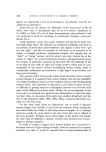
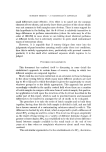
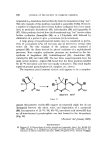
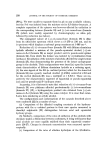
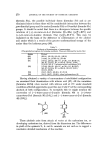
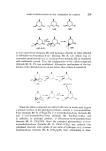
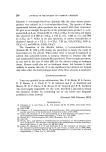
SENSORY TESTING -- A STATISTICIAN'S APPROACH 217 he suggests that there is a probability (p) of the panel member making a correct sensory perception of the nature of the sample. Thus in an n+n test, there is a pn chance of correctly identifying the group of n using a binomial distribution, it is possible to compute probabilities of correctly identifying any number of samples up to n. However, when less than n items are correctly identified, the model has also provision for the possibility of further "correct" selections by chance. In the terminology used earlier in this paper, which differs slightly from that used by Gridgeman: n+m=t (For the cases inTablelI, n=m=•) p= probability of making a single correct identification (i.e. not by pure random selection) q=l -p x----number of correct identifications r----number of correct allocations (including random selections in addition) Then tm•r•x•0 P (r m)= m! (t-m) ! (m-x) ! x (t-2m+r) ! (m-r) ! ' (t-x) !x! P q X•O Using this approach, we are able to calculate a series of probabilities assuming different levels of discrimination on the part of panel members. Table III. Probability of completed correct allocation for given probability of basic discrimination. Nature of Response test 2+2 test 2 correct 3+3 test 3 correct 4-t-4 test 4 correct 5+5 test 5 correct 6-t-6 test 6 correct 5 & 6 correct 0 0.1 0.5 0.9 1.0 0.330 0 0.340 0 0.500 0 0.873 4 1.000 0 0.100 0 0.104 8 0.268 8 0.792 6 1.000 0 0.028 6 0.031 1 0.146 4 0.717 7 1.000 0 0.007 9 0.009 1 0.079 2 0.648 8 1.000 0 0.002 2 0.002 8 0.042 4 0.585 7 1.000 0 0.077 9 0.086 7 0.325 6 0.934 8 1.000 0 From TableHi then weshow not only the probability of an individual's correct discrimination, assuming the null hypothesis of pure random selection, but also the probabilities of correct discrimination assuming
Purchased for the exclusive use of nofirst nolast (unknown)
From: SCC Media Library & Resource Center (library.scconline.org)