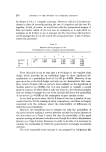
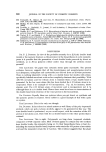
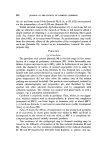
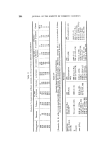
218 JOURNAL OF THE SOCIETY OF COSMETIC CHEMISTS various alternative hypotheses this enables us to consider the power of the test in the statistician's language. However, when we start to deal with groups of people collected together in a panel then we start at once to meet practical ditticulties it is a well-known fact of life that panel members have differing basic nasal sensitivities it is not enough to consider a large group of people all with the same sensitivity. This means that we can expect to find in a panel of 30 people several who are extremely sensitive to the difference in question and a considerable proportion slightly aware of the same difference. The complications which beset the statistician when he gets away from the simple null hypothesis are tied up with this problem of a distribution of sensitivities and there appears to be little practical advantage in pursuing this matter very much further, except to note that the 6+6 test enables us to make quite useful statements about each individual member of the panel, instead of as with the smaller tests (e.g. 2+2, 3+3) where we can only talk meaningfully about the panel as a whole. The following table (Table I V) gives details for three conventional panel sizes, the numbers of positive results required to show the existence of meaningful differences from the null hypothesis using the 6+6 test design. Table IV. 6-t-6 Test design (Tests of significance) Panel size Number of panel scoring 6/6 Number of panel members scoring 5/6 Fairly sure Sure Almost certain (P 0.05) (P0.01) (P0.001) 10 0 combined with 4 4 6 1 combined with 0 2 3 2 or more almost certain under all circumstances 20 0 combined with 5 6 8 1 combined with 2 4 6 2 or more almost certain under all circumstances 30 0 combined with 7 8 10 1 combined with 3 5 7 2 combined with 0 0 4 3 or more almost certain under all circumstances SOME PRACTICAL CONSIDERATIONS WITH N+M TEST DESIGNS This paper has discussed at some length the probability and statistical

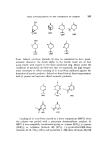
SENSORY TESTING -- A STATISTICIAN'S APPROACH 219 aspects of these sensory testing procedures. To recapitulate, the procedure is as follows:-the panel member is confronted with n samples of one kind and m samples of the other which are coded in a randomly allocated numerical sequence there should be no other detectable difference except the particu- lar characteristic under test. The panel member is then requested to divide 'up the two sorts of sample into their appropriate groups using the relevant sense. If n+m is large enough, it may be possible to judge whether each panel member is a discriminator or not. If, on the other hand, the value of nq-m is too small, it may not be possible to categorise each panel member, but it will still be possible, by using a large enough panel, to declare whether there is any evidence of a distinguishable difference from the results of the panel as a whole. The essential elements of the test are that panel members can physically sort the unidentified samples using the sense to be tested if this sorting agrees with the experimenter's undisclosed coding, then we can demon- strate a discriminable difference. Why do such tests? As we have already suggested, the purpose of the test may simply be to discover whether a detectable difference exists between two samples. However, it frequently happens that the basic requirement is one of establishing preference between samples even where the primary concern is one of difference, we may still wish to know which of two different samples is the more acceptable. There is an extension to this line of argument it is to be taken as axiomatic that unless people can distinguish between two samples, they cannot validly express a preference for one rather than another. "I cannot tell the difference between these two samples, but I prefer that one" is not an acceptable statement from a panel member. One approach to this has been to select in advance a specialist group of panel members who specialise in distinguishing between particular types of products, or between certain brands within a product group. It is, however, a serious problem with any organisation dealing with any appreciable number of product fields that it would be necessary to set up a very large number of such specialist panels. What is more, these would require setting up in advance of every new piece of investigation, and this could be a severe limitation on the speed with which research is conducted. However, for those fields of investigation for which an n+m test of sufficient size can be used (e.g. 4+4 and over), it is possible to carry out a
Purchased for the exclusive use of nofirst nolast (unknown)
From: SCC Media Library & Resource Center (library.scconline.org)