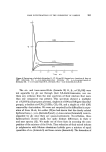
202 JOURNAL OF THE SOCIETY OF COSMETIC CHEMISTS oxide at different rates, the H/L balances for the three series will be differ- ent. Consequently, when one series has been brought to its optimum H/L balance, the other series will be off balance. Another possible source of im- perfection is that each parent alcohol will be distributed among several homologues having a range of N-values and, therefore, a range of H/L balances. If the range is too wide, the surface-active properties of the series will be adversely affected. One object of this study was to examine the way in which ethoxy units are distributed in the products of the reaction of ethylene oxide with an alcohol. A second objective was to explore the effect of molecular structure on surface activity by measuring the decrease in the benzene/water inter- facial tension caused by individual ethoxy compounds. EXPERIMENTAL Preparation of elhoxylates (a) Ethylene oxide (1 ml about 5 equivalents) was added to a cold (--10øC) mixture of cholesterol (2 g), benzene (20 ml) and sodium (0.1 g), and the tube was sealed and set aside at room temperature. After 4 months the tube was opened and the contents were evaporated to dryness under reduced pressure. (b) A second preparation differed only in the quantity of ethylene oxide (5 ml 25 equivalents) and the reaction time (6 weeks). Similar preparations containing lanostenol (=dihydro-lanosterol) (2 g) plus ethylene oxide (1 ml) and n-octadecanol (3 g) plus ethylene oxide (1 ml) were also set aside for 4 months. Chromatography Standard methods of laminar chromatography were used except where specified. Glass plates were coated with Silicagel G (Merck) using the Shan- don apparatus. For normal work the spreader gap was 0.3 mm and for pre- parative chromatography it was 0.6 mm. Chromatograms were developed in tanks which had been lined with filter paper soaked in solvent all eluent compositions are expressed in volumes. Sulphuric acid was the usual chromogenic reagent in the cold, cholesterol derivatives were easily distinguished because they gave reddish- purple spots whereas derivatives of the other alcohols remained colourless.

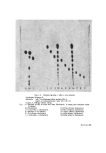
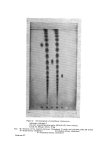
POLYETHOXY CHOLESTEROLS 203 On heating the chromatoplate, lanosterol derivatives exhibited a transient yellow colour eventually, all the organic compounds charred. Isolation of ethoxy cholesterols Product (a) (1.5 g) was chromatographed on 15 preparative chromato- plates in three batches of five. Four elution was performed with benzene/ acetone/water for the first two the volume ratio was 400+ 100+ 1 and for the next two it was 140+60+ 1. Recovery of the components, using ether/ ethanol/water (14+ 5 + 1) as the extracting solvent, yielded:- N: 0+ 1 2 3 4 5 6 7 8 and more mg: 457 160 184 182 139 92 71 132 Product (b) (2.9 g) was chromatographed on 20 preparative plates in exactly the same way to yield:- N: 0+1+2 3 4 5 6 7 8+9 8-22 mg: 88 35 51 68 79 103 353 1 090 (from N=7 upwards the resolution became progressively poorer) The mixture N =8-22 (800 mg) was chromatographed on 8 large (20 X 40 cm) preparative chromatoplates in one batch, using a combination of the gradient- and multiple-elution techniques. The tank was charged with benzene/acetone/water (140+60+1 1 500 ml). After the first elution, the solvent-composition in the tank was change d by the addition of a different solvent, and the chromatogram was developed again. This sequence of operations was repeated as follows:- After the nth development v ml of benzene/acetone/water was added. 1 100 5+5+2 2 100 5+5+2 3 lOO 5+5+2 4 500 6+4+ 1 5 100 5+5+2 6 250 5+5+2 7 0 -- 8 250 5+5+2 9 250 5+5+2 10 250 5+5+2 11 250 5+5+2 12 500 4+6+3
Purchased for the exclusive use of nofirst nolast (unknown)
From: SCC Media Library & Resource Center (library.scconline.org)