204 JOURNAL OF THE SOCIETY OF COSMETIC CHEMISTS Recovery of the components using ethanol/water (4+ 1) as the extractive solvent gave the following yields:- N: 8 9 10 11 12 13 14 15 16 17-20 mg: 23 42 79 94 91 78 67 58 53 95 The mixture N----0-t-1 (300 mg) was chromatographed on ten prepara- tire plates by the technique of continuous development using cyclohexane/ ethyl acetate (4-t-1) as the eluent. Recovery of the compounds using ether as the extractive solvent afforded cholesterol (222 mg), m.p. and mixed m.p. with an authentic sample, 148øC, and mono-ethoxy cholesterol (68 mg). All compounds were purified by further chromatography by the multiple development technique or by continuous elution. For example, penta-ethoxy cholesterol was subjected to continuous elution for 6 h in benzene/acetone/water (400+100q-1) and it was recovered using ether/ ethanol/water (190-t-9-t-1) as the extractive solvent. Analytical data Satisfactory elemental analyses were obtained only for mono-ethoxy cholesterol, (found: C, 80.7 H, 11.6% C29H5002 requires: C, 81.0 H, 11.6 %) and di-ethoxy cholesterol (found: C, 78.2 H, 11.4% C 31H5403 requires: C, 78.5 H, 11.4%). Although all the higher homologues were dried by storage over phos- phorous pentoxide, in vacuo, for 4 weeks, elemental analyses indicated that they could not be dehydrated completely. For example, for N=3 the calculated carbon content is 76.55%, for the hemihydrate it is 75.1% and for the monohydrate it is 73.8%. On prolonged drying, the carbon content increased from 74.1% to 75.7%. Concurrently, the melting point increased from 80 ø to 101øC, and the optical rotation changed from --23 ø to --27 ø. Analyses indicated, for tetra-ethoxy cholesterol (C, 72.6 H, 11.0%) the monohydrate, and for tetradeca-ethoxy cholesterol (C, 63.4 H, 9.9%) the dihydrate. Intermediate members contained non-stoichiometric amounts of water which increased with the number of ethoxy units in the compound. Melting points and optical rotations of the lower members of the series are: N 1 2 3 4 5 6 7 9 13 16 mp(øC) 116 108 101 90 84 76 70 60 46 44 [a]D(CHC13) m33 ---29 --27 --23 --21 m20 --19 --9 •6 (in ethanol)

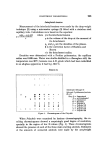
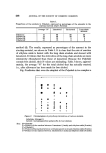
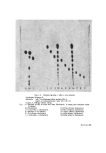
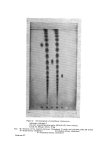
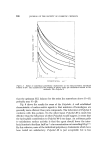
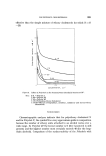
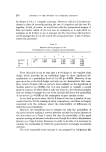
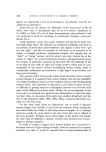
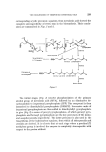
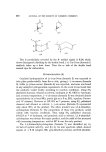
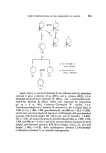
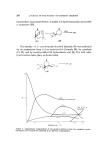
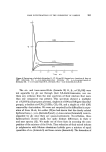
POLYETHOXY CHOLESTEROLS 205 Interfacial tension Measurement of the interfacial tensions were made by the drop-weight technique (2) using a micrometer syringe (3) fitted with a stainless steel capillary tube. Calculations were based on the equation: !x(p •--02) g • where ¾ is the interfacial tension r !x is the volume of the drop at the moment of its detachment. P 1 and 02 are the densities of the phases. • is the correction factor of Harkins and Brown r is the detachment radius. Densities were determined with a Perkins pyknometer the capillary radius was 0.626 mm. Water was double-distilled in a Barraglass still the temperature was 20øC benzene was A.R. grade which had been redistilled in an all-glass apparatus it had b.p. 80.1øC. RESULTS L 0 C H o b Substrate: Silicagel G Solvent: Cyclohexane/acetone ß . . (9+1) ß ' Key: L-• Lanostenol ß . O = •-Octadecanol C = Cholesterol H----- Hartolan ! ' . -•- a = Polychol l• • :• • b = Polychol 10 • m c = Polychol II• c O e d = Polychol 20 e = Polychol •0 Chromatogram of the Polychols Figure 1. When Polychols were examined by laminar chromatography, the re- suiting chromatograms showed a surprisingly good degree of resolution, specially in the region of low N-values (Fig. 1). These chromatograms showed the presence of each of the three main starting alcohols. Estimates of the amounts of unreacted alcohols were made by the area/weight
Purchased for the exclusive use of nofirst nolast (unknown)
From: SCC Media Library & Resource Center (library.scconline.org)