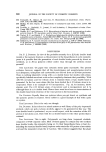
222 JOURNAL OF THE SOCIETY OF COSMETIC CHEMISTS Much more di•cult to conceal are the differences between clear liquids and cloudy suspensions which can arise in making smell comparisons between alternative formulations. In these circumstances it is sometimes necessary to conceal the actual surface of the layer of product by a wire gauze baffle, or a layer of grinding rods or some such inert material. As a final resort, the use of special dim or coloured lighting or even the wearing of dark goggles is effective. If there is any doubt whatsoever, a preliminary test could be to require the subjects to sort the samples wittyout using the sense (taste, smell, etc.) which is really to be tested if the subjects succeed, then the conditions for the test are not appropriate. For the statistician it should not be necessary to draw attention to the fact that the samples under test should be allocated to their code numbers at random. This was forcibly brought home to one statistician who lapsed into a convenient convention of always labelling one group of samples in a 6-•6 test with odd numbers and the other with even numbers. This was convenient because the incorrect items in the sorted groups •vere at once obvious. However, when the test organisers carried out a test in which all twelve samples were poured out of a single bottle of bath additive, it was found that a significant proportion of the panel (at a probability quite beyond the accepted extreme 1 in 1 000 level) were dividing the samples up into odds and evens. It was therefore established that random numbering of samples under test was the only acceptable procedure. Finally, it must be stressed that the form of presentation of the sample to the subject needs very careful consideration. Sensory tests of the kind we are discussing can only handle one aspect of the product at a time we can, for example, carry out tests of the neat smell of a product in the iar, a face cream, a deodorant stick or what you will we may test a shampoo when diluted down in water, or a bath preparation when steaming in hot water, or the residual smell left after using a hair spray, but whatever we test, we must take note of the fact that we are only considering and testing one particular facet of the organoleptic characteristics of the product. One of the more unwelcome tasks of the statistician is to have to draw attention to his clients that they may not generalise from such limited tests, say of the odour of a bath powder in the dry state to the perfume acceptability of the product in general. Too often it proves to be only too convenient to accept the easily obtained answer instead of the relevant one unfortun- ately we so often never get enough information to know how misled we have been.

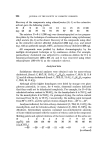
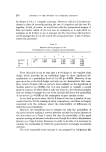
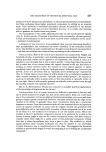
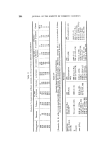
SENSORY TESTING -- A STATISTICIAN'S APPROACH 223 The subject's response We have so far considered these tests from the point of view of the test organiser the statistician has to be aware of the fact that it is of no avail designing elaborate procedures and methods for their analysis if it is not possible to obtain enough experimental material - in this instance, people willing and able to act as subjects. It will be recalled that although the discussion has so far been concerned with looking for differences, we have referred to the use of these techniques to assist with preference assessments. Working on the assumption that only those people who are aware of a difference have any valid basis for having a preference, it is possible to use the higher order n+n tests as a means of jointly assessing the ability to detect a difference and, having done this, to only take note of the preferences of those individuals who have made the correct responses. We ourselves make extensive use of the 6-½6 test for the purpose of assessing odour as we have seen, this effectively permits us to identify the individual panel members who can discriminate, and who can discriminate on that particular occasion. In short, we pick a specialist panel for the job in hand, and we pick that panel for sensitivity at the very time that we are interested in obtaining their choices. Thus, if they are temporarily suffering from catarrh and cannot use their sense of smell, then they auto- matically exclude themselves on that occasion only, without prejudice to their further selection on another occasion. Moreover, if the panel member is not well motivated, and does not adequately smell the samples, then he or she will likewise fail to discriminate and therefore will effectively be excluded from the panel. This gets over the whole problem of a rapidly changing pattern of testing if pre-picked panels were used, the greater part of the time would be occupied in selecting new panels rather than using the existing ones. By the use of the techniques just described, we select and use simultaneously. A typical set of results using a panel size of 30 looks as follows- the Table V. Result of a 6+6 test (R. & C. O.P. test 6 200) 6 correct $ correct 4 correct 3 correct Prefer A No preference Prefer B s - - •o% 6 s 2 43% 4 $ 1 33% - 4 - •4% (n=$O)
Purchased for the exclusive use of nofirst nolast (unknown)
From: SCC Media Library & Resource Center (library.scconline.org)