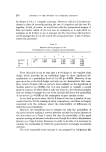
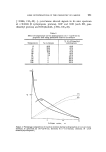
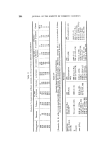
220 JOURNAL OF THE SOCIETY OF COSMETIC CHEMISTS form of instant panel selection. By requiring a series of panel members to carry out such an n+m test, and then asking them to say which group of samples they prefer, it is possible to pick out those individuals who can discriminate and only taking note of their preferences. In this way it is possible to pick out an expert panel and carry out a preference test all in the one operation indeed by this means it is possible to eliminate the pre- ferences of those panel members who on the testing occasion in question were unwilling or unable (perhaps owing to coryza or catarrh) to discrimin- ate. For this purpose, particularly for testing of perfume or smell, the 6+6 test has proved admirably suited panel members find themselves well able to assess twelve samples, the design is balanced and so bias is not introduced into the preference assessment, and the design provides for two grades of judgement, 6/6 or completely correct judgement (with a probability on a random null hypothesis, of 0.002), and 5/6, or a judgement with only one error, which still has a probability of less than 0.08. This, then, is a device for selecting suitable panel members one obtains first of all, an indication of the magnitude of differences existing between the two samples under test one then proceeds to assess the acceptability of that difference by examining the preferences of those panel members who demonstrate that they are able to discriminate. These constitute a ready made specialist panel, whose ability to discriminate is assessed virtually simultaneously with the obtaining of their preference judgement. What panels should be used? The selection of judges, subjects, panel members (these names are virtually synonymous) is dependent, as always, upon the objectives for which the whole experiment is to be designed. The n+m test may be used to establish whether the view of a particular research worker about the existence of some sensory difference can be confirmed. In this instance, the research worker himself would be checked in a double blind trial to see if he or she could detect the difference using the 6+6 test, the likelihood of any correct allocation of the samples being due to chance may be regarded as negligible. On the other hand, it is equally clear from Table III that the single observer, even though having a 9/10 probability of spotting the difference in question in a single observation, has still a very appreciable probability of not getting all his allocations correct (P of 6/6 is still only 0.59) however, it is an interesting phenomenon that the research worker in these circumstances is so taken aback at the thought that he is not 100%

SENSORY TESTING -- A STATISTICIAN'S APPROACH 221 perfect (and demonstrably so !) that he is willing to concede that perhaps the difference is not as great as was hitherto thought. It should be noted from Table III, however, that with the same 9/10 probability on the single identi- fication, the likelihood of the single panel member getting 5 out of 6 in a 6+6 test is as high as 0.935. At this point, it is appropriate to make use of wider panels of non- specialist individuals, preferably having nothing to do with the technical a•pects of the product under consideration. It will be possible to establish then whether there are generally detectable differences present it is usual to find that only a proportion of the panel can clearly discriminate. The general finding is that panel members are idiosyncratic in the differences they can detect some panel members can detect certain differences and different sets of panel members are good at other differences. Yet again there are small groups who appear to be good at a very wide range of differences. A hypothesis which would be open to investigation is that these groupings may be genetically determined and could throw light on the mechanisms of the sense of smell. How should the samples be presented? It is clearly of the essence of the logic of the tests described that the differences between the samples should be made manifest only by the sense under test. The test procedure lays down that if the panel member sorts the samples into the correct groups, then there is evidence that the choice was by something other than random selection. It is, however, only by careful attention to the actual mechanism of presenting the samples to the subject that we can be in a position to assume that the only alternative basis for the subject's choice is the use of the relevant test. It we are conducting a test on taste, the food technologist will wish to make sure that we cannot tell Stork from butter by its different colour with an odour test of bath crystals, we shall wish to disguise colour differ- ences in order to be sure that discrimination can only be made by the sense of smell in an auditory test of violins (9), •ve shall wish to conceal the actual Stradivarius from the audience panel by a screen. In the toiletries situation, where we are concerned with perfumes, we find it relatively easy to make comparison between alternative versions of our own products it becomes more difficult if we wish to compare our own product with a competitor. The use of amber-glass jars conceals very minor variations in appearance, of the kind which are sometimes detectable in full light between powders perfumed with different perfume ingredients.
Purchased for the exclusive use of nofirst nolast (unknown)
From: SCC Media Library & Resource Center (library.scconline.org)