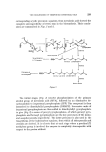
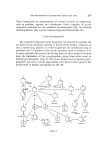
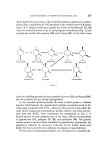
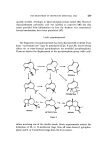
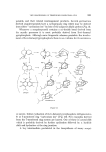
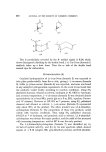
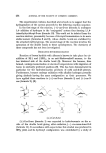
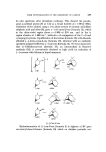
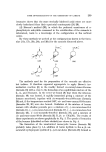
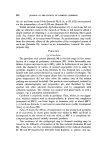
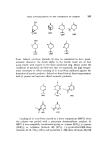
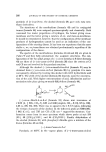
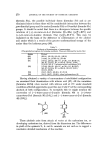
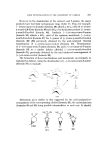
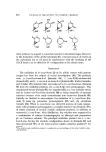
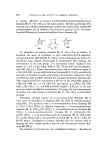
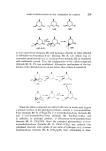
THE BIOGENESIS OF TERPENOID ESSENTIAL OILS 241 penolds, and their related rearrangement products. Several germacrane derived sesquiterpenoids have a cyclopropane ring which may be derived from either "carbonium ion" by loss of the adjacent allylic proton (Fig. 9). Whenever a sesquiterpenoid contains a cis-double bond derived from the acyclic precursor it is most probably derived from 2-cis-farnesyl pyrophosphate. Although some biogenetic schemes postulate the involve- ment of 6-cis-farnesyl pyrophosphate there is no evidence for its occurrence ongifolcn½ o Figure 11 •n nature. Initial cyclisation of 2-cis-farnesyl pyrophosphate will generate a 6- or 7-membered ring "carbonium ion" (Fig. 10). Few examples derived from the 7-membered ring system are known. One of these is carotol (53) which is probably derived by further cyclisation followed by a hydride shift and hydration at the ring junction. A key intermediate postulated in the biosynthesis of many sesqui-

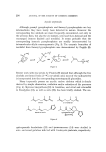
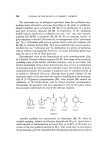
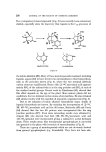
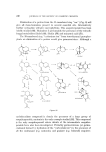
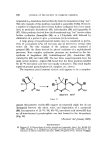
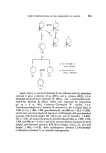
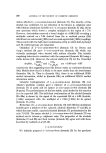
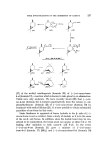
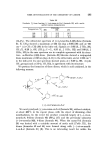
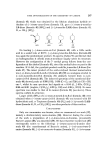
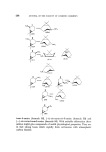
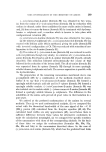
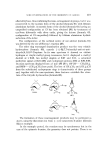
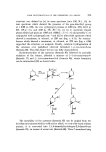
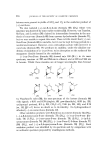
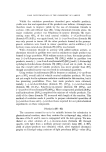
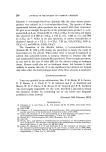
242 JOURNAL OF THE SOCIETY OF COSMETIC CHEMISTS terpenoids is ¾-bisabolene derived directly from the 6-membered ring "ion". The only example of this skeleton examined is paniculide B (54). However, a number of compounds derived from further cyclisation have been exam- ined, in particular trichothecin (55), helicobasidin (56) and lagopodine B (57). Other products derived from the 6-membered ring "ion" involve either further cyclisation (fumagillin (58), or a 1,2-hydride shift followed by elimination of a proton to give ¾-curcumene (or [I-curcumene). A large group of sesquiterpenoid skeleta may be considered as deriva- tives of ¾-curcumene (Fig. 11) but may also be derived by several other routes (3). The only example of the cadinene group examined is gossypol (59), the dimer derived by phenol oxidation of a naphthalenoid precursor. More complex cyclisation processes are involved in the bio- synthesis of longifolene (60), helminthosporal (61), dendrobine (62), coriamyrtin (63) and tutin (63). The last three sesquiterpenoids have the same carbon skeleton. Arigoni (63) found that the three positions labelled by [2-14C ]mevalonic acid were not equally radioactive. This result implies a pool of geranyl pyrophosphate (cf. camphor, etc. above). The important plant hormone abscisic acid appears to be a sesquiter- OH- O•OH abscJsic acid Figure 12 penoid. Biosynthetic results (65) support its terpenoid origin but do not distinguish between the direct route, and degradation of a carotenoid (66). Incorporation of [2-14C, 3R, 4R-3H 1] mevalonic acid shows (67) that an all-trans-farnesyl pyrophosphate was first formed in the biosynthesis (Jig. (Received: 3rd January 1970J REFERENCES (1) Clayton, R. B. Biosynthesis of steroIs, steroids and terpenoids. Quart. Rev. 19 168, 201 (1965). Nicholas, H. ]. Biogenesis of naturally occurring materials. {n Bernreid, P. The •{•õen•{• o• •atura• •• 2nd Edn. (1•67) (Pergamon Press, Oxford) Pridh•m,
Purchased for the exclusive use of nofirst nolast (unknown)
From: SCC Media Library & Resource Center (library.scconline.org)