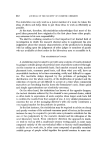
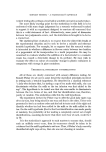
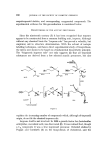
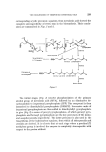
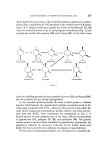
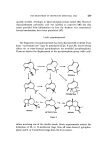
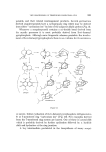
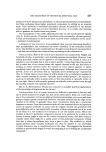
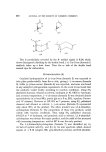
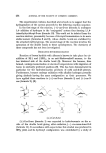
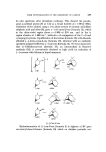
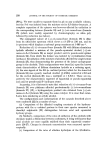
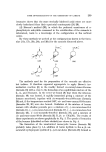
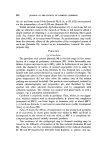
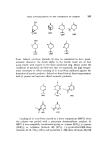
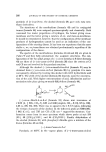
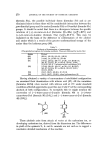
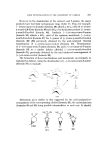
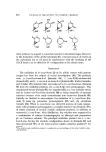
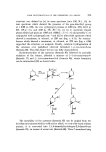
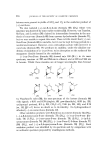
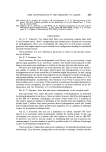
THE BIOGENESIS OF TERPENOID ESSENTIAL OILS 239 quately studied. Attempts to label artemisia ketone failed (10). However chrysanthemum carboxylic acid was labelled as expected (46) but this result provided little information on how the skeleton was constructed. Several mechanisms have been postulated {47). Cyclic sesquiterpenoids The biogenesis of sesquiterpenoids has been discussed (3) in detail. Four basic "carbonium ions" may be postulated (Figs. 9 and 10), derived from either cis- or trans-farnesyl pyrophosphate (or nerolidyl pyrophosphate). These are derived by displacement of the pyrophosphate group with cycli- bulncso1 gcrmacratrilnc .... Figur• 9 sation involving one of the double bonds. Steric requirements restrict the formation of 10- or 11-membered rings from all trans-farnesyl pyrophos- phate and 6- or 7-membered rings from the 2-cis isomer.

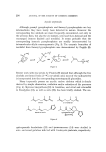
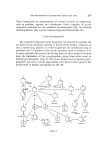
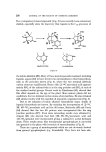
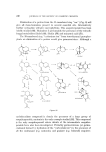
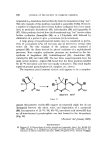
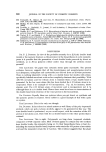
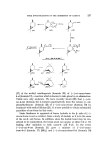
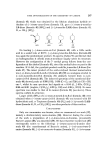
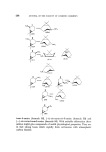
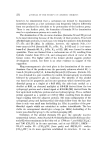
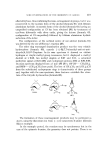
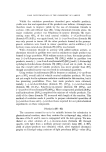
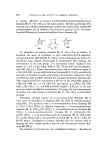
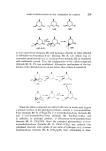
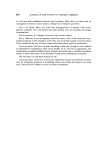
24O JOURNAL OF THE SOCIETY OF COSMETIC CHEMISTS Elimination of a proton from the 11-membered ring "ion" (Fig. 9) will give all trans-humulene present in several essential oils. Alternatively further cyclisation will give caryophyllene. This sesquiterpenoid has been briefly studied (48). Humulene is presumably the precursor of the tricyclic fungal metabolites illudol (49), illudin (50) and marasmic acid (51). The 10-membered rinõ "carbonium ion" from trans-farnesyl pyrophos- phate on elimination of a proton would give germacratriene. Although a y b• cbo ½n½ k4½0 0 '•a•illin •'-curcurncnc0 caro•ol 0 % ø helico basid•n l:igure 10 cyclodecadiene compound is clearly the precursor of a large group of sesquiterpenoids, santonin is the only example studied (52). This compound is the only sesquiterpenoid where details of the intermediate sesquiter- penoids have also been investigated. Probably germacratriene (or germa- cradienol formed by hydration of the "carbonium ion") is the precursor of all the eudesmane (e.g. santonin), and guaiane (e.g. bulnesol) sesquiter-
Purchased for the exclusive use of nofirst nolast (unknown)
From: SCC Media Library & Resource Center (library.scconline.org)