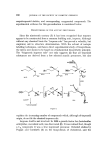
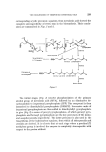
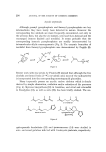
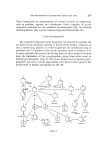
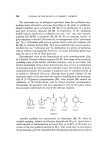
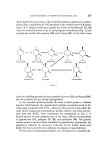
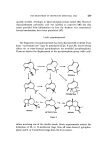
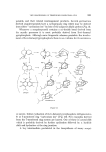
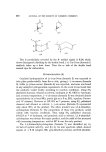
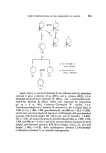
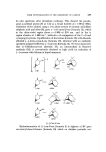
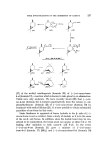
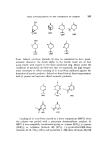
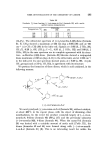
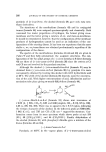
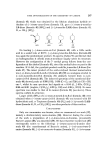
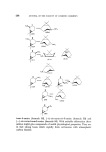
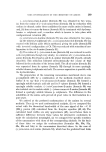
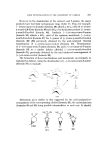
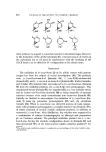
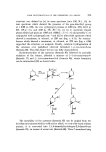
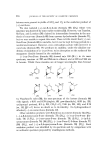
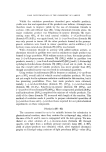
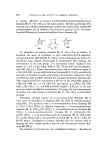
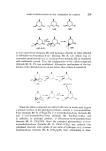
THE BIOGENESIS OF TERPENOID ESSENTIAL OILS 247 produces all trans farnesyl pyrophosphate, or all trans geranyl geranyl pyrophosphate, and then synthesises these higher isoprenoid compounds, by adding on cis isoprene units. This conclusion is somewhat speculative because the position of the tritium atoms along the chain has not been identified however, it is certain that enzymes able to generate cis double bonds are present. The biosynthesis of the indole alkaloids proceeds via the monoterpenoid loganin (Fig. 8). In this case the 4 R proton of mevalonic acid is retained by all trans geraniol, so that an isomerization to nerol must have occurred before cyclization to the cyclo- --pentanyl monoterpenoid. A MEMmER OF T•E AUDIE•CE: I was surprised when you were discussing dimethyl- allyl pyrophosphate and mentioned the stereo chemistry of the methylene carbon atom. This thrilled me quite considerably as I thought at least this part was elementary --and that one would not have expected any asymmetry at this carbon atom. TaE LECTURER: Most of the work I have described was conducted by Popj&k and Cornforth (4) who, in particular, were studying squalene biosynthesis. However, I am certain that their results can be applied to all terpenoids, and I think it came as a surprise to a lot of people that it was so stereo specific. At any stage where the enzyme has to select one of two atoms (where the organic chemist would say that there is nothing to choose between them) the enzyme in every respect appears to stereo specifically select only one of the two hydrogen atoms. Although they have not yet proved, as far as I am aware, that an "optically active methyl group" is generated (Fig. 1), I think there is every chance it will be found to be so. Certainly a number of other enzyme systems do involve "optically active methyl groups". An enzyme is made up of optically active a-amino acids, so that the enzyme is optically active in its own right. Hence it will normally generate an optically active product even though the starting material was optically inactive. MR. D. E. BUTTERFIELD: Would you comment on possible practical applications of the knowledge of biogenesis for the future? TaE LECTUREm It is, of course, always very difficult to speculate in this way and one is almost bound to be caught out, but on the other hand I think one could make one or two comments. As I see essential oil chemistry developing, one is more and more going to require specific compounds. However, the plant certainly has the edge on the chemist in its ability to generate those trace components which give a particular fragrance or aroma. From the commercial point of view essential oils are an important source of complex molecules. In many cases the organic chemist can synthesise with great difficulty and in very small yield, a number of these compounds, but if we want to use them as a raw material it is necessary to use the natural source. Hence the problem is that if a particular compound is known to be produced by a plant in the remote Amazon jungle it may not be a useful commercial source. One then wants to consider where there might be a useful source of this particular compound. I think that this is where biosynthesis may have a part to play. The methods by which plants generate these complex molecules can often be related to our knowledge of plant taxonomy one is complementary to the other. This suggests the botanical families or species which might be worth investigating if one is looking for a particular compound.

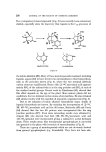
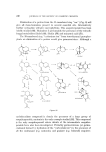
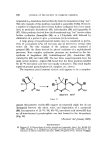
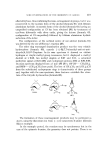
JOURNAL OF THE SOCIETY OF COSMETIC CHEMISTS Another area which is proving very important is the application of mono or sesquiterpenoids to pest control. The area of insect hormones and related com- pounds is certainly going to be a very important field in the future. Another group of interesting compounds is the cytotoxic sesquiterpenoids. These may have applications in cancer chemotherapy so that specific terpenoids need to be searched for. Abscisic acid {Fig. 1oe) is a very important plant hormone. There may be analogues of this compound as we do not know how universal this hormone is. Much of the present work relies on the very large specific rotation of abscissic acid so that it can be de- tected in very small quantities. However, there may well be analogues which are even more active biologically that have as yet to be found.
Purchased for the exclusive use of nofirst nolast (unknown)
From: SCC Media Library & Resource Center (library.scconline.org)