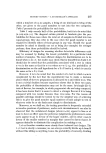
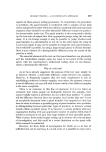
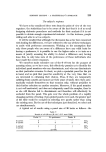
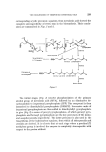
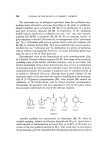
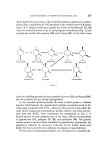
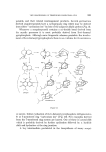
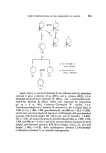
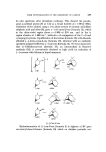
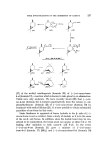
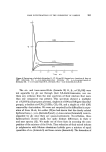
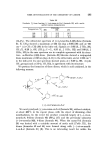
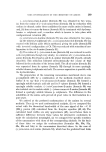
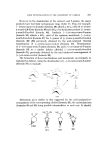
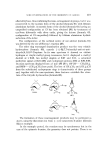
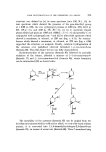
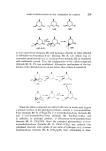
SOME INVESTIGATIONS OF THE CHEMISTRY OF CARENE 275 structure was defined by (a) its mass spectrum (m/e 150, M+), (b) its nmr spectrum which showed the presence of the gem-dimethyl group at x 8.09 (s, 13H), the two cyclopropyl protons at 8.130 (m, 2H), 8.13 (s, 3H, CH3C----C ), and 4.33 (s, 1H, HC=C), (c) its ir spectrum (liquid phase) which had peaks at 1 1395 and 1 1358 (C = C--C = 0 and possibly C = O conjugated with cyclopropyl) cm-1 and (d) its ultraviolet spectrum which showed a maximum, in ethanol, at 229 nm (log, c 4.11). Its semicar- bazone which showed a maximum, in ethanol, at 272 nm (log c 4.36) supported the structure we assigned. Finally, catalytic hydrogenation of the carenone over palladised charcoal furnished (+)-cis-caran-5-one (formula 25). Thus this elusive ketone was fully characterized. Hydroboronation of the carenone (formula 137) followed by peroxide oxidation of the borane, afforded a mixture of (--)-cis-caran-trans-4~ (formula 17) and (--)-cis-caran-trans-5-ol (formula 24), whose formation can be rationalised (55) as shown below. (17) HO• •,•4) The instability of the carenone (formula 137) can be judged from the fact that on treatment with ice-cold acid or alkali, or even with warm sodium acetate, it is converted into 1,1,4-trimethylcyclohepta-2,4-diene-13-one (formula 70), an isomer of eucarvone (formula 139). These 7-membered ring

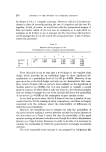
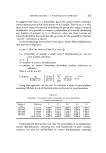
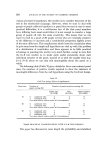
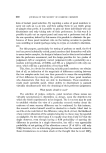
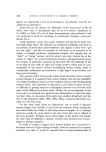
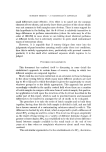
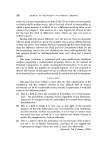
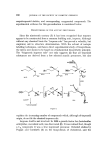
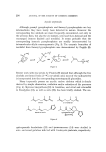
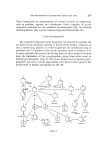
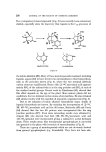
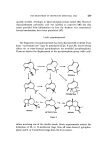
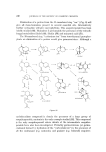
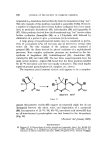
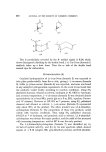
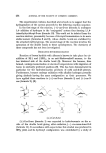
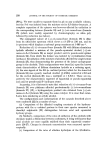
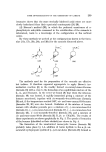
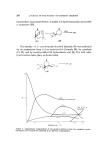
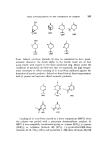
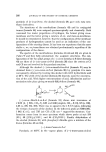
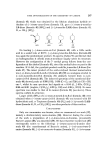
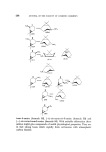
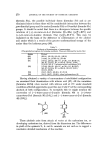
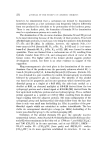
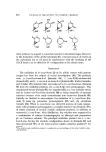
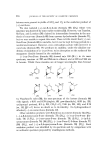
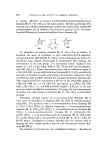
276 JOURNAL OF THE SOCIETY OF COSMETIC CHEMISTS ketones were present in yields of 3.5% and 1% in the oxidation product of (q-)-car-3-ene. We also isolated (+)-car-3-en-2-one (formula 68) (2%) whose very existence was doubted by some earlier workers (52). However, van Tamelen, McNary, and Lornitzo (56) claimed its intermediate formation in the syn- thesis of eucarvone (formula 69) from carvone hydrobromide (formula 71), but •ve were unable to repeat this work. There is little doubt that (+)-car- 3-en-2-one (formula 68) is unstable, but it can be kept for long periods in a neutral environment. However, even cold sodium acetate will convert it to cucarvone (formula 69). We attribute its stability, under the alkaline con- ditions of oxidation of (q-)-car-3-ene, to its absorption on the surface of the manganese dioxide formed in the oxidation. (+)-car-3-en-2-one (formula 68) showed m/e 150 (M+) in its mass spectrum, maxima at 227 and 254 nm in ethanol, and at 221 and 244 nm in hexane. Whilst these maxima are at longer wavelengths than forecast 0 HO 7 o (76) (77) (78) (79) by Woodward's rules (58), the nmr spectrum of the ketone (formula 68) with signals, z 8.91 and 8.78 (singlets, 6H gem-dimethyls), 8.52 (m, 2H, cyclopropyl protons), 8.3 (s, 3H, CH3C=C ), 7.46 (m, 2H, H5), and 3.75 (m, 1H, I-IC=C) leaves no doubt as to its identity. On hydrogenation it afforded (--)-cis-caran-2-one (formula 12). Other oxidation products were 8-hydroxy-m-cymene (formula 72) (3%), (--)-a-3,4-epoxycaran-5-one (formula 73)(2%), (+)-car-2-en-4-one (for- mula 74) (1.5%), (+)-nor-caran-3-one (formula 75)(2.5%), (+)a-3,4,- epoxycarane (formula 76) (18) (2%), (--)-car-3-ene-2, 5-dione (formula 77) (58) (5%), and (+)-a-3,4-epoxycaran-2-one (formula 78) (2%). Each oxidation product was identified by its spectrum and by comparison with an authentic specimen prepared by unambiguous methods.
Purchased for the exclusive use of nofirst nolast (unknown)
From: SCC Media Library & Resource Center (library.scconline.org)