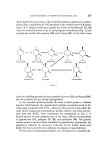
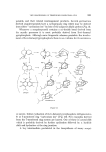
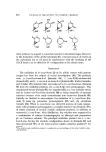
SOME INVESTIGATIONS OF THE CHEMISTRY OF CARENE 277 Whilst the oxidation procedures described gave valuable products, yields were low and separation of the products was tedious. Attempts were therefore made to improve yields by the use of chromium trioxide in acetone, •vith and without base (54). Using chromium trioxide alone, the major oxidation product was 8-hydroxy-m-cymene (formula 72) repre- senting some 45% of the total neutral volatiles. (--)-Car-3-ene-5-one (formula 67) (8.2%) was again found, but (+)-car-3-en-2-one (formula 68) was only present in traces. All the other products formed in the perman- ganate oxidation were found in minor quantities and in addition (+)-3 hydroxy-trans-caran-4-one (formula 79) (10%) was formed. When chromium trioxide in acetone with added sodium acetate, or chromium trioxide in pyridine were used as oxidants no single product was formed in large quantities. With sodium acetate as base, the major product was (+)-a-3,4-epoxycarane (formula 76) (24%) whilst in pyridine two products, namely (--)-car-3-en-5-one(formula 67)(25%)and 1, 1,4-trimethyl cyclohepta-2,4-dien-6-one (formula 70) (28%) stood out in yield. In any case the overall yield of volatile products was never greater than 20% though unoxidised carene was recovered in substantial quantities. Using tertiary butylchromate (59) in benzene as oxidant, (+)-car-3-ene gave a 35% overall yield of volatile neutral oxidation products. We have not yet sought for the optimum oxidation conditions for this reaction, but it has promising possibilities. Thus, four main products were obtained, namely, (--)-car-3-en-2,5-dione (formula 77), (11%), (+)-car-3-en-2-one (formula 68) (11.4%), 8-hydroxy-rn-cymene (formula 72) (27%), and (--)-car-3-en-5-one (formula 67) (4½%). Minor oxygenated products (0.8%) and hydrocarbons (3.8%) completed the mixture of volatile products. The yield of the dione (formula 77) increased with length of the reaction. This method of oxidation made it possible to prepare substantial quantities of (+)-car-3-en-2-one and (--)-car-3-en-5-one required for our photochemical experiments on these compounds. Photolysis (60---62) The caranones seemed to us to be suitable ketones for submission to photochemical reaction, since they contain the cyclopropyl ring, which in the case of the 2- and 5- ones is conjugated with the keto group. We irra- diated an ether solution of (--)-cis-caran-4-one (formula 18) through quartz, with light from a medium pressure mercury lamp (60). A 50% yield of photo-products was obtained, which, after repeated chromat½- graphy on Kieselgel using a mixture of light petroleum (95%)--ether (5%)

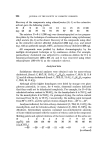
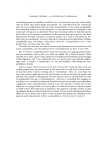
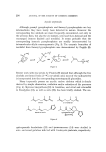
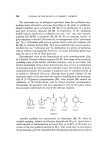
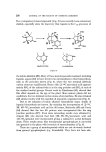
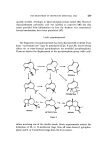
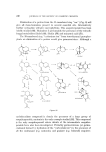
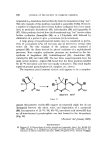
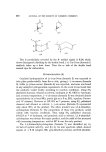
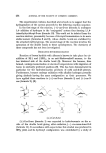
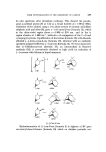
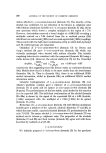
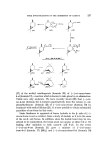
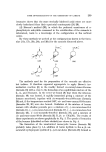
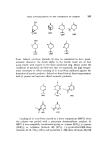
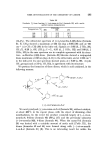
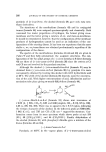
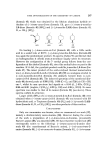
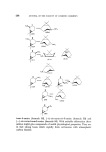
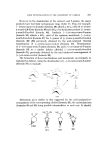
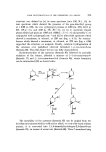
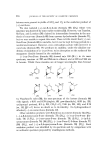
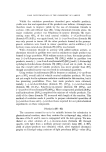
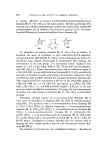
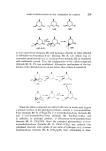
278 JOURNAL OF THE SOCIETY OF COSMETIC CHEMISTS as solvent, afforded (q-)-trans-l,l,3-trimethyl-5-vinylcyclopentan-2-one (formula 80 R, CH=CH2) as the main product. Heckert and Kropp (61), carrying out a similar photochemical reaction also isolated this substituted cyclopentanone, but in addition they isolated a mixture of cis- and trans- 2-methyl-2(3-methyl-2-oxocyclobutyl)but-3-ene (formula 81). 0 4 0 r • z o I (80) We identified our ketone (formula 80 R, CH=CH2) as follows. It absorbed one mole of hydrogen to give trans-5-ethyl-l,l,3-trimethyl- cyclopentan-2-one (formula 80 R, C 2H 5). It also exchanged one proton for deuterium using sodium deuterioxide in deuterioxide thus showing the environment of the keto group. The deuteriated ketone displayed nmr signals at • 4-5.1 (C_H=CH_2), 8.86 (s, 3H, CH33), 8.97 and 9.2 [singlets, each 3H, (CH 3)2C] ß Before deuteriation there was an additional signal at x 7-8.4 (1H, H3). As expected the ketone (formula 80 R, C2H 5) reacted with one mole of bromine in acetic acid giving a monobromo compound, which on refluxing with pyridine afforded the unsaturated ketone (formula 82). This compound showed a maximum at 227 nm in the ultraviolet, peaks at 1 706 and 1 639 cm-1 in the infra-red, and signals at • 2.92 (s, 1H, H4), 8.25 (s, 3H, CH 3C=C), and 8.96 and 9.09 [singlets, (CH 3)2 C] in its nmr spectrum which identified it conclusively. We assign the trans-arrangement of methyl and vinyl groups in (formula 80 R, CH=CH 2) on theoretical grounds. Photolysis, through quartz, of (q-)-cis-caran-5-one (formula 25) in ether gave an abundance of products (62), the yield of volatile products being 65%. The products were (--)-cis-m-menth-8-en-5-one (formula 83 R, CH3C=CH2)(37%), its dihydro compound (--)-cis-m-menthan-5-one Iformula 83 R, (CH3)2CH 1 (12%), (--)-m-menth-3-en-5-one (formula 84) (15%), (--)-cis-m-menthan-cis-5-ol [formula 85 R, (CH3)2CH R1, [t-OHI (15%), (--)-cis-m-menthan-trans-5-ol [formula 85 R, (CH 3) 2CH R1, a-OH• (1-2%) and cis-m-menth-8-en-cis-5-ol (85 R, CH3C=CH2 R1 I•-OH) (trace). Irradiation in hexane afforded only the ketones and in benzene the only volatile product was the a,[t- unsaturated ketone (for- mula 84) (32%). The identities of the ketones were established as follows:• Reaction of
Purchased for the exclusive use of nofirst nolast (unknown)
From: SCC Media Library & Resource Center (library.scconline.org)