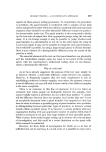
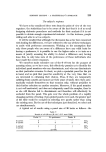
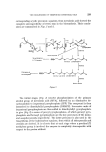
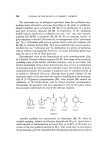
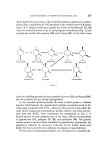
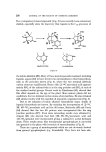
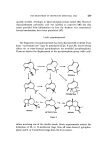
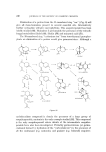
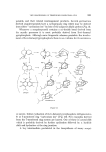
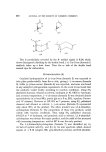
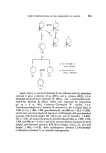
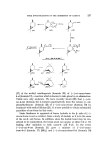
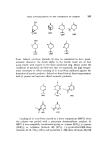
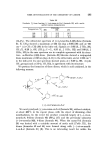
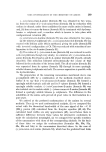
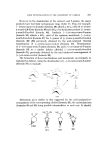
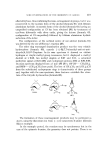
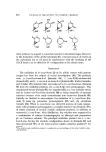
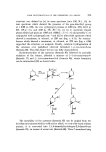
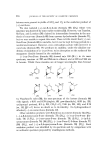
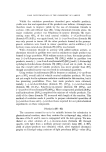
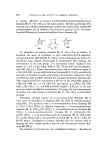
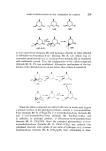
SOME INVESTIGATIONS OF THE CHEMISTRY OF CARENE 279 (SG$ Rl'Cl) • o (+)-cis-caran-5-one (formula 25) with hydrogen chloride in ether afforded (+)-8-chloro-cis-m-menthan-5-one (formula 86 R, C1) which was re- converted quantitatively to (+)-cis-caran-5-one (formula 25) on treatment with methanolic potash. Thus the configuration of the chloro-compound (formula 86 R, C1) was established. Alternative mechanisms of the for- mation of the chloroketone are shown below. One of these is concerted. •(+ "OH 0 C• 0 C C • (25) (SE• R• Ct ) OH • (25) When the chloro-compound was stirred with zinc in acetic acid, it gave a mixture of three of the photolysis products, namely (--)-cis-m-menthan- 5-one (formula 83 R, (CH3)2CH), (--)-m-menth-3-en-5-one (formula 84) and (--)-cis-m-menth-8-en-5-one (formula 83 R,CH3C•- CH2) and in addition, as principal product, (+)-8-acetoxy-cis-m-menthan-5-one (formula 86 R, CH3CO0 ). Since the principal photoproduct (--)-cis- m-menth-8-en-5-one (formula 83 R, CH3C=CH2) was reduced over palladised charcoal, with uptake of one mole of hydrogen, to (--)-cis-m- menthan-5-one [formula 83 R, (CH3)2CH] their relationship is clear.

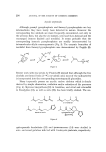
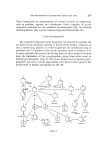
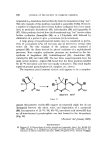
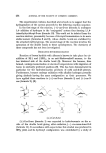
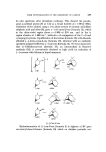
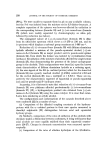
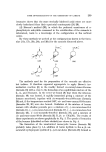
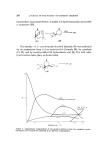
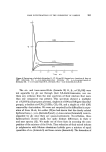
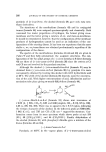
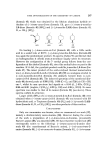
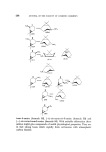
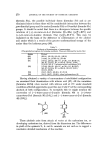
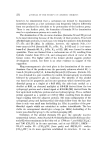
280 JOURNAL OF THE SOCIETY OF COSMETIC CHEMISTS Likewise (--)-m-menth-3-en-5-one (formula 84), the other ketone photo- product was reduced to (--)-cis-m-menthan-5-one. The spectra of these unsaturated ketonic photo-products are in accord with their structures. We give as an example the spectra of the principal photo-product, (--)-cis- m-menth-8-en-5-one (formula 83 R, CH 3C =CH2). In the infra-red region this absorbed at 3 067 (C=CH2), 1 712 (C=O), 1 645 (C=C), and 890 (C=CH2) cm-1, whilst in its nmr spectrum, in carbon tetrachloride, it displayed signals at z 5.2 (s, C--CH2), 7.76 {m, CH2COCH2), 8.25 (s, CH 3C = C), and 8.95 (d, J 6Hz, CH 3C). The formation of the dihydro ketone, (--)-cis-m-menthan-5-one [formula 83 R, (CH 3)2CH• during the photolysis is clearly the result of intervention by the solvent. When either ether or hexane is employed as solvent this saturated ketone is formed, whereas in benzene only the a, [I- unsaturated ketone (formula 84) is produced. There is ample precedent, at any rate in the case of ether (63), for the solvent acting as hydrogen donor. Hexane could also act as hydrogen donor, but benzene is most unlikely to assume this role. It is also significant that alcohols are formed only when ether, the best hydrogen donor of the three solvents, is employed. ACKNOWLEDGMENTS I am very grateful to my collaborators, Drs. P. H. Boyle, M. S. Carson, D. P. Hanna, A. C. Pratt, P. V. R. Shannon and P. A. Staniland and Messrs. W. D. P. Burns, S. M. Evans, D. H. Grayson and P. B. Kulkarni who were largely responsible for the work described. I also wish to thank the Chemical Society for permitting me to use tables and diagrams published in their Journal. (Received: 19th February 1970) REFERENCES (1) Simonsen, J. L. and Owen, L. N., The terpenes, II 65, 73 (1949). (Uniwrsity Press, Cambridge). (2) ibid, 61-99. (3) Acharya, S. P. Conformations of 3-carerie and 2-carerie. Their conformational preference and the reactivity of the double bond. Tetrahedron Letters, 4117 (1966). (4) Cocker, W., Shannon, P. V. R. and Staniland, P. A. The chemistry of terpenes, Part I. Hydrogenation of the pinenes and carenes. J. Chem. Soc. C 41 (1966). (5) Brown, H. C. tIydroboronation 123 (1962) (Benjamin, New York). (6) ,:bi•, 136. (7) Brown, H. C. and Zweifel, G. Hydroboronation of Terpenes, II. The hydroboronation of a- and [t-pinene. The absolute configuration of the dialkylborane from the hydroboro- nation of a- pinene, J. Am. Chem. Soc. 86 393 (1964). (8) Cocker, W., Shannon, P. V. R. and Staniland, P. A. The chemistry of terpenes, Part III. Oxidafire hydroboronation of Car-2-,-3-, and-4-enes. J. Chem. Soc [C] 485 (1967). The chemistry of terpenes. Part IV. The hydroboronation of (+)-Car-3-ene at elevated temperatures. J. Chem. Soc [C] 915 (1967).
Purchased for the exclusive use of nofirst nolast (unknown)
From: SCC Media Library & Resource Center (library.scconline.org)