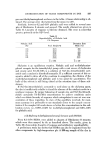
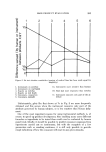
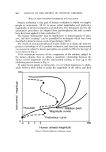
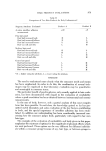
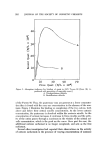
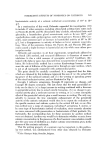
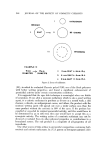
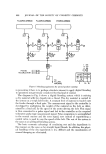
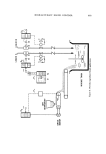
HAIR PRODUCT EVALUATION 565 •X 1 2 Yb Yc 3 4 5 6 Figure 2. Six test situation sensitivities (spacing of vertical lines has been made equal for simplicity) 1. Instruments on switches 2. Instruments on real heads 3. Experts on switches 4. Experts on real heads 5. Consumers, comparison 6. Consumers, monadie Ya. Instruments more sensitive than humans Yb. Real hair more responsive than switches Yc. Instrument measures only part of the at- tribute Unfortunately, plots like that sho•vn at Yc in Fig. 2 are more t•requently obtained and this occurs •vhen the instrument measures only part of the attribute perceived by human subjects, or is less sensitive than human judg- ment. One ot• the most important reasons t•or using instrumental methods is, of course, to speed up product development, thus enabling many more different formulas or ingredients to be tested than could ever be evaluated by human panel trials. Ideally, it should be possible to predict consumer responses t•rom experiments carried out on instruments, but with the exception ot• a t•ew parameters such as combing resistance, it is still only possible to provide rough indications of how the consumer will react to any given stimulus.

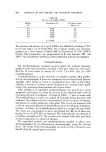
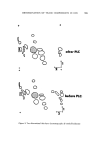
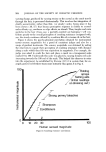
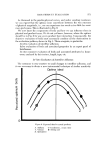
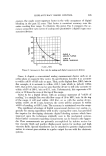
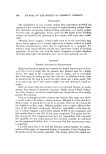
566 JOURNAL OF THE SOCIETY OF COSMETIC CHEMISTS ROLE OF QUANTITATIVE PSYCHOLOGY IN EVALUATION Sensory evaluation is that part of human evaluation in which we employ people as instruments (10,11) to assess actual magnitudes and preference magnitudes of product properties and attributes. The techniques used in the quantitative procedures are adapted from psycho-physics but only recently have they been applied to hair evaluation (5). The human "instruments" may be hairdressers or trained panels of asses- sors, and their "readings" can be quantified by techniques which have been described in detail in classic works of psychology (12,13). The results of such psycho-physical studies enable us to obtain the most im- portant relationships of all in product evaluation, and data from instrumental measurements related to human perception can usually be fitted to the type of curve shown in Fig. 3. If the instrument measures all the components of the attribute judged by the human subjects, then we obtain a monotonic relationship between the human sensed magnitude and the instrumental reading, at least up to the inhibition point as shown in Fig. 3. In using human panels as instruments, it is of critical importance to distin- guish between their ability to judge the magnitude of the effect, and their lOO o o Threshold Inhibition point • •'Magnitude curves \Preference curve , , k Human sensed magnitude Figure 3. Psyeho-physioa] evaluation curves lOO
Purchased for the exclusive use of nofirst nolast (unknown)
From: SCC Media Library & Resource Center (library.scconline.org)