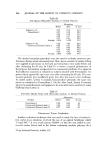
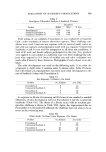
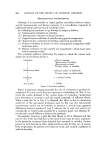
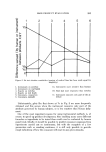
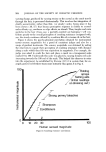
HAIR PRODUCT EVALUATION 569 This work was then extended to determine if and where group maxima of preferred combing resistance existed, as suggested by the general psycho- physical curves in Fig. 3. In genera], it was found that zero combing resistance was not preferred by any observer and some individuals preferred low comb- ing resistance and others high values, if the hair was to be judged to have any degree of body. Further work will be aimed at determining where the maximum preference magnitudes are when the resistance is chiefly second-order. This work confirms part of the general shape of the psycho-physical curves of Fig. 3. It also shows clearly the need to distinguish simple perception mag- nitude from preference magnitude. EVALUATION OF "BODY" Unlike combing resistance, which is relatively uncomplicated and easily as- sessed objectively, body presents a most complex challenge not only to our understanding of it in physical terms but in how to measure it objectively. Body is typical of many complex consumer terms like "manageability", "condition", and "smoothness" which have so far defied complete understand- ing (18). It is possible that this lack of understanding has delayed the devel- opment of products that impart the right physical effects to hair which can be construed as giving body. (The special dissatisfaction with bodying products was highlighted earlier). Research in both the USA and UK has shown that no single word uniquely defines body in physical terms. However, using advanced statistical tech- niques applied to word association, we have established that three major words together can describe body. These are: springiness (bounciness), vol- ume (bulk, thickness ), and stiffness (set, not soft). Principal Components Analysis (PCA) may be used to derive these associa- tions quantitatively. In this approach, a battery of hair descriptors is obtained by group discussion. Words such as curliness, set, bounce, springiness, tight- ness of curl, texture, cleanness, softness, stiffness, compactness, body, bulk, and so forth are those most frequently used. A correlation matrix is then obtaified for the relationship between any pair of these deschptors (including body) using covariation of frequency of word usage, or variation of judgment magni- tudes. Then using PCA on this matrix, we can obtain as few independent attributes (components) as possible that account for as much of the variation as possible, by calculating the accumulated variance. These independent com- ponents are called principal components. The three words associated with body mentioned above are structural me- chanical factors and are affected by length of hair, thickness and stiffness of individual hairs, sparseness of hair, curliness of hair, and so forth. Thus, peo- ple with a small number of thin straight hairs have the greatest need for in- creasing body. Conversely, people with densely packed curly hair may feel less body is needed.

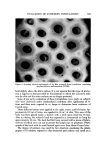
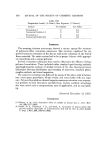
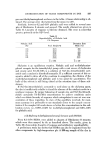
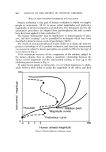
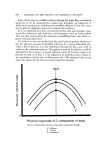
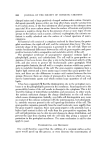
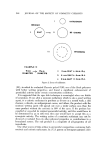
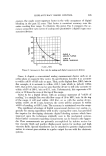
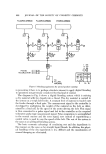
570 JOURNAL OF THE SOCIETY OF COSMETIC CItEMISTS Body of hair may be modified without altering the single-fiber mechanical properties at all. By using geodetic engineering principles, an impression of body can be produced by modifying the interfiber adhesion of hair (for exam- ple, by polymer deposition between contiguous hair surfaces ). It is not surprising then that conventional setting aids, post-shampoo treat- ments like thickeners and texturizers, and hairsprays used on back-combed hair, are often perceived by the consumer as modifying body-but at the ex- pense of losing natural feel. We believe we can now predict that the ideal bodying product should give just the optimum amount of interfiber adhesion, for a given individual, pro- vided a film of polymer is evenly distributed through the hair mass, with no surfeit on the outermost surfaces. This optimum amount of adhesion could be identified by the consumer as giving optimum values of the three major com- ponents of body as in Fig. 5. (The separation of individual curves shown is not quantitative, but for ease of illustration only. ) The optimum body occurs where the optima for the three perceived properties coincide. Ideal X Y Z Physical magnitude of 3 components of body Figure 5. Ideal optima of three measurable components of bocly X. Stiffness Y. Volume Z. Springiness
Purchased for the exclusive use of nofirst nolast (unknown)
From: SCC Media Library & Resource Center (library.scconline.org)